Microgreen Seed Prices India 2026: ₹50 to ₹360 per 100g
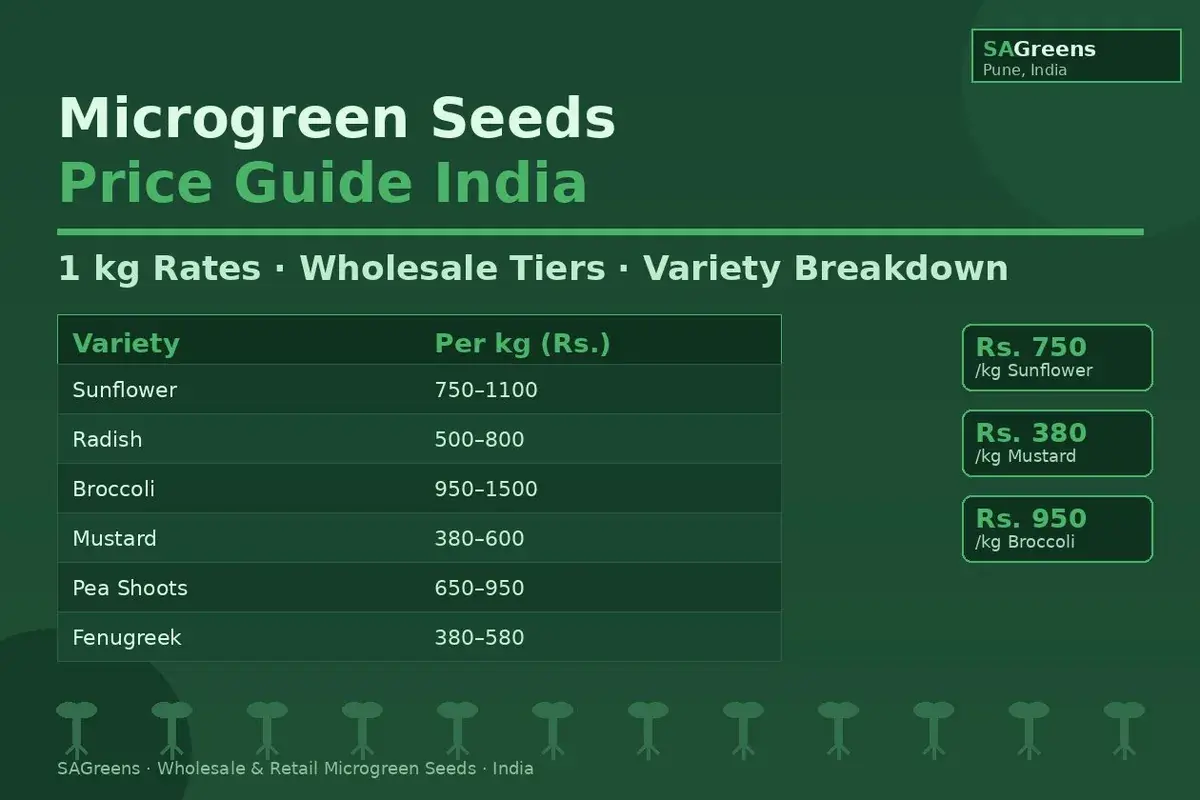
Microgreen Seeds Price India: 1 kg & Wholesale Rates 2026
Key Takeaways: Microgreen seed prices in India in 2026 range from ₹60 per 100g for common varieties like mustard and fenugreek to ₹250 per 100g for premium varieties like broccoli. Wholesale 1 kg prices range from ₹380 for mustard to ₹1500 for broccoli. The cheapest seeds are rarely the most cost-efficient — germination rate determines your real cost per productive harvest. SAGreens supplies food-grade microgreen seeds across India with transparent pricing and documented germination rates. Contact us for bulk and wholesale quotes.
Microgreen seed prices in India vary enormously — and for first-time buyers, navigating this price variation without clear guidance often leads to expensive mistakes. You might buy a 500g bag of sunflower seeds at a seemingly great price, then discover that only 55% germinate, meaning you effectively paid premium prices for half the seeds you needed. Or you might overspend on premium retail packets when your growing volume clearly warrants wholesale pricing.
This guide cuts through the confusion. We cover what determines microgreen seed prices in India, the current 2026 price range for every major variety at retail and wholesale quantities, how to calculate your true cost per harvest rather than just cost per gram, where the real price differences between suppliers come from, and how to buy the best microgreen seeds online at the right price for your volume.
The price data in this guide reflects SAGreens' 2026 pricing alongside market research on other Indian suppliers. Prices are quoted in Indian Rupees and represent quality food-grade seeds — not treated field agriculture seeds, not uncertified "organic" claims, but genuinely sourced and tested microgreen seeds.
What Determines Microgreen Seed Prices in India
Seed prices in the Indian market reflect several intersecting factors. Understanding these factors is essential to evaluating whether you are getting value from a supplier, or simply being charged a premium for a brand name, or worse — paying low prices for quality you cannot rely on.
Seed variety and physical size: Sunflower seeds are larger than mustard seeds, requiring more raw material per 100g of finished product. This is reflected in pricing. Large seeds like sunflower, pea shoots, and wheatgrass cost more per gram than small seeds like mustard, radish, or fenugreek. This is not a quality differential — it is simply a physical reality of what you are buying.
Organic certification status: NPOP-certified organic seeds cost more to produce than conventionally grown seeds. The certification process, the farm practices required, and the testing involved add real cost that legitimate certified suppliers pass on to buyers. If a supplier is offering "organic" seeds at conventional prices, that is worth scrutinising. Either their certification is not genuine, or their quality in other dimensions is being compromised to hit that price point.
Germination rate and testing: Seeds that have been tested for germination and come with documented germination percentages cost more than untested seeds. This testing adds cost. But it also dramatically reduces your risk as a grower — you know what to expect from each batch before you commit it to your production schedule.
Packaging quality: Proper moisture-barrier packaging appropriate for India's humidity conditions adds cost but dramatically extends shelf life and maintains germination rates over time. Seeds in poor quality packaging that have been exposed to humidity will underperform regardless of how good their original germination rate was.
Sourcing chain length: Seeds sourced directly from NPOP-certified farms and sold to you with minimal intermediary handling are priced differently from seeds that pass through multiple wholesale distributors. SAGreens sources directly, which reduces chain length and allows us to offer competitive pricing while maintaining certification standards.
Delivery included vs excluded: Some Indian online seed sellers list low base prices but add significant courier charges. For small orders, courier costs can add ₹60–120 to your total. Always calculate total delivered cost rather than seed price alone when comparing suppliers.
Microgreen Seeds Price List India 2026: All Major Varieties
Here is a comprehensive price reference for microgreen seeds in India as of August 2026. Prices shown are ranges reflecting quality variation across suppliers — the lower end typically represents uncertified or untested seeds, the upper end reflects NPOP-certified, germination-tested food-grade seeds.
| Variety | Retail 50g | Retail 100g | Wholesale 500g | Bulk 1 kg |
|---|---|---|---|---|
| Sunflower | ₹75–110 | ₹120–180 | ₹450–650 | ₹750–1100 |
| Radish | ₹50–80 | ₹80–130 | ₹300–480 | ₹500–800 |
| Mustard | ₹40–60 | ₹60–100 | ₹220–380 | ₹380–600 |
| Broccoli | ₹90–140 | ₹150–250 | ₹550–850 | ₹950–1500 |
| Fenugreek (Methi) | ₹40–60 | ₹60–100 | ₹220–360 | ₹380–580 |
| Pea Shoots | ₹65–100 | ₹100–160 | ₹380–580 | ₹650–950 |
| Amaranth (Lal Saag) | ₹50–80 | ₹80–130 | ₹300–480 | ₹520–800 |
| Wheatgrass | ₹45–70 | ₹70–110 | ₹260–420 | ₹440–700 |
| Coriander (Dhania) | ₹55–85 | ₹90–140 | ₹340–520 | ₹580–900 |
| Kale | ₹80–120 | ₹130–200 | ₹490–720 | ₹850–1300 |
| Beetroot | ₹70–110 | ₹110–180 | ₹420–620 | ₹720–1100 |
| Kohlrabi | ₹80–120 | ₹130–200 | ₹490–720 | ₹850–1300 |
Kohlrabi is the clearest example of why pack price misleads: it carries the highest pack price we sell and costs roughly a third of what broccoli does per tray, because broccoli's 20g pack works out at ₹10 a gram. Our kohlrabi microgreen seed guide sets out the per-tray figures across the range.
| Spinach | ₹60–90 | ₹100–160 | ₹380–560 | ₹650–950 |
|---|
These prices apply to food-grade seeds appropriate for microgreen growing. Browse SAGreens' seeds page for current exact pricing on varieties we stock. Spinach is the one line where the price per 100g understates the real cost, because a tray takes 15-20g rather than the 8-12g a brassica needs — our spinach microgreen seed guide works the per-tray figure through.
Wholesale Pricing: What You Pay at Different Quantity Tiers
The price-per-gram drops meaningfully as quantity increases. Here is how the economics work out for sunflower seeds as a representative example:
| Quantity | Typical Price | Price Per 10g |
|---|---|---|
| 50g (retail pack) | ₹75–110 | ₹15–22 |
| 100g (retail pack) | ₹120–180 | ₹12–18 |
| 250g | ₹240–360 | ₹9.6–14.4 |
| 500g (wholesale) | ₹450–650 | ₹9–13 |
| 1 kg (bulk) | ₹750–1100 | ₹7.5–11 |
| 5 kg (commercial) | ₹3000–4500 | ₹6–9 |
The per-gram reduction from 100g to 1 kg is approximately 35–40% for most varieties. The reduction from 1 kg to 5 kg is a further 15–20% for commercial buyers.
However, quantity discounts only make financial sense if you can use the seed before it degrades. For home growers using 50–100g of sunflower seeds per month, buying 1 kg may save money per gram but risks seed degradation after 6–8 months if storage is not optimal. The right quantity to buy is the quantity you can use within 6–12 months, stored in an airtight container in a cool, dry environment.
Commercial growers with consistent weekly production cycles should absolutely buy at bulk quantities — the savings compound significantly over a full year of production.
The Real Cost of Cheap Microgreen Seeds
If you are buying seed to grow for sale rather than for your own table, our guide to where to sell microgreens covers what each channel pays. The most important concept in microgreen seed pricing is the difference between purchase price per gram and real cost per productive harvest. Many buyers make expensive purchasing mistakes by optimising for purchase price without accounting for germination performance.
Real cost calculation: If you pay ₹500 for 1 kg of radish seeds with 60% germination, your effective productive seed is 600g. If you pay ₹700 for 1 kg of radish seeds with 92% germination, your effective productive seed is 920g. The second purchase costs you ₹200 more but gives you 320g more productive seed — a real cost of ₹0.54 per productive gram vs ₹0.83 per productive gram. The premium seeds are actually cheaper per productive gram despite being more expensive per gram at purchase.
This calculation matters even more for large seeds like sunflower, where seeding density is around 150–200g per standard 30x60cm tray. The difference between 60% and 92% germination on a 200g seeding is 64g of ungerminated seed per tray — effectively wasted material that you paid for, plus the growing medium that was prepared for seeds that never germinated.
Always ask your supplier for their germination rate per variety before placing a bulk order. A supplier who cannot provide this information does not have tested seed stock. A supplier who provides fabricated numbers will quickly be identifiable when your actual germination falls short.
Best Microgreen Seeds Online India: How to Compare Suppliers Fairly
When evaluating where to buy microgreen seeds online in India — whether you are in Pune, Mumbai, Delhi, Bangalore, Hyderabad, or Chennai — use these comparison criteria:
1. Germination documentation: Does the supplier provide germination rate data? What is the basis — tested in their own facility or certification from the originating farm?
2. Certification: NPOP (organic), FSSAI compliance, or other relevant certification that establishes the seed as food-grade?
3. Total delivered cost: Base price plus courier charges to your city. Compare total cost, not base price.
4. Minimum order: Does the minimum order make sense for your current production volume? Buying 5 kg when you need 500g per month creates storage challenges and ties up working capital.
5. Delivery timeline to your city: India's courier network delivers in different timeframes to different cities. From Pune-based suppliers like SAGreens, Mumbai gets next-day or 2-day delivery; Delhi, Bangalore, Hyderabad, and Chennai get 3–5 days; most tier-2 cities receive orders within 5–7 days.
6. Return and quality policy: If a batch has significantly lower germination than documented, what is the supplier's resolution process? Reputable suppliers stand behind their germination rates.
For a comprehensive guide to evaluating and choosing a supplier, see our complete microgreen seeds buying guide.
City-by-City Price Comparison: Does Location Affect What You Pay?
Microgreen seed prices for online purchases across India do not vary significantly by city for the seed itself — the price is set by the supplier. What varies is the total delivered cost due to courier charges.
For buyers in Pune and Maharashtra, purchasing from a local supplier like SAGreens offers both lower delivery costs and faster delivery timelines compared to suppliers based in other states. For buyers in Delhi, Bangalore, Mumbai, Hyderabad, or Chennai, the courier cost for an order from Pune is similar to courier from any other major city in India — typically ₹60–100 for small retail orders, often free or reduced for orders above ₹500 from most quality suppliers.
Buying from specialised microgreen seed suppliers — whether they are based in Pune, Delhi, or Bangalore — will generally get you better food-grade seed quality than buying from general agricultural suppliers in your local area, even accounting for courier costs.
Calculating Your Seed Budget: A Framework for Commercial Growers
If you are growing microgreens commercially in India — for restaurant supply, household subscriptions, or a dedicated farm operation — here is a simple framework for calculating your monthly seed budget:
Step 1: Count your weekly tray production. For example: 30 trays per week.
Step 2: Break down trays by variety. For example: 12 sunflower, 8 radish, 6 mustard, 4 pea shots.
Step 3: Calculate seed per tray by variety. Typical seedings: sunflower 150–200g, radish 20–30g, mustard 15–20g, pea shots 80–120g.
Step 4: Calculate weekly seed consumption. For example: 12 x 175g sunflower = 2100g; 8 x 25g radish = 200g; 6 x 18g mustard = 108g; 4 x 100g pea = 400g.
Step 5: Multiply weekly consumption by 4.3 to get monthly consumption. Then add 20% buffer for test trays, new variety trials, and reorder timing gaps.
Step 6: Apply bulk pricing at your calculated monthly volume. At 2100g sunflower per week (9 kg per month), you would be buying at 5 kg+ pricing — approximately ₹6–9 per 10g rather than ₹15–22 per 10g at retail.
For commercial growers with this kind of volume, seed cost at bulk pricing is typically 25–40% of what it would be at retail — a meaningful operational cost reduction. Contact SAGreens for commercial pricing discussions.
Seasonal Price Variation: Do Microgreen Seed Prices Change Through the Year?
Microgreen seed prices in India show mild seasonal variation in some varieties:
Pea shoot seeds, which are in high demand globally for culinary use, can see price increases in the October–March window when global demand peaks. Wheatgrass seeds used in health and wellness contexts sometimes reflect seasonal demand patterns during festival and New Year health-reset periods (October–January).
Most common varieties — mustard, radish, fenugreek, sunflower — show relatively stable pricing throughout the year, with only minor variation (5–10%) related to harvest cycles and supply chain factors.
Buying a 2–3 month supply of high-demand varieties before the October peak can help commercial growers lock in stable pricing for their busy season. The bulk microgreen seeds guide covers seasonal procurement strategy in detail.
Frequently Asked Questions: Microgreen Seed Prices in India
What is the price of 1 kg microgreen seeds in India?
1 kg microgreen seed prices in India vary by variety: mustard and fenugreek ₹380–600, radish ₹500–800, sunflower ₹750–1100, pea shoots ₹650–950, broccoli ₹950–1500, wheatgrass ₹440–700. Prices at the higher end reflect NPOP-certified organic sourcing and documented germination rates. Visit SAGreens' seeds page for current pricing.
What is the wholesale price of microgreen seeds in India?
Wholesale microgreen seed prices in India (500g quantities) typically range from ₹220–380 for common small-seed varieties like mustard and fenugreek to ₹550–850 for premium varieties like broccoli. At 1 kg quantities, wholesale pricing is approximately 20–30% lower than retail 100g pricing per gram. Contact SAGreens for wholesale quotes for your specific variety and volume requirements.
Which are the cheapest microgreen seeds to buy in India?
The cheapest microgreen seeds per gram in India are mustard (sarson) and fenugreek (methi) — both available for ₹60–100 per 100g retail. These are also among the fastest-growing varieties (7–10 days to harvest) and among the most versatile in Indian cooking, making them excellent value for home growers.
Are expensive microgreen seeds better quality?
Not necessarily. Price reflects variety, certification, and testing — not automatically quality. The most important quality indicator is documented germination rate. A well-priced seed with 90% germination is better value than an expensive seed with no germination documentation. Always ask for germination data before placing a bulk order.
Is buying 1 kg of microgreen seeds worth it for a home grower?
For a home grower using one or two trays per week, 1 kg of a single variety may be more than you can use within 12 months. A 250g or 500g purchase of each variety you want to grow is typically more appropriate for home-scale growing. Buying at 1 kg+ makes financial sense when your growing volume means you will use the seed within 6–9 months.
What is the best microgreen seed to buy online in India?
For beginners: radish, mustard, or fenugreek — all germinate in 1–2 days, grow in 7–10 days, and are priced accessibly at ₹60–130 per 100g. For nutritional density: broccoli (sulforaphane content), sunflower (healthy fats and amino acids), or pea shoots (complete protein profile). For Indian cuisine integration: fenugreek (methi), mustard (sarson), and coriander (dhania) work naturally in dal, roti, and rice-based dishes. Browse SAGreens' complete range to find the right varieties for your needs.
Where can I buy microgreen seeds online in India with guaranteed germination?
SAGreens supplies microgreen seeds across India — to buyers in Pune, Mumbai, Bangalore, Delhi, Hyderabad, Chennai, and all other major cities — with documented germination rates for every variety. Visit our seeds page or contact us for wholesale enquiries.
Do different cities in India pay different prices for microgreen seeds?
The seed price itself is the same across India from a given online supplier. What varies is delivery cost: buyers closer to the supplier's dispatch location pay lower courier charges. From SAGreens in Pune, Maharashtra buyers typically pay the lowest delivery costs. Pan-India buyers pay standard courier rates, which are typically ₹60–100 for small orders and often free or subsidised above a minimum order value.
Price summary for 2026: Expect ₹80–180 per 100g for common varieties (radish, mustard, fenugreek, sunflower) and ₹150–250 per 100g for specialty varieties (broccoli, pea shoot, purple sango, Swiss chard, Chinese pink radish, basil). Bulk pricing from 500g reduces per-gram cost by 20–35%. NPOP-certified seeds cost more than uncertified agricultural seeds but deliver better effective tray cost when 85%+ germination is accounted for.
When comparing prices across Indian suppliers, always verify: NPOP certification status (certificate number, not just a label claim), germination rate guarantee (and what happens if the batch fails it), whether the quoted price includes delivery, and what documentation is included with commercial orders.
Pricing: SAGreens microgreen seeds start at ₹50 per 100g with pan-India delivery. Bulk orders of 500g+ get 10–15% discount. All seeds NPOP-certified organic with 90-95% germination guarantee. Order online or WhatsApp us for bulk pricing.
Do microgreen seed prices vary between cities in India?
The seed price itself is the same across India from a given online supplier. What varies is delivery cost: buyers closer to the supplier's location pay lower courier charges. From SAGreens in Pune, Maharashtra buyers pay the lowest delivery costs. Pan-India buyers pay standard courier rates, typically ₹60-100 for small orders, varying by city and weight.
How do I calculate real cost per harvest, not just price per gram?
Divide the seed cost by the germination rate to get effective cost per productive gram. A ₹500 bag of seeds with 60% germination costs ₹0.83 per productive gram. A ₹700 bag with 92% germination costs ₹0.76 per productive gram. The premium seeds are actually cheaper per usable harvest. Always factor germination rate into your price comparison.
About SAGreens: Transparent Pricing, Tested Seeds
SAGreens is a Pune-based microgreens farm and seed supplier run by Ajay Toradmal of the three-generation farming family, a third-generation farming family in Maharashtra. We price our seeds transparently — what you see on our seeds page is what you pay, with no hidden charges for certification that should be a baseline requirement.
Every seed variety we sell has been tested in our own Pune growing facility under real Indian conditions — Pune's heat in April, the humidity of June monsoon, the cooler months of November to February. Our germination data reflects actual Indian growing conditions, not lab conditions in a controlled environment elsewhere.
For home growers starting out, our beginner seed guide is the right starting point. For commercial growers ready to discuss bulk and wholesale requirements, contact SAGreens directly.
Price summary: SAGreens microgreen seed runs from ₹50 per 100g for wheatgrass and ₹69 for fenugreek, through ₹88 to ₹124 for pea shoot, white radish, red radish, sunflower, mustard and coriander, up to ₹360 for kohlrabi. Taramira seed, the rocket of north India, is ₹99 and the cheapest brassica on the list, which the taramira seed guide works out per tray. Broccoli is ₹200 for a 20g pack. Every batch is germination tested before packing. Volume discounts start at 500g per variety, and delivery is charged separately by weight and destination. See our seed catalogue for current pricing.
Pricing Note: SAGreens organic seeds from ₹50/100g (wheatgrass) to ₹200/20g (broccoli). Delivery charged at checkout. See the seed catalogue for current prices.
Is it cheaper to grow your own microgreens?
Yes, substantially, once you are past the first order. A 100g pack of radish seed at ₹120 fills about ten trays, and each tray yields 200 to 300g of greens. That works out near ₹12 of seed per tray, plus a few rupees of cocopeat, against ₹120 to ₹180 for 100g of cut microgreens bought fresh. Even counting trays and a rack, most households are ahead within the first month or two. The honest caveat is that you are paying with time rather than money: sowing, watering and harvesting every week is roughly ten minutes a day, and if that lapses the saving disappears with the tray.
More Microgreens Tips & Recipes
Buying Microgreen Seeds Online: Safety & Quality Checks
Learn what to check before buying microgreen seeds online in India — untreated seed, germination testing, NPOP certification and pricing.
What Untreated Seed Means, and How to Spot Treated Seed
Untreated means no fungicide coating. Non-GMO is a separate claim. How to tell them apart on a label, and why dyed seed must never reach an edible tray.
Microgreen Seeds Bangalore: Buy for Home & Commercial Use
Where to buy microgreen seeds in Bangalore. SAGreens supplies Non-GMO, food-grade seeds for home growers and commercial farmers with pan-India delivery.
Fresh Tips & Exclusive Offers
Subscribe for growing tips, seasonal updates, and exclusive offers on fresh organic microgreens in Pune.