Microgreens in Mumbai: Grow Fresh Microgreens at Home
Grow fresh microgreens at home in Mumbai with SAGreens seeds. We ship untreated, germination-tested seed from our Pune farm — usually 1 to 2 days — with growing guidance written for Mumbai humidity. Cut microgreens are delivered in Pune only.
Key Takeaways
- SAGreens ships microgreen seeds to Mumbai. Cut microgreens are delivered within Pune only, so Mumbai customers grow their own.
- Seed reaches most Mumbai postcodes in one to two days by express courier from our Pune farm.
- Radish and mustard are the varieties to start with in Mumbai — both are fast and both hold up in humidity.
- Mumbai humidity is managed with three habits: bottom watering, a small fan, and short-cycle varieties.
- One 25cm × 25cm tray fits any windowsill and gives a cut of greens 7 to 14 days after sowing.
SAGreens sells microgreen seeds to Mumbai. We do not deliver cut microgreens here — our farm is in Keshav Nagar, Pune, and greens harvested at dawn cannot reach a Mumbai kitchen in the state they leave in. What we do ship is untreated, germination-tested seed, which travels by express courier from our farm to yours. From there a windowsill in Andheri, a balcony shelf in Thane or a kitchen counter in Worli produces a cut of fresh greens every week or two, with no garden and no soil. This page covers what to buy, what grows well in Mumbai's climate, and how to work around the humidity that catches most new growers out. For a street-level view of the city, read our complete Mumbai microgreens guide.
Growing support comes from Ajay Toradmal's three-generation farming family in Pune — the same expert guidance we give our own family members starting their first tray.
- 1–2 days
- Typical seed delivery
- 7–14 days
- Seed to first harvest
- 15+
- Seed varieties
- 85–95%
- Germination, tested before packing
Why Mumbaikars Are Growing Microgreens at Home
No Garden Space Required
A 25cm × 25cm tray is smaller than a laptop and gives roughly 80 to 120g of cut greens. A kitchen counter, a windowsill or a balcony shelf is enough.
Fresh in Mumbai's Climate
Mumbai's year-round warm temperatures suit most microgreen varieties. The humidity requires fan ventilation and choosing fast-growing varieties — covered in our Mumbai growing guide.
Skip the Cold Chain
Mumbai's fresh produce travels long distances and sits in transit. Growing microgreens at home means zero supply chain — harvest what you need, when you need it.
Seed Ships From Pune
Express courier reaches most Mumbai postcodes in one to two working days. Seed is packed in moisture-proof bags, which matters more here than in most Indian cities.
Harvest Every Week
Three trays sown a few days apart keep one always ready to cut, which is less work than it sounds and turns growing into a routine rather than a project.
Mumbai Growing Community
A growing community of Mumbai residents is discovering microgreens. WhatsApp us to connect with tips specific to your Mumbai area and apartment setup.
Where to Start: Seeds That Suit Mumbai
Radish Microgreen Seeds
The variety to start with in Mumbai. Six to eight days from sowing to cut, and short cycles are the simplest defence against humidity.
View productMustard Microgreen Seeds
Nearly as fast as radish at seven to nine days, with a warm pungency that suits Indian cooking. Handles damp air well.
View productSunflower Microgreen Seeds
Thick stems and a nutty flavour, substantial enough to be the base of a salad. Needs soaking and a weighted blackout; best from October to March.
View productBroccoli Microgreen Seeds
Mild and fresh, eight to ten days. Prefers Mumbai's drier months and rewards disciplined bottom watering.
View productGetting Started in Mumbai
- 01
Order seed
Pick your varieties and order online or on WhatsApp. Seed leaves our Pune farm the same working day and usually reaches Mumbai in one to two days.
- 02
Sow and cover
Fill a 25cm × 25cm tray with damp cocopeat, sow evenly, and cover for the blackout phase. Cocopeat is sold at nurseries in Dadar, Mulund, Thane and Bandra.
- 03
Light, air, harvest
Uncover into bright indirect light, water from below only, and keep a small fan moving air across the tray. Cut 7 to 14 days after sowing, depending on the variety.
Growing Microgreens in Mumbai: What You Actually Need

Growing microgreens in Mumbai is one of the most rewarding things you can do with a spare windowsill, and it asks for remarkably little in return. Whether you live in a compact 1BHK in Andheri, a sea-facing flat in Worli or a high-rise in Thane, microgreens fit into the smallest corner of city life. These are young seedlings of vegetables and herbs, cut seven to fourteen days after sowing. Microgreens can carry higher concentrations of certain vitamins and phytochemicals than the mature plant, though how much higher varies a great deal by variety and growing conditions — a 2012 study of 25 varieties in the Journal of Agricultural and Food Chemistry (Xiao et al.) found differences ranging from modest to several-fold. They grow indoors without a garden, a terrace or any prior experience. If you have ever wanted to grow something edible in a Mumbai apartment, this is the place to start.
At SAGreens, we are a three-generation farming family based in Pune, and founder Ajay Toradmal has spent years refining seed varieties that perform brilliantly in western Maharashtra's climate. This guide covers what to buy, what suits the city's climate, and the habits that keep a tray clean through a Mumbai monsoon.
What Exactly Are Microgreens?
Microgreens sit between sprouts and baby greens. Unlike sprouts, which are eaten whole (roots and all) after germinating in water, microgreens are grown in a shallow layer of growing medium, given light so they develop true green leaves, and then snipped above the soil line. Because they are cut above the medium rather than eaten root and all, and because they are grown in light rather than in a warm wet jar, they avoid the food-safety problems sprouts are prone to. A tray of radish microgreens delivers a peppery crunch; sunflower microgreens are nutty and substantial; broccoli microgreens are mild and fresh, and are the variety most often studied for glucoraphanin, the precursor to sulforaphane. You can read more about the full category on our microgreens overview page.
Why Mumbai Apartments Are Actually Ideal
Many Mumbaikars assume they cannot grow anything because they lack outdoor space. Microgreens turn that assumption on its head. A standard growing tray measures 25 by 25 centimetres — smaller than a laptop — and most varieties need only four to six hours of bright, indirect light. A window ledge in Dadar, a kitchen counter in Powai under a simple LED light, or a shaded balcony in Juhu all work perfectly. Because microgreens are harvested so young, they never outgrow their tray, never need repotting and never demand fertiliser. Mumbai's warm temperatures actually speed up germination compared with cooler cities, so your seeds sprout in twenty-four to forty-eight hours for most fast varieties.
The one genuine challenge Mumbai throws at growers is humidity, particularly from June to September. The good news is that humidity is entirely manageable with three simple habits: choosing fast-growing varieties, watering from below rather than misting from above, and keeping gentle air movement across your trays with a small fan. We cover these in depth later in this guide, and our detailed monsoon growing guide goes even further.
What to Grow First
For absolute beginners in Mumbai, we recommend starting with radish. It is the fastest and most forgiving variety we sell — ready in six to eight days, vigorous even in humid weather, and delicious on everything from poha to sandwiches. Sunflower microgreen seeds make a brilliant second crop: slightly slower at ten to twelve days, but so satisfying to grow and substantial enough to use as a salad base. Once you have two successful trays behind you, branch out into broccoli, mustard and pea shoots. Our complete how to grow microgreens guide covers every variety in detail.
Common First-Week Questions
New growers in Mumbai tend to ask the same handful of questions, so let us answer them upfront. Fuzzy white growth on the roots in the first few days is almost always root hairs, not mould — root hairs are fine, uniform and cling to the root, while mould is patchy, web-like and sits on the medium. Leggy, floppy seedlings mean the tray needs more light after uncovering, not more water. And if germination seems slow during a cool December week in Mulund or Malad, be patient: a day or two of delay is normal and the tray will catch up.
You do not need to get everything perfect on your first attempt. Microgreens are cheap to grow, quick to retry and genuinely difficult to fail at once you understand the rhythm. Order a starter pack of SAGreens seeds, and if a tray does something you cannot read, send us a photo through our contact page.
Where to Buy Microgreen Seeds in Mumbai
SAGreens is a Pune farm, not a Mumbai one. Our relationship with Mumbai is seed: we pack it at Keshav Nagar in Mundhwa and send it by express courier, which reaches most Mumbai postcodes in one to two working days. Cut microgreens we deliver within Pune only, because greens harvested at dawn do not survive the journey in the state they left in.

What we ship
Around fifteen varieties, all untreated and undyed, germination tested before packing. The ones Mumbai growers order most are radish, mustard, sunflower and broccoli. Order them directly: organic red radish seeds at ₹120 per 100g, mustard at ₹124 per 100g, sunflower at ₹124 per 100g and broccoli at ₹200 per 20g. The full seed catalogue lists every variety with current pricing.
Small packs and bulk
Standard packs are 100g, which covers roughly eight to twelve trays of a small seed like radish and is the right size for a household growing two or three trays at a time. Wholesale starts at 500g per variety, typically 25 to 45 per cent below retail, and drops further from 1kg — relevant if you are supplying a cafe or running a commercial growing operation. Tell us your weekly tray count rather than a weight and we will work the quantity back from it.
How to order
Two routes. Order online through the seed store and pay at checkout, or send a WhatsApp message on +91 99709 58370 with the varieties, quantities and your Mumbai delivery address. Orders confirmed on a working day are dispatched the same day. Delivery is charged at checkout and varies by weight and postcode.
What comes with the seed
A variety-specific growing sheet covering sowing rate, blackout, watering and harvest timing, written for Indian conditions rather than adapted from American growing advice. If a tray goes wrong afterwards, photograph it and send it through our contact page — most problems are diagnosable from a picture, and the failures we see from Mumbai are consistent enough that we usually recognise them.
For a fuller comparison of seed sources in the city, including what to check before buying anywhere, see our guide to microgreen seeds in Mumbai.
Looking for microgreen seeds in Mumbai? Browse the SAGreens seed range and start growing fresh microgreens at home.
Best Microgreen Seeds for Mumbai's Climate
Not all microgreens behave the same way in a Mumbai flat. Some varieties shrug off 90 per cent humidity; others sulk the moment the monsoon arrives. Some are ready in six days; others need a fortnight of patience. Choosing the right variety for your season, your windowsill and your kitchen is the difference between a hobby that sticks and a tray that ends up abandoned behind the mixer-grinder. Below is our honest, farm-tested ranking of the best microgreen varieties for Mumbai homes, based on years of feedback from growers across Bandra, Andheri, Thane and beyond.
Radish: The Mumbai All-Rounder
If you grow only one variety in Mumbai, make it radish. Radish microgreen seeds germinate within twenty-four hours in Mumbai warmth, race to harvest in six to eight days, and tolerate humidity better than anything else we sell. The short growing window is itself a defence: the tray simply is not around long enough for mould to establish. Flavour-wise, radish delivers a genuine peppery kick — think of it as a fresher, more delicate cousin of mooli — that livens up dal, sandwiches, eggs and chaat. The stems come in striking pinks and purples depending on the cultivar, which makes radish the most photogenic tray on your sill. It is our top recommendation for beginners, for monsoon growing and for anyone impatient to see results.
Sunflower: The Satisfying Staple
Sunflower microgreen seeds grow the variety people fall in love with. Thick, crunchy stems, nutty flavour and a substantial texture mean they work as the base of a salad rather than a garnish — a single tray yields a genuinely filling bowl. They take ten to twelve days and need a proper blackout phase with weight on top to shed their seed hulls, so they suit a grower with one or two trays of experience. In Mumbai, grow sunflower from October to March for the cleanest results, and during monsoon only with a fan running. Sunflower is also the best-value variety for volume: the yield per tray outweighs every other crop in our range.
Broccoli: The Nutrition Heavyweight
No microgreen carries more health-halo than broccoli, and deservedly so. Young broccoli seedlings have been measured with higher glucoraphanin — the precursor to sulforaphane — than mature broccoli heads, although published figures vary widely with cultivar, seed lot and growing conditions, so treat any single multiplier you read with caution. The flavour is mild and faintly cabbage-like, easy to add to smoothies, sandwiches and bowls without dominating. Broccoli takes eight to ten days and prefers Mumbai's drier months; in peak monsoon it needs disciplined bottom watering and steady airflow. The seed is small and light, so weigh it rather than eyeballing it. It is grown from the same untreated stock as the rest of our range — see our organic microgreens page for how we grow it.
Mustard: The Desi Favourite
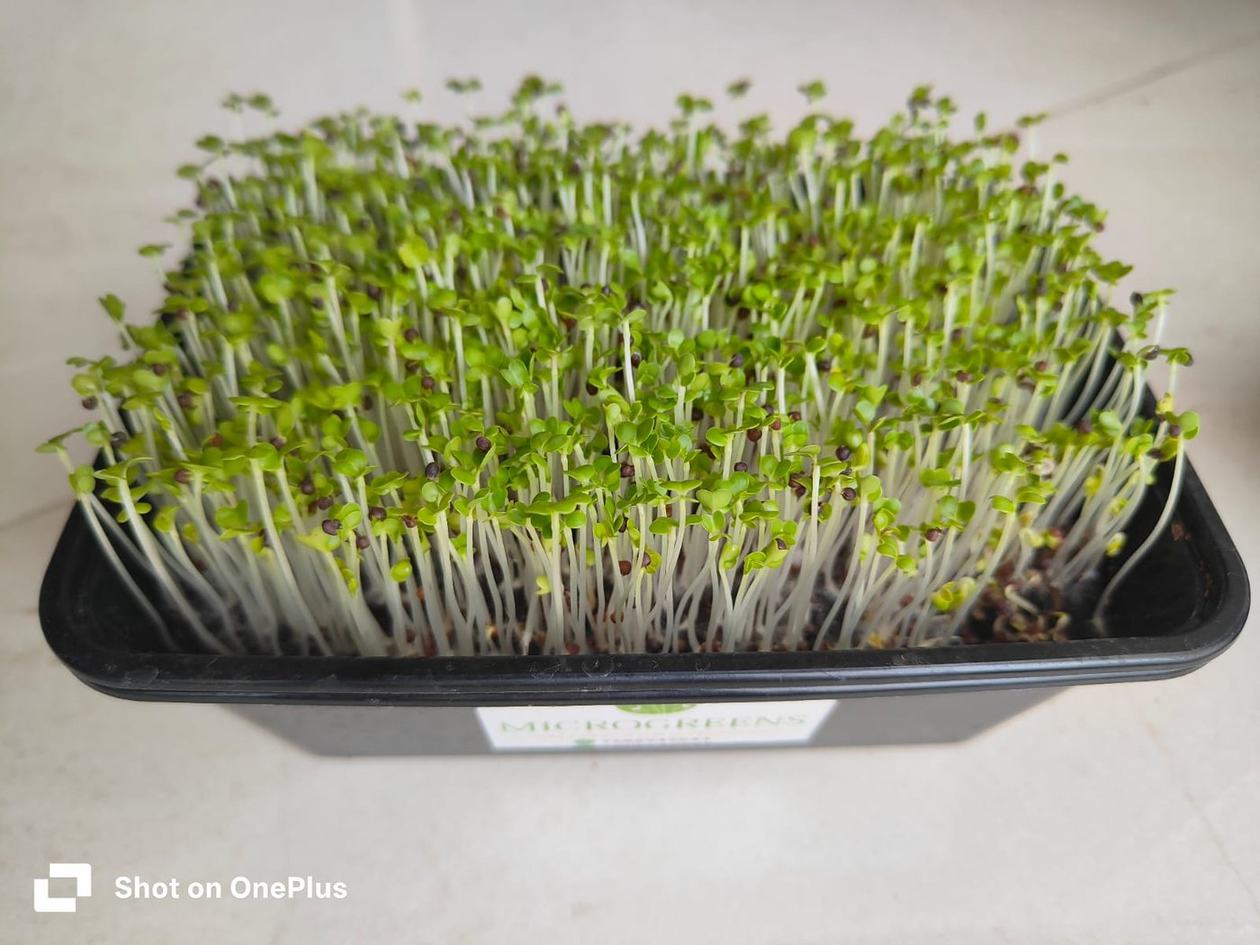
Mustard microgreens deserve far more attention than they get. They are nearly as fast as radish — seven to nine days — equally humidity-tolerant, and carry a warm, wasabi-edged pungency that Maharashtrian and North Indian kitchens absorb effortlessly: over poha, folded into raita, scattered on sabzi. Mustard seed is also economical, making it perfect for growers experimenting with density and technique. We have published a dedicated walkthrough on how to grow mustard microgreens in Mumbai, covering seed rates, blackout timing and monsoon adjustments specific to the city's conditions.
Pea Shoots: The Winter Treat
Pea shoots are the sweetest microgreen in the range — crisp, juicy and tasting of fresh green peas. They need ten to fourteen days and dislike sustained high humidity, which makes them a November-to-February crop in Mumbai. Grown in the cool season on a bright Powai or Mulund windowsill, they are spectacular: tall, tendrilled and abundant, with the bonus that they often regrow for a second, smaller cut. Stir-fry them briefly with garlic, or eat them straight off the tray.
Quick Comparison for Mumbai Conditions
| Variety | Days to Harvest | Humidity Tolerance | Best Mumbai Season | Flavour |
|---|---|---|---|---|
| Radish | 6-8 | Excellent | All year | Peppery, sharp |
| Mustard | 7-9 | Excellent | All year | Warm, pungent |
| Broccoli | 8-10 | Moderate | Oct-May | Mild, fresh |
| Sunflower | 10-12 | Moderate | Oct-Mar | Nutty, crunchy |
| Pea shoots | 10-14 | Low | Nov-Feb | Sweet, juicy |
Building Your Personal Rotation
The most successful Mumbai growers do not pick one favourite; they run a rotation matched to the calendar. A sensible starting portfolio looks like this: radish and mustard as your year-round workhorses, sunflower joining from October, broccoli through the dry months while conditions suit it, and pea shoots as a December-January indulgence. During the four monsoon months, drop back to the two fast varieties, run your fan, and keep harvests coming while less-prepared growers pause. This rotation also keeps your kitchen interesting — five distinct flavours across the year rather than one repeated garnish.
A final note on seed quality, because variety choice only matters if the seeds germinate. Microgreen sowing is dense — a full tray uses ten to thirty grams of seed — so a batch with poor germination shows up as embarrassing bald patches rather than one missing plant. Every variety above is available in our online seed store, tested for germination rate before packing at our Pune farm. If you cannot decide where to start, send us a photo of your growing space and tell us the month, and we will suggest a starter combination.
How to Grow Microgreens in a Mumbai Apartment
Ten steps from an empty tray to a cut of greens. None of them need equipment you cannot buy in Mumbai, and the whole cycle takes seven to fourteen days depending on the variety.
- Choose a location. A windowsill or balcony shelf getting four to six hours of bright but indirect light. East-facing is ideal in Mumbai — morning sun without the harsh western glare that cooks a tray in May. A kitchen counter under a cheap LED strip works if you have no good window.
- Pick a tray. A 25cm × 25cm seedling tray with drainage holes, sitting inside a second solid tray with no holes. The two-tray setup is what makes bottom watering possible, and bottom watering is what makes Mumbai humidity manageable.
- Add the growing medium. Two to three centimetres of cocopeat, moistened until it clumps when squeezed but does not drip. Cocopeat is sold at nurseries in Dadar, Mulund, Thane and Bandra, and online. Level the surface before sowing.
- Sow the seed. Scatter evenly and densely — eight to twelve grams for a small seed like radish or mustard, more for large seed like sunflower or pea. Press gently into the surface. Do not bury the seed and do not cover it with medium.
- Blackout. Cover with an inverted tray or a piece of cardboard for two to four days depending on variety. Darkness and slight pressure give even germination and straighter stems. Check daily; mist only if the surface looks dry.
- Move to light. Uncover when the seedlings are two to three centimetres tall and pale. In Mumbai's warmth this comes a day sooner than most packet instructions suggest. They green up within a day. In the monsoon, when cloud cover holds for weeks, a basic full-spectrum LED prevents leggy trays.
- Water from below. Pour water into the outer tray and let the medium drink through the drainage holes. Never wet the leaves. Pour in only what is absorbed in ten minutes and tip out the rest. Judge by weight: lift the tray, and water only if it feels light.
- Keep air moving. A small clip-on USB fan blowing gently across the trays, not down onto them. Run it during daylight at minimum and around the clock through the monsoon. The seedlings should sway slightly, which also strengthens the stems.
- Harvest. Cut just above the medium with clean scissors when the first true leaves start to show — six to eight days for radish, seven to nine for mustard, eight to ten for broccoli, ten to fourteen for sunflower and pea. Rinse, pat dry, and refrigerate what you are not eating.
- Clean up. Compost the medium and root mat, wash both trays in hot water with a splash of vinegar, and dry them fully before the next sowing. Spores from one crop will happily colonise the next, and this two-minute habit prevents most repeat problems.
Ready to grow your first tray? Choose your microgreen seeds and order online, or contact SAGreens on WhatsApp. The complete growing guide goes deeper on each stage.
Mumbai's Climate and the Microgreen Growing Seasons
Understanding Mumbai's climate is the single biggest shortcut to consistent microgreen harvests. Unlike temperate cities where growers battle cold and darkness, Mumbai offers warmth and light all year round — the trade-off is heat in April and May and heavy humidity through the monsoon. Once you know what each season does to a tray of seedlings, you can choose varieties and adjust routines so that something is always growing on your windowsill, whether you are in Bandra, Navi Mumbai or Thane.
Mumbai's coastal position keeps temperatures within a relatively narrow band: roughly 24 to 34 degrees Celsius for most of the year, rarely dipping below 17 degrees even on the coolest January nights. For microgreens, which germinate best between 20 and 30 degrees, this is genuinely excellent news. Seeds that take four days to sprout in a north Indian winter will sprout in thirty-six hours in a Dadar kitchen. The variables you actually need to manage are humidity and, in peak summer, heat stress — both of which are far easier to handle than cold.
The Three Growing Seasons of Mumbai
Think of the Mumbai microgreen calendar in three broad blocks, each with its own strengths:
| Season | Conditions | Recommended Varieties | Growing Tips |
|---|---|---|---|
| Winter Nov-Feb | Cooler and drier, bright reliable light | Broccoli, pea shoots, sunflower, radish, mustard | Normal growing. The season to try the slower varieties. |
| Summer Mar-May | Hotter, light is intense, medium dries faster | Radish, mustard, amaranth | Bright indirect light rather than direct sun, and keep air moving. |
| Monsoon Jun-Oct | Humid and overcast for weeks at a time | Radish, mustard | Fan running, bottom watering only, sow slightly thinner. |
Winter: The Golden Season
From November through February, Mumbai is a microgreen grower's paradise. Humidity drops to comfortable levels, daytime light is bright and reliable, and temperatures sit squarely in the ideal germination range. This is the season to attempt slower, more delicate varieties. Broccoli microgreens, which can sulk in peak humidity, grow beautifully in December. Pea shoots stay crisp rather than turning soft. Sunflower trays produce their thickest, most uniform stands. If you are starting your microgreen journey between November and February, expect near-perfect results even as a complete beginner — and use the season to build habits that will carry you through the harder months.
Summer: Manage Heat, Harvest Fast
March to May brings intensity. Temperatures in inland suburbs like Mulund, Powai and Thane can push past 34 degrees, and a tray sitting in direct afternoon sun on a west-facing Malad balcony can cook. The fixes are straightforward. Move trays to bright but indirect light — an east-facing window that gets gentle morning sun is ideal. Water slightly more often, always from below, because cocopeat dries faster in hot weather. And lean on heat-tolerant, quick varieties: radish microgreens positively thrive in warmth and can go from seed to harvest in six days flat during a Mumbai May. Avoid leaving harvested greens out of the fridge; in summer heat they wilt within an hour.
Monsoon: The Season That Separates Growers
From the first June downpour to the retreating rains of October, Mumbai's relative humidity hovers between 85 and 95 per cent. This is the season new growers fear, and it is true that a carelessly managed tray can develop mould in forty-eight hours. But thousands of Mumbai households grow right through the rains by following three rules: choose fast varieties so trays spend fewer days at risk, keep air moving with a small clip-on fan, and never wet the leaves — bottom watering only. Cloud cover also reduces natural light dramatically, so trays that lived happily on a Juhu windowsill in January may become leggy in July; a basic full-spectrum LED light solves this completely. Our dedicated monsoon microgreens guide walks through the entire wet-season playbook, and the humidity section later on this page covers the techniques in detail.
Microclimates Within the City
Mumbai is not one climate but several. Sea-facing homes in Worli, Bandra and Juhu enjoy steadier temperatures but noticeably saltier, damper air — wipe down trays and equipment more often and be extra disciplined about airflow. Inland and lake-adjacent areas such as Powai and the eastern suburbs run hotter in summer but slightly drier, which actually favours germination. High-rise apartments above the fifteenth floor in Navi Mumbai or Thane often have stronger breezes and lower ambient humidity than street-level flats, making them surprisingly good growing environments. Pay attention to your specific windowsill for a week — note how many hours of light it receives and whether it feels damp — and you will learn more than any generic chart can teach you.
Compared with Pune: What Mumbai Growers Should Adjust
Our home farm sits in Pune, where the drier air and cooler nights create slightly different conditions — you can see how we grow there on our Pune microgreens page. Mumbai growers should germinate for one day less than Pune instructions suggest (warmth accelerates sprouting), water slightly less often during monsoon despite the heat (the air itself keeps medium moist), and harvest a day earlier than the packet suggests in summer, because warm-grown microgreens shoot up fast and are at their sweetest just as true leaves emerge.
The bottom line: there is no month in Mumbai when you cannot grow microgreens. Match the variety to the season, respect the humidity, and your kitchen will produce fresh greens fifty-two weeks a year. Browse the full range of SAGreens seed varieties to plan a seasonal rotation.
Growing Microgreens During Mumbai Monsoon
If there is one topic that decides whether a Mumbai microgreen grower succeeds or gives up, it is humidity. The city's air routinely holds 70 to 80 per cent relative humidity even outside the monsoon, and from June to September it climbs to 90 per cent and stays there for weeks. Humid air slows evaporation, keeps growing medium wetter for longer, and creates exactly the still, damp conditions in which mould spores flourish. The encouraging truth is that every one of these risks has a simple, inexpensive counter-measure — and growers from Bandra to Navi Mumbai harvest clean, healthy trays right through the wettest weeks of July by following the routine below.
Rule One: Keep the Air Moving with a Fan
Stagnant air is the real enemy, not humidity itself. Mould needs still, saturated air sitting on the surface of your growing medium; the moment air moves, spores struggle to settle and moisture on leaves evaporates before problems begin. A small USB clip-on fan — the kind sold for office desks at a few hundred rupees — positioned to blow gently across (not directly down onto) your trays transforms your growing environment. Run it during daylight hours at minimum, and around the clock during the monsoon. The airflow should be soft enough that seedlings sway slightly; this gentle movement also strengthens stems, giving you sturdier, more upright microgreens. If you grow inside an air-conditioned bedroom in Worli or Powai, the AC itself dehumidifies beautifully, but still add the fan, because conditioned air often pools without circulating at windowsill level.
Rule Two: Bottom Watering, Always
Misting the tops of your microgreens in Mumbai is asking for trouble. Wet leaves in humid air stay wet for hours, and prolonged leaf wetness is the classic trigger for damping-off disease and surface mould. Bottom watering solves this elegantly: place your growing tray (with drainage holes) inside a second solid tray, and pour water into the outer tray so the medium drinks from below through capillary action. The roots get everything they need while the leaves and the surface of the medium stay dry. Pour in only what the medium absorbs within ten minutes and tip out any excess — standing water defeats the purpose. During the monsoon, you may find trays need watering only every second or third day because the saturated air slows drying dramatically. Check by weight: lift the tray, and if it feels light, water; if it has heft, wait. Our complete growing guide includes a full walkthrough of the two-tray bottom watering setup.
Rule Three: Choose Fast Varieties in Humid Months
Every extra day a tray spends growing is an extra day of mould risk. The smartest monsoon strategy is simply to shorten the race. Radish microgreens sprint from seed to harvest in six to eight days and are naturally vigorous in warm, damp conditions — they are the undisputed monsoon champion. Mustard is nearly as quick and shares that vigour; our guide on growing mustard microgreens in Mumbai covers it step by step. Save slower crops such as sunflower, pea and broccoli microgreens for the drier window from November to February, or grow them during monsoon only if you have a fan and disciplined watering already in place. Rotating your variety choices with the calendar is not a compromise — it is what experienced growers everywhere do.
Supporting Habits That Compound the Big Three
Beyond the fan, bottom watering and fast varieties, a handful of small habits stack the odds further in your favour:
- Sow slightly thinner: Reduce seed density by ten to fifteen per cent during monsoon. Overcrowded seedlings trap moisture between stems and block airflow at the base of the canopy.
- Shorten the blackout period: Uncover trays a few hours earlier than you would in winter. The warm, humid dark phase is when problems begin, so move to light as soon as seedlings reach two centimetres.
- Sterilise between crops: Wash trays with hot water and a splash of vinegar after every harvest. Spores from one crop happily colonise the next.
- Use fresh cocopeat: Reusing growing medium is tempting but risky in humid months, as old medium carries fungal passengers.
- Space trays apart: Leave a hand's width between trays so air can circulate around each one rather than stagnating in the middle of a cluster.
Root Hairs vs Mould: Do Not Panic Prematurely
The most common false alarm in Mumbai growing groups is a photo of healthy root hairs captioned as mould. Root hairs are fine, white, evenly distributed fuzz radiating directly from the root of every seedling — they appear during germination, look almost frosty, and vanish when you bottom water. Mould, by contrast, is patchy rather than uniform, sits on the surface of the medium or bridges between stems like a spider web, and often carries a grey, blue or greenish tinge with a musty smell. If you see genuine mould in one corner, remove that patch of medium and seedlings with a spoon, improve airflow immediately, and the rest of the tray is usually salvageable. If more than a quarter of the tray is affected, compost it and restart — with six-day radish, you have lost almost nothing.
A Monsoon Morning Routine That Takes Two Minutes
Growers in Mulund, Malad and Thane who harvest all through the rains tend to follow the same brief daily ritual: glance at each tray for colour changes or webbing, lift each tray to judge water weight, top up the bottom tray only if light, confirm the fan is running and repositioned across the trays, and rotate trays half a turn for even light. That is the whole job. Two minutes with your morning chai keeps trays clean through the heaviest July fortnight. For the full seasonal strategy — including light management under cloud cover and what to do during a multi-day power cut — read our detailed monsoon growing guide for India.
Microgreen Seeds Delivered Across Mumbai
Seed goes out by express courier from Pune and reaches most of the Mumbai metropolitan region in one to two working days. Coverage follows the courier network rather than any promise we can make ourselves, so treat the timings below as typical rather than guaranteed — a monsoon week or a public holiday adds a day, and a few pockets take longer. If you want your postcode checked before ordering, ask us.
South Mumbai
Colaba, Marine Lines, Worli and Dadar. Older buildings here often have deep, generous windowsills that suit tray growing well, and sea-facing flats get steadier temperatures with damper, saltier air — wipe equipment down more often and be strict about airflow. Dadar deserves a mention of its own: a neighbourhood of lifelong plant people, where microgreens slot in beside the tulsi and curry leaf already on the balcony.
Western suburbs
Bandra, Khar, Santacruz, Andheri, Juhu and Borivali. This is where the city's microgreens culture is most visible, with cafes and salad bars from Pali Hill to Carter Road already using them. Andheri's compact studios and 1BHKs are exactly the space microgreens suit — one tray on a counter under a clip-on light. Growers here report the best results on east-facing windows that catch morning light and miss the late-afternoon sea glare.
Eastern suburbs
Powai, Mulund and Ghatkopar. Slightly drier air than the coast, which helps germination, and Powai's planned townships tend to have wide windows and good ventilation. Mulund, sitting against Sanjay Gandhi National Park, gets marginally cooler nights and cleaner air than most of the city, and broccoli rewards that with unusually even trays.
Thane and Navi Mumbai
Thane West and Thane East, and across Navi Mumbai to Vashi, Nerul, Kharghar and CBD Belapur. Newer, larger apartments with balconies you can actually use, and societies that often encourage terrace gardening outright. This is where growers most often scale from one tray to a shelf rack. Thane's inland position makes summers hotter but monsoon air slightly less saturated than the island city.
Wherever you are, the growing routine is the same and the humidity advice on this page applies. For a street-by-street version covering 35 areas, read our complete Mumbai microgreens guide.
Equipment for Mumbai Apartment Microgreen Growing
One of the best-kept secrets of microgreen growing is how little equipment it genuinely requires. You can start in a Mumbai apartment for less than the cost of two restaurant salads, and even a serious multi-tray setup costs less than a gym membership renewal. This guide covers exactly what you need, what you can improvise from things already in your kitchen, and what is worth upgrading once the hobby sticks — with specific notes for Mumbai's humidity and light conditions along the way.
Trays: The Foundation of Your Setup
You need two trays per growing station: an inner tray with drainage holes that holds the medium and seeds, and a solid outer tray that catches water and enables bottom watering. Purpose-made microgreen trays (roughly 25 by 35 centimetres) are inexpensive and stack neatly, but Mumbai kitchens are full of workable substitutes — steel thalis, disposable food containers with holes punched in, even cut-down water bottles for single-portion experiments. Whatever you choose, shallow is better: microgreen roots need only two to three centimetres of medium, and deep containers waste cocopeat while staying soggy at the bottom. If you buy purpose-made trays, get at least four so you can run staggered sowings, a technique covered in our scaling section later on this page.
Growing Medium: Cocopeat Wins in India
Cocopeat — coir pith, a by-product of India's coconut industry — is the ideal microgreen medium for Mumbai growers: cheap, widely available, lightweight, clean to handle indoors and excellent at holding moisture without waterlogging. Buy it as compressed bricks, soak in water and it expands five to seven times into a fluffy, ready-to-use medium. Avoid garden soil indoors; it is heavy, variable and frequently carries fungal spores that Mumbai's humidity will happily activate. Vermiculite-cocopeat blends are a refinement, not a requirement. One practical monsoon tip: store unused cocopeat bricks in a sealed container, because an opened brick left loose in a Malad or Juhu kitchen absorbs ambient moisture and can grow mould before you ever use it.
Light: Windowsills First, LEDs Later
From October to May, a bright Mumbai windowsill is all the lighting you need — east-facing is ideal, giving gentle morning sun without the punishing western afternoon glare. The equation changes during monsoon, when weeks of cloud cover leave seedlings pale and leggy. The fix is a basic full-spectrum LED grow light, or honestly even a bright white LED tube, positioned fifteen to thirty centimetres above the trays and run for ten to twelve hours a day. LEDs draw trivial power and generate almost no heat. For growers in deep-set flats in Dadar or north-facing towers in Thane where direct light never reaches the sill, an LED turns any shelf — including inside a cupboard — into prime growing territory year-round.
The Humidity Kit: Non-Negotiable for Mumbai
Two items earn their place in every Mumbai setup regardless of budget. First, a small clip-on or desk fan to keep air moving across trays — the single most effective mould preventer available, as covered in our humidity section above. Second, a simple hygrometer-thermometer combo (a few hundred rupees online) so you actually know your growing corner's conditions instead of guessing. When the hygrometer reads above 85 per cent, you know to run the fan continuously, water less and stick to fast varieties. A spray bottle rounds out the kit for the germination phase only; after uncovering, all watering happens from the bottom tray.
Three Budget Tiers for Mumbai Growers
| Setup | Approximate Cost | What You Get | Suits |
|---|---|---|---|
| Starter | Under ₹500 | 2 improvised trays, 1 cocopeat brick, spray bottle, seeds | First-timers testing the hobby |
| Committed | ₹1,500-2,500 | 4-6 proper trays, USB fan, hygrometer, seed variety pack | Weekly household harvests |
| Serious | ₹5,000-8,000 | Multi-shelf rack, LED lights, 10+ trays, timer plug | Daily harvests, sharing or selling |
What You Do Not Need
The internet will try to sell you plenty of unnecessary kit, so let us save you money. You do not need hydroponic nutrient solutions — microgreens run entirely on the energy stored in the seed and are harvested before they need feeding. You do not need heating mats in Mumbai; the city never gets cold enough. You do not need pH meters, humidity domes (actively harmful here — they trap exactly the moisture you are fighting), fancy misting systems or imported growing mats when Indian cocopeat outperforms them at a tenth of the price. Every rupee saved on gadgets is better spent on quality seeds, which are the one input where quality genuinely determines your results.
Setting Up Your Growing Corner
Bring it all together in one dedicated spot: a windowsill, a kitchen counter end, or a shelf in a well-ventilated room. Place the fan so it sweeps across all trays. Keep a small caddy nearby with scissors, the spray bottle and a measuring spoon for seed — friction kills habits, and having everything within reach makes the two-minute daily routine effortless. Growers in compact Andheri studios often use a single vertical shelf unit by the window: trays on two shelves, supplies on the third, fan clipped to the frame. It occupies a quarter of a square metre and produces salad for two people continuously.
Everything on this page besides seeds is available in any Mumbai hardware shop or online marketplace. The seeds themselves — the heart of the whole system — come from our farm in Pune, tested and packed fresh, arriving anywhere from Worli to Navi Mumbai in one to two days via our online seed store. New to the process entirely? Pair your equipment shopping with our step-by-step how to grow microgreens guide, or WhatsApp SAGreens at +91 99709 58370 for a setup recommendation matched to your space and budget.
Building a Mumbai Apartment Microgreen Garden: Scaling Up
Once you've grown a few successful trays in your Mumbai flat, the natural next question is how to scale up without overwhelming your space, your time, or your budget. Scaling microgreen growing well — maintaining quality and freshness without creating a production burden — is different from simply buying more trays and sowing more seeds. This section covers how Mumbai's most organised home growers have built consistent, enjoyable growing systems in apartments from 500 square feet to 1,500 square feet.
The staggered sowing system: Rather than growing one large batch and harvesting all at once, the well-organised microgreen grower maintains three to four trays in constant rotation, staggered by 2–3 days. One tray is always ready to harvest, one is in its growth phase, and one is just germinating. This provides fresh microgreens every 2–3 days from a small permanent setup rather than a feast-or-famine pattern from batch growing.
Choosing your permanent growing location: Identify the best light in your Mumbai flat and commit to it as your microgreen growing station. East-facing windows (morning sun in Bandra, Andheri, Powai) are ideal. South-facing windows provide consistent light throughout the day. West-facing windows have afternoon sun — good in winter, potentially too hot in summer without shade adjustment. A balcony with shade cloth (50% shade) is excellent for most of the year except peak monsoon.
Equipment for a 4-tray rotation: Four growing trays with holes (25cm × 25cm each), four matching solid catch trays, a spray bottle, clean scissors, and a timer or reminder to check moisture every 24–36 hours. Total investment: ₹800–1,500 one-time. Monthly seed cost for continuous growing across 4 trays: approximately ₹400–600 depending on varieties. This is the complete ongoing cost of a well-functioning home microgreen station.
Managing humidity at scale: Four trays in a Mumbai kitchen or on a balcony during monsoon creates more moisture than one. Position trays with gaps between them rather than touching — airflow between trays prevents the stagnant humid microclimate that encourages mould. Add a small fan during monsoon months. Monitor the medium's moisture level by feel rather than by schedule — in high humidity, you may need to water less frequently than in drier months.
When to expand beyond windowsill growing: If you want to grow more than 4 trays simultaneously, consider a small shelving unit (a 2-tier wire shelf unit from a home store, ₹1,500–2,500) near your best window or supplemented with a basic LED grow strip. This multiplies your capacity without taking more floor space. Mumbai growers who supply surplus trays to neighbours or local cafes often use a 3-tier setup with 8–12 active trays in rotation.
Order seeds for your Mumbai growing setup at our seed store. Full range and pricing on our microgreen seeds India page. For growing support at any scale, Ask us through our contact page.
Frequently Asked Questions
Ready to Grow Your First Tray?
Choose your microgreen seeds and order online, or send us a WhatsApp message and we will suggest a starter combination for the month you are ordering in.