Microgreen Seeds Bangalore: Buy for Home & Commercial Use
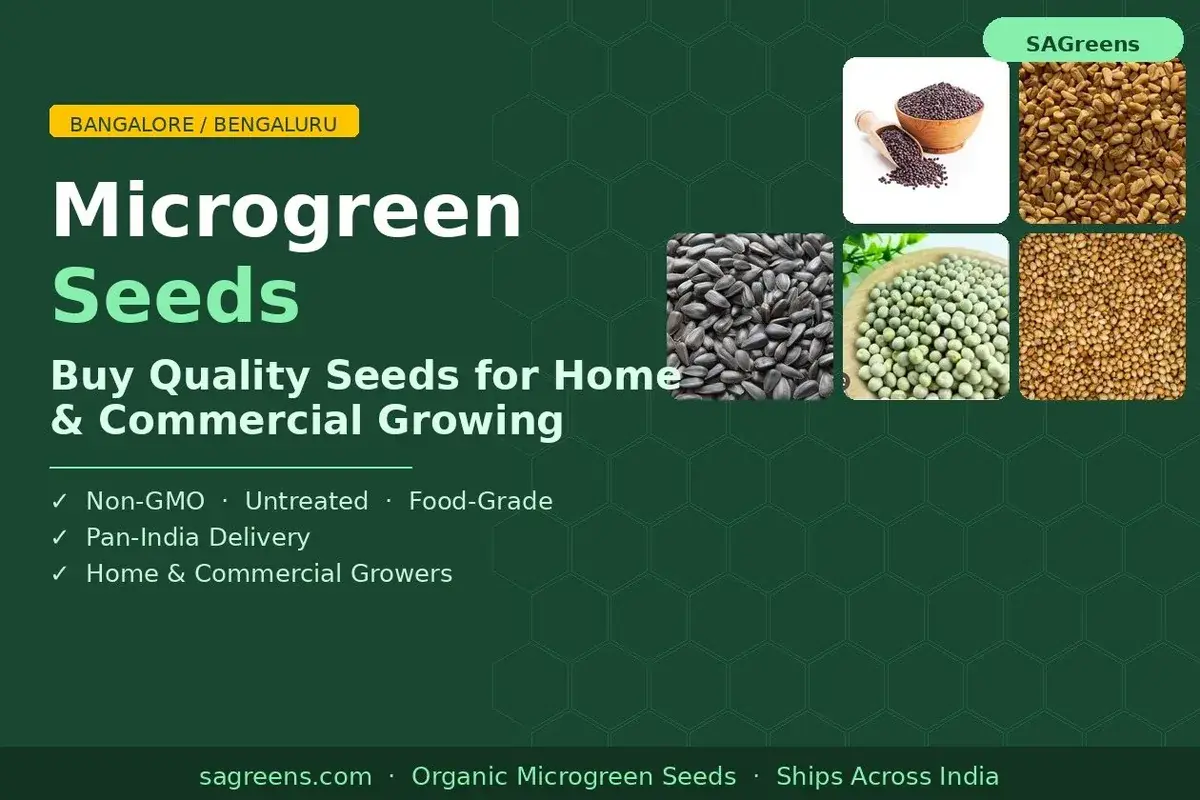
Key Takeaways: Microgreen seeds in Bangalore are available online from SAGreens, which ships pan-India including all Bengaluru pin codes. Choose untreated, Non-GMO, food-grade seeds selected for microgreen growing — not regular agricultural seeds often coated with fungicides. For home growers, start with radish, mustard (sarson), or fenugreek (methi). Commercial growers in Bengaluru can order bulk quantities. Never use brightly coloured (pink, blue, red) seeds for microgreens — those are chemical-treatment warning colours meaning the seeds are not safe to eat as food.
Bangalore — Karnataka's capital and India's tech hub — is one of India's fastest-growing cities for health-conscious eating, and microgreens have become a staple in kitchens across Koramangala, Indiranagar, HSR Layout, and Whitefield. Home growers are setting up trays on apartment balconies. Restaurants and cloud kitchens are sourcing fresh microgreens from local Bengaluru growers. Urban farms are supplying hotels and health cafes from Electronic City to Hebbal.
All of that growth depends on one thing: reliable, safe microgreen seeds.
Sourcing the right seeds is harder than it sounds. Most seeds sold in local nurseries and agri-marts across India are intended for field agriculture and are coated with chemical fungicides and insecticides. These treatments are invisible to the eye and completely appropriate for growing a mature plant over months — but not for microgreens, where you eat the seedling within 7-14 days, often with the seed coat still attached.
SAGreens supplies untreated, Non-GMO microgreen seeds online across India, including Bangalore and Bengaluru. Our seeds are selected specifically for microgreen growing — for germination consistency, flavour, stem strength, and crop duration suitable for tray production. Whether you are a first-time home grower or running a commercial microgreens operation, you can browse our complete seed range and order directly online.
In this guide, we cover everything a Bangalore grower needs to know: which varieties work well, where to source seeds, how to choose a reliable supplier, and how to get started.
How much do microgreen seeds cost per 100g packet in India?
Prices at SAGreens: sunflower seeds ₹124/100g, radish ₹120/100g, mustard ₹124/100g, broccoli ₹200/20g, fenugreek ₹69/100g, and red amaranthus ₹198/100g. Each packet yields 2–4 standard growing trays. Browse all seed varieties or WhatsApp SAGreens for bulk orders.
*This guide is written by the SAGreens team — a three-generation farming family from Pune, Maharashtra, led by Ajay Toradmal. We grow microgreens year-round at our Keshav Nagar farm and supply certified untreated, Non-GMO seeds to home growers, restaurants, and commercial farms across India.*
Why Microgreen Seeds Are Different from Regular Vegetable Seeds
Many people assume any vegetable seed can be used for microgreens. This is partly true but practically risky in India.
The core difference is seed treatment. Seeds sold for field agriculture in India — including many packets found in nurseries, agri-marts, and kirana shops — are frequently coated with one or more chemical compounds before packaging. Common chemicals include thiram, captan, carbendazim, imidacloprid, and thiamethoxam. Treated seeds are often dyed bright pink, red, or blue as a mandatory visual warning that they must not be consumed by humans or animals.
Watch for brightly coloured seeds: Pink, red, or blue seeds are almost always chemically treated. Never use bright-coloured seeds for microgreens. Untreated, food-grade seeds look natural in colour — off-white, brown, beige, green, or black depending on the variety.
In field agriculture, seed treatment makes complete sense. The plant grows over several months and the chemical coating breaks down naturally before harvest. But with microgreens, you harvest the seedling at day 7-14 and the seed coat may still be attached to what you are eating raw.
Beyond seed treatment, microgreen-specific seeds are selected for:
- Germination consistency: Uniform germination across the tray is critical for commercial production
- Stem strength: Weak stems that collapse before harvest waste an entire tray
- Flavour at cotyledon stage: Not all varieties develop good flavour at 7-14 days
- Seed size and density: Tray seeding rates require appropriate seed sizes for even coverage
- Freshness and viability: Old seed stock means poor germination and wasted growing space
Read our detailed guide on microgreen seeds vs regular seeds India for a full comparison, and our complete guide to untreated Non-GMO seeds for microgreens India for the full safety picture.
Best Microgreen Seeds to Grow in Bangalore
Bangalore's climate is one of India's most microgreen-friendly: moderate temperatures year-round (18-30 degrees C), relatively low humidity compared to coastal cities, and consistent light availability. Almost all microgreen varieties grow well in Bengaluru with minimal climate control.
| Variety | Hindi Name | Flavour | Growing Period | Difficulty | Best For |
|---|---|---|---|---|---|
| Radish | Mooli | Peppery, sharp | 6-8 days | Easy | Beginners, chefs, salads |
| Mustard | Sarson | Spicy, pungent | 5-7 days | Easy | Dal garnish, salads |
| Fenugreek | Methi | Bitter, herby | 7-10 days | Easy | South Indian cooking, health |
| Sunflower | Surajmukhi | Nutty, mild | 10-14 days | Medium | Smoothies, snacking |
| Pea Shoots | Matar | Sweet, grassy | 10-14 days | Easy | Raw eating, garnish |
| Coriander | Dhaniya | Citrusy, floral | 14-18 days | Medium | South Indian cuisine |
| Wheatgrass | Gehun | Earthy, grassy | 7-10 days | Easy | Juicing, wellness shots |
| Kohlrabi | Ganth Gobhi | Mild, cabbage-like | 8-10 days | Easy | Restaurant plating, salads |
| Spinach | Palak | Mild, earthy | 10-14 days | Medium | Home cooking, smoothies |
Best varieties for Bengaluru beginners: Radish, mustard, and fenugreek are the fastest-growing, most forgiving varieties for Bangalore's climate. They germinate within 2-3 days and are ready to harvest in under 10 days. They are the most cost-effective varieties to trial — a 100g packet covers several starter trays.
Coriander (dhaniya) takes longer than most varieties (14-18 days) and benefits from soaking before sowing, but it is one of the most popular choices in Bengaluru kitchens given its role in South Indian cooking. Our organic coriander seeds are pre-cleaned to reduce the double-seed clusters that slow germination.
Where to Buy Microgreen Seeds in Bangalore
Bengaluru has several options for sourcing microgreen seeds, each with different trade-offs.
Local nurseries and garden centres: Available in areas like Jayanagar, JP Nagar, and Banashankari. Most stock is not labelled as untreated and variety selection for microgreens is limited.
Supermarkets and health stores: Some premium grocery stores stock a small range of sprouting or microgreen seeds. Prices are high and variety selection limited.
Local agri-marts: Priced for farmers, not home growers. Seed stock is almost always treated with fungicides for field use. Not recommended for microgreens.
Online suppliers: The most reliable option for microgreen-specific seeds in Bangalore. You can compare varieties, verify treatment status, and order in the exact quantity you need — from a small 100g packet for home growing to bulk quantities for commercial microgreen farms.
What to check before buying microgreen seeds online: Look for explicit statements that seeds are untreated, Non-GMO, and food-grade. Avoid any supplier that cannot confirm treatment status. Growing information on the product page is a good sign — it indicates the supplier understands microgreen production, not just seed retail.
SAGreens seeds are available to order online with delivery across Bengaluru. Read our complete microgreen seeds buying guide India for detailed sourcing advice covering all major Indian cities.
Why Choose SAGreens for Microgreen Seeds
SAGreens is a three-generation farming family from Pune, Maharashtra, led by Ajay Toradmal. We grow microgreens year-round at our Keshav Nagar farm and have selected every seed variety based on actual growing experience — germination performance, stem strength, flavour at cotyledon stage, and harvested crop shelf life.
What makes our seeds different:
- Untreated and Non-GMO: All seeds are food-grade and untreated — no fungicide, no insecticide, no chemical coating
- Microgreen-specific selection: Varieties chosen for tray growing, not field farming
- Fresh stock rotation: We maintain stock quantities that ensure high-viability seeds with fast turnover
- 9 varieties available: Radish, mustard, sunflower, fenugreek, pea shoots, coriander, wheatgrass, kohlrabi, and spinach
- Retail and bulk: 100g packets for home growers to bulk quantities for commercial Bengaluru farms
- Pan-India delivery: We ship to Bangalore, Bengaluru, Mumbai, Delhi, Chennai, Hyderabad, Kolkata, and all major Indian cities
- Growing knowledge: Product pages and guides built on our own year-round growing experience
Looking for microgreen seeds in Bangalore? Explore our seed range or contact SAGreens for bulk requirements.
Microgreen Seeds for Home Growers in Bangalore
Bangalore apartments are some of the most practical spaces in India to grow microgreens. The city's mild climate means you do not need a grow tent or climate control for most varieties. A balcony, kitchen counter, or any well-lit space in Whitefield, Indiranagar, or Koramangala works perfectly year-round.
Best starter varieties for Bangalore home growers:
- Radish (mooli) seeds: Ready in 6-8 days, peppery flavour, very forgiving of beginner mistakes
- Mustard (sarson) seeds: Ready in 5-7 days, spicy kick, excellent as dal or sabzi garnish
- Fenugreek (methi) seeds: Ready in 7-10 days, bitter-herby flavour, popular in South Indian cooking
- Pea shoot seeds: Sweet and crisp, fast-growing, ideal for raw eating
- Wheatgrass (gehun) seeds: Fast-growing, ideal for morning juice shots and wellness routines
- Spinach (palak) seeds: Mild flavour, excellent for smoothies and home cooking
For your first tray, start with a 100g pack of radish or mustard. You will see germination within 2 days and can harvest by day 7-8. Once you have a successful first harvest, try fenugreek or pea shoots.
Whether you are growing on a balcony in HSR Layout or a kitchen window in Jayanagar, the basic setup is the same: a shallow tray, cocopeat, untreated seeds, and indirect light. See our complete best microgreen seeds for beginners India guide for step-by-step variety advice.
Microgreen Seeds for Commercial Farming in Bangalore
Bengaluru's restaurant and hospitality industry is one of the most microgreen-receptive markets in India. Establishments in Koramangala, Indiranagar, and the CBD are regularly adding microgreens to menus as a fresh local garnish. Cloud kitchens from Electronic City to Hebbal are building microgreens into health bowl and salad offerings. Hotels in the Whitefield tech corridor are sourcing locally grown microgreens for buffet and room service presentations.
Whether you are growing microgreens to supply Bengaluru restaurants, running a training centre for urban farmers in Marathahalli, or building a microgreens subscription delivery business in Banashankari, consistent seed supply is the foundation of reliable commercial production.
Consistency is everything in commercial microgreens: A restaurant buyer in Bengaluru will stop ordering the moment they receive a tray with uneven germination or off-flavour. Commercial growers need seed suppliers who can maintain consistent quality across repeat orders — not just one good batch.
What commercial growers in Bengaluru need from a seed supplier:
- Consistent seed quality across repeat orders
- Reliable stock of key varieties to cover growing cycles without gaps
- Variety range covering fast-turnover crops (radish, mustard) and premium crops (sunflower, coriander, pea shoots)
- Bulk pricing for regular volume orders
- Reliable delivery to Bengaluru on schedule
SAGreens supplies bulk microgreen seeds in Bangalore and across India. Contact SAGreens for bulk microgreen seed requirements to discuss your Bengaluru operation. Read our complete guide on bulk microgreen seeds India for commercial sourcing strategy including variety selection for Bengaluru market conditions.
How to Choose the Right Microgreen Seeds
Whether you are buying seeds in Bangalore for the first time or switching suppliers, use this checklist:
- Untreated confirmed: Explicitly labelled as untreated, food-grade seeds with no fungicide or insecticide coating
- Non-GMO verified: Supplier confirms Non-GMO seed origin
- Variety suited to your growing method: Tray-growing in cocopeat suits most varieties
- Fresh stock: Old seed means poor germination — look for recent packing dates where available
- Seed cleanliness: Seeds should be free of debris, empty hulls, and foreign material
- Flavour at cotyledon stage: Confirm the variety develops good flavour as microgreens, not just as mature vegetables
- Growing notes provided: A supplier who provides variety-specific growing information understands microgreens
- Consistent availability: Your key varieties should be in stock reliably, not just occasionally
- Trial quantity available: Can you buy a small 100g pack to trial before committing to bulk?
- Delivery to Bangalore confirmed: Check that the supplier ships reliably to your Bengaluru pin code
How Much Microgreen Seed Do You Need?
Seed quantity varies by variety, seed size, tray size, and preferred crop density. Here are approximate figures for a standard 10x20 inch (25x50 cm) tray — the most common size used by home growers and commercial operations across India:
| Variety | Approx. Seed per Tray | Notes |
|---|---|---|
| Radish | 30-40g | Medium seed, sow densely for best yield |
| Mustard | 25-35g | Small seed, spreads well |
| Fenugreek | 50-70g | Large seeds, dense sowing recommended |
| Sunflower | 120-150g | Large seed, requires full tray coverage |
| Pea Shoots | 180-220g | Large seed, thick sowing for good stem density |
| Coriander | 30-50g | Soak first to separate seed clusters |
| Wheatgrass | 150-200g | Dense sowing, full tray coverage |
| Kohlrabi | 20-30g | Small seed, light sowing |
| Spinach | 40-60g | Medium seed, even layer coverage |
These are example figures to guide planning, not guaranteed recommendations. Your growing conditions, cocopeat depth, and preferred crop density all affect the ideal seeding rate for your specific setup in Bengaluru.
For commercial operations, estimate trays per week per variety, multiply by the per-tray seeding rate, and order 4-6 weeks of stock at a time. This ensures buffer stock without seed viability degrading from long storage.
How to Grow Microgreens from Seeds
Growing microgreens at home in Bangalore is straightforward with the right seeds and basic equipment. Here is a step-by-step process that works for most varieties in Bengaluru's climate.
1. Select your seeds
Choose an untreated, food-grade variety suitable for microgreens. Start with radish or mustard for your first crop.
2. Prepare your growing medium
Cocopeat is the most popular and cost-effective growing medium across India. Fill your tray to 3-4 cm depth and moisten evenly before sowing.
3. Sow seeds evenly
Spread seeds in a single even layer across the surface. Do not pile seeds — thick clumps cause mould and uneven germination.
4. Blackout period
Cover the tray with another tray or dark cloth for the first 2-4 days. This maintains humidity, encourages germination, and promotes stem elongation. Fenugreek (methi), sunflower, and pea shoots benefit most from a blackout period.
5. Move to light
Once seeds have germinated and stems reach 3-5 cm, remove the cover and move to indirect natural light. Bangalore's ambient light near a window suits most varieties without supplemental lighting.
6. Water from below
Add water to the base tray rather than watering from above. Bottom watering prevents mould on the seed surface and keeps cotyledons dry.
7. Maintain airflow
Good air circulation reduces mould risk — especially important during Bengaluru's monsoon months when ambient humidity rises.
8. Harvest at the right time
Harvest when cotyledons are fully open and before the first true leaves appear — typically day 6-14 depending on variety. Cut just above the growing medium with clean scissors.
9. Rinse and store
Rinse harvested microgreens gently and dry well. Store in a sealed container in the refrigerator. Most varieties keep 4-7 days after harvest.
Microgreen Seeds Delivery to Bangalore
Customers across Bengaluru can order microgreen seeds online from SAGreens. We ship pan-India, covering all Bangalore pin codes — from Whitefield and Marathahalli in the east to Banashankari and JP Nagar in the south, and Yelahanka and Hebbal in the north.
Orders are packed carefully to protect seed viability during transit. Seeds are dry goods and ship safely via standard courier with typical delivery timelines for Bangalore orders from Pune.
For bulk and commercial orders from Bengaluru and across Karnataka, contact our team directly to discuss quantities, pricing, and delivery scheduling for your operation.
Browse microgreen seeds and place your Bangalore order here.
Organic Certification: SAGreens supplies NPOP-certified organic microgreen seeds — untreated, non-GMO, tested at 85%+ germination rate. Available with pan-India delivery from our Pune farm.
Best Microgreen Seeds to Buy Online in Bangalore
Bangalore's climate is the kindest in India for microgreens. Moderate temperatures for most of the year, cool nights, and none of the extreme summer heat that forces Delhi or Ahmedabad growers indoors from March. Almost everything grows well here, which makes the question less about what survives and more about what is worth your tray space.
Best sellers to Bangalore, ranked by what customers reorder: radish for speed and flavour, sunflower for volume, broccoli for sulforaphane, and coriander because Bangalore kitchens use dhania constantly. Prices from ₹50 to ₹200 per pack, with delivery charged at checkout and delivery to every Bengaluru pin code in 2-4 business days.
| Seed | Days | Why it suits Bangalore | Price |
|---|---|---|---|
| Radish | 6-8 | Fastest crop, thrives year-round here | ₹120/100g |
| Sunflower | 7-10 | Highest yield per tray, mild climate suits it | ₹124/100g |
| Mustard | 6-8 | Fast, peppery, no soaking needed | ₹124/100g |
| Broccoli | 8-12 | Highest glucoraphanin of any variety | ₹200/20g |
| Coriander | 12-18 | Concentrated dhania, worth the wait | ₹124/100g |
| Pea shoot | 10-14 | Regrows twice, best value per sowing | ₹88/100g |
| Fenugreek | 8-10 | Methi flavour, very forgiving | ₹69/100g |
| Wheatgrass | 8-12 | Cheapest entry point, for juicing | ₹50/100g |
| Red amaranthus | 8-12 | Deep red keerai, colour holds well here | ₹198/100g |
| Beetroot | 12-18 | Deep colour, cool nights help pigment | ₹178/100g |
Bangalore's cool season from October to February is genuinely the best growing window in urban India. Pigmented varieties like purple sango radish and chinese pink radish develop noticeably deeper colour here than in hotter cities, because anthocyanin production increases at lower temperatures.
Delivery Across Every Bengaluru Area
SAGreens ships seed to all Bengaluru pin codes from our Pune farm, typically arriving in 2-4 business days. Coverage by zone:
East Bengaluru
Whitefield, Marathahalli, Bellandur, Sarjapur Road, KR Puram, Mahadevapura, Brookefield, Kadugodi, Varthur, Hoodi and Kundalahalli. The tech corridor accounts for most of our Bengaluru seed orders, largely apartment growers working with balcony space and limited light.
South Bengaluru
Koramangala, HSR Layout, BTM Layout, Jayanagar, JP Nagar, Banashankari, Basavanagudi, Bommanahalli, Electronic City and Bannerghatta Road. Koramangala and HSR between them place more repeat orders than any other Bengaluru area.
North Bengaluru
Hebbal, Yelahanka, RT Nagar, Hennur, Kalyan Nagar, Jakkur, Thanisandra, Devanahalli and Yeshwanthpur. Independent houses here often have terrace space, which suits larger tray counts than apartment growing allows.
West Bengaluru
Rajajinagar, Malleshwaram, Vijayanagar, Nagarbhavi, Kengeri, Peenya and Magadi Road. Malleshwaram and Basavanagudi households tend toward the traditional varieties, particularly methi and dhania.
Central Bengaluru
Indiranagar, Domlur, Ulsoor, MG Road, Frazer Town, Richmond Town and Shivajinagar. Restaurant and cafe demand is concentrated here, which is where purple sango and other plating varieties go.
For bulk or commercial quantities to any of these areas, contact us on WhatsApp for wholesale rates.
What to Buy First in Bangalore
If you are ordering for the first time, two packs cover most of what a household needs.
Start with radish and sunflower. Radish teaches tray management with almost no risk of failure at six to eight days, and sunflower gives enough volume to feel worthwhile rather than decorative. Between them that is ₹284 and roughly twenty trays.
Add pea shoots third. They regrow twice after the first cut, so a single ₹88 pack produces more total harvest than anything else in the range.
Leave coriander until you have a few successful trays behind you. It takes 12-18 days and germinates slowly enough that beginners routinely discard trays that were growing normally. Our guide to the fastest growing microgreens explains which crops forgive mistakes and which do not.
Frequently Asked Questions
Where can I buy microgreen seeds in Bangalore?
You can buy microgreen seeds in Bangalore online from SAGreens, which ships to all Bengaluru pin codes. SAGreens stocks untreated, Non-GMO, food-grade seeds selected specifically for microgreen growing, including radish, mustard, fenugreek, sunflower, pea shoots, coriander, wheatgrass, kohlrabi, and spinach.
Which microgreen seeds are best for beginners?
For first-time growers in Bangalore, radish, mustard, and fenugreek are the best starting varieties. They germinate in 2-3 days, reach harvest in 6-10 days, and are forgiving of beginner mistakes in watering and light management.
Can I buy microgreen seeds online in Bangalore?
Yes. SAGreens ships microgreen seeds online to Bangalore and all major Indian cities. You can browse all varieties on the website and order 50g retail packs or bulk quantities depending on your requirement.
Which microgreen seeds are suitable for commercial farming?
Radish and mustard are the fastest-turnover commercial crops. Sunflower and pea shoots command higher prices at Bengaluru restaurants and health cafes. Coriander (dhaniya) and fenugreek (methi) are popular in South Indian cuisine. A balanced commercial operation in Bengaluru typically grows 4-6 varieties to meet different buyer preferences.
How long do microgreens take to grow?
Growing time varies by variety. Radish and mustard are among the fastest at 6-8 days. Sunflower and pea shoots take 10-14 days. Coriander takes the longest at 14-18 days. Most varieties grown in Bangalore's climate fall within 7-14 days from sowing to harvest.
How should microgreen seeds be stored?
Store microgreen seeds in a cool, dry, dark location in an airtight container or sealed original packet. Avoid storage near a stove or in a humid kitchen area. Properly stored seeds remain viable for 1-2 years depending on the variety.
How much microgreen seed should I use per tray?
Seeding rate varies by variety. For a standard 10x20 inch tray: radish 30-40g, mustard 25-35g, fenugreek 50-70g, sunflower 120-150g, and pea shoots 180-220g. These are approximate figures — your growing conditions and preferred crop density will influence the ideal rate.
Does SAGreens deliver microgreen seeds to Bangalore?
Yes. SAGreens delivers microgreen seeds to all Bangalore and Bengaluru pin codes including Koramangala, Indiranagar, HSR Layout, Whitefield, Electronic City, Hebbal, Marathahalli, Jayanagar, JP Nagar, Banashankari, and Yelahanka.
What is the difference between microgreen seeds and regular vegetable seeds?
Microgreen seeds are the same plant species as regular vegetable seeds, but they must be untreated (no chemical coating), selected for germination consistency at cotyledon stage, and fresh-stocked for high viability. Regular vegetable seeds sold for field farming in India are often chemically treated — safe for growing a mature crop over months, but not appropriate for microgreens where you eat the seedling within 7-14 days.
Are organic microgreen seeds better than conventional?
The most important factor for microgreens is that seeds are untreated — no chemical coating at point of sale. Organic certification adds quality assurance in the supply chain. SAGreens seeds are Non-GMO and untreated, suitable for producing clean microgreens at home or commercially in Bangalore.
What is the best time of year to grow microgreens in Bangalore?
Microgreens grow well in Bangalore year-round. October to February (winter) is the easiest period — temperatures of 15-25°C suit all varieties with minimal mould risk. March to May (summer) is manageable indoors with good airflow. June to September (monsoon) requires careful bottom watering and ventilation to prevent mould, but radish and mustard handle it well. Unlike most Indian cities, Bengaluru's moderate climate means no month is truly unsuitable for indoor microgreens.
Can I grow microgreens on a Bangalore apartment balcony?
Yes. Bangalore's ambient light and moderate temperatures make balcony microgreens growing very practical. East or north-facing balconies work best — they receive morning or indirect light without harsh afternoon sun. During summer (March-May), move trays slightly back from the direct sun exposure after 11am. During monsoon, bring trays indoors when heavy rain creates excess splash-back. Most Bengaluru balconies in areas like HSR Layout, Whitefield, or Indiranagar have adequate conditions year-round.
How do I grow microgreens in Bangalore during monsoon season?
During Bengaluru's monsoon (June-September), reduce the blackout phase by half a day to prevent mould in high humidity. Switch entirely to bottom watering — never water from above during monsoon. Use a small desk fan on low setting to maintain airflow around trays. Harvest slightly earlier than usual (1-2 days before the standard window for that variety). Radish and mustard are the most mould-resistant varieties for monsoon growing in Bangalore.
Which microgreens are most popular with Bangalore restaurants?
Bengaluru restaurant buyers most commonly order sunflower microgreens (for salads and garnish), pea shoots (for their sweet flavour and clean look on modern plating), radish microgreens (for peppery bite), and coriander (dhaniya) microgreens (for South Indian and fusion dishes). Premium establishments in Koramangala and Indiranagar increasingly request kohlrabi and broccoli for their mildly bitter, sophisticated flavour profile.
What does microgreen seed cost in Bangalore?
Microgreen seeds ordered online from SAGreens range from ₹50-360 per 100g depending on variety. Wheatgrass (gehun) seeds are among the most affordable at ₹50 per 100g. Radish (mooli) is ₹120 and mustard (sarson) ₹124 per 100g. Sunflower is ₹124, pea shoots ₹88 and fenugreek (methi) ₹69 per 100g. Coriander (dhaniya) is ₹124 per 100g due to its longer growing cycle and lower seeding density. All prices include pan-India delivery to Bangalore.
Can I use Bangalore tap water (BWSSB supply) for microgreens?
Bangalore's BWSSB tap water is generally suitable for microgreens when used with bottom watering. If your water has a noticeable chlorine smell, let it stand in an open container for 30-60 minutes before use — this off-gasses most chlorine. If your building water is particularly hard (common in some Electronic City and Whitefield areas), a basic carbon filter removes most issues. Reverse osmosis (RO) water works well but is not necessary for microgreens growing in Bengaluru's conditions.
How do I start a microgreen business in Bangalore?
Starting a microgreens business in Bengaluru typically involves: sourcing untreated seeds (radish, mustard, sunflower, pea shoots as core varieties), producing 10-20 trays per week, identifying initial buyers (local organic stores, health cafes, restaurants in Koramangala, Indiranagar, or HSR Layout), and building a WhatsApp order system for weekly delivery subscriptions. Many Bengaluru microgreens businesses start with home delivery to apartment communities before approaching commercial buyers. Contact SAGreens for bulk seed pricing suitable for small commercial operations.
Is cocopeat or soil better for growing microgreens in Bangalore?
Cocopeat is strongly preferred over soil for microgreens in Bangalore. Cocopeat is sterile (no soil-borne pathogens), lightweight, retains moisture evenly, and produces far fewer mould problems — especially important during Bengaluru's monsoon months. Garden soil typically introduces fungal spores and pests that cause crop losses at the densities required for microgreen tray growing. Cocopeat is widely available from nurseries in Jayanagar, JP Nagar, and Banashankari, and online via quick commerce across Bengaluru.
Which microgreen seeds are best for beginners in Bangalore?
Radish and mustard. Both need no soaking, germinate within 24 hours, harvest in six to eight days, and tolerate the mistakes beginners actually make — over-watering, uncovering late, and insufficient light. Sunflower is the natural third once you are comfortable with soaking. Bangalore's moderate climate makes all three more forgiving here than in Delhi or Chennai.
Which microgreen seeds are suitable for commercial farming in Bangalore?
Radish, mustard and sunflower for volume, because they turn over fastest and yield reliably. Purple sango radish and other pigmented varieties for restaurant supply, where colour commands a premium. Bangalore's cool season from October to February produces the best commercial-quality trays of the Indian year.
How long do microgreens take to grow in Bangalore?
Six to eight days for radish and mustard, seven to ten for sunflower, eight to twelve for broccoli, and twelve to eighteen for coriander and beetroot. Bangalore's moderate temperatures mean these figures hold year-round, unlike cities where summer heat compresses the cycle and degrades quality.
How should microgreen seeds be stored in Indian conditions?
Airtight, cool and dark, away from the kitchen stove. Bangalore is kinder than coastal Mumbai or Kochi, but the June to September monsoon still raises humidity enough to matter. Decant from paper packets into sealed containers and add a silica gel sachet during those months. Our seed storage guide covers shelf life by variety.
More Microgreens Tips & Recipes
Buying Microgreen Seeds Online: Safety & Quality Checks
Learn what to check before buying microgreen seeds online in India — untreated seed, germination testing, NPOP certification and pricing.
What Untreated Seed Means, and How to Spot Treated Seed
Untreated means no fungicide coating. Non-GMO is a separate claim. How to tell them apart on a label, and why dyed seed must never reach an edible tray.
Microgreen Seeds Pune: Buy Online & Wholesale 2026
Find the best microgreen seeds in Pune: online ordering, wholesale prices, local suppliers and delivery to all Pune pin codes.
Fresh Tips & Exclusive Offers
Subscribe for growing tips, seasonal updates, and exclusive offers on fresh organic microgreens in Pune.