Fastest Microgreens: Radish and Mustard in 6 to 8 Days
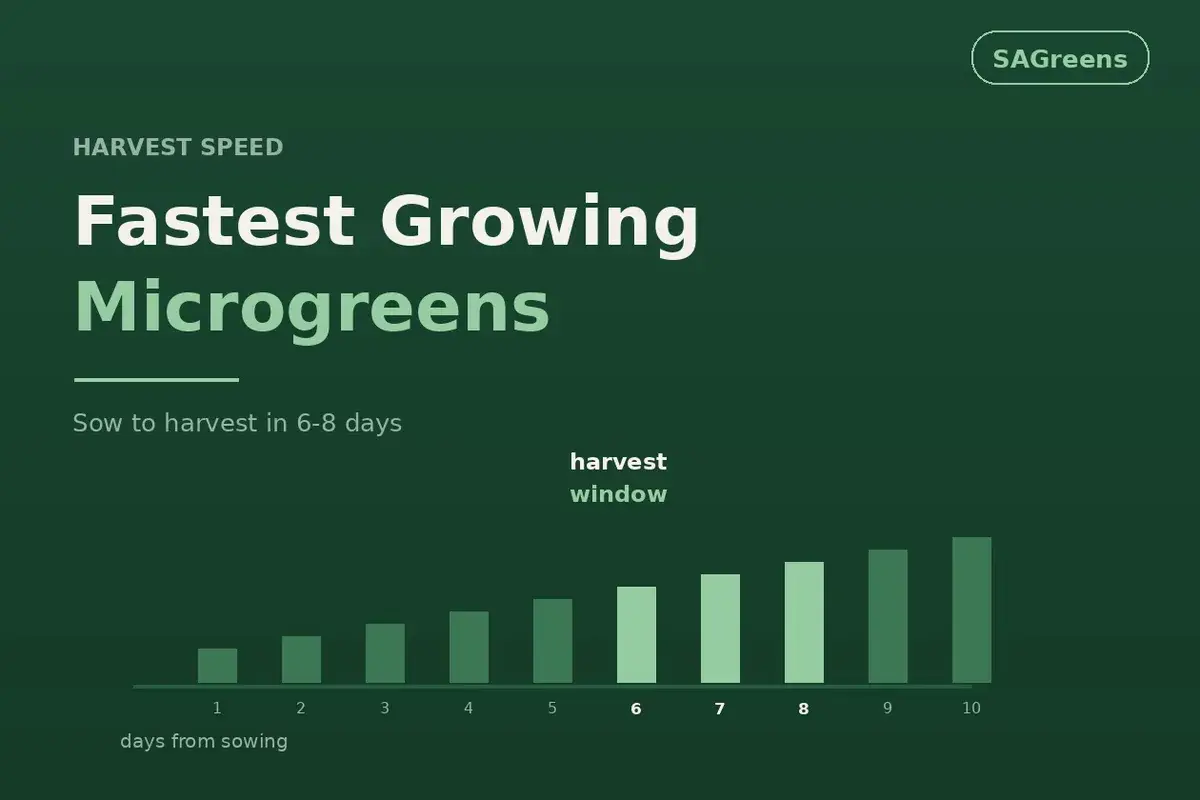
Speed is the most underrated variable in microgreen growing. Not because fast crops are better — they are not, particularly — but because harvest time decides whether you can actually keep greens on the table every week without the routine collapsing.
Key Takeaways: Radish and mustard are the fastest microgreens at 6-8 days from sowing, needing no pre-soaking. White radish matches them. Broccoli, kale and cabbage follow at 8-10 days. Coriander and beetroot are slowest at 12-18 days. Two trays of a 7-day crop, sown four days apart, produce a continuous harvest indefinitely. Speed costs you nothing in nutrition but does cost yield per tray.
This guide is about using speed rather than admiring it: which crops finish fastest, why, and how to build a rolling schedule that keeps a household or a restaurant supplied.
The Fastest Microgreens, Ranked
| Variety | Sow to harvest | Pre-soak | Blackout |
|---|---|---|---|
| Radish (China Rose) | 6-8 days | None | 3 days |
| Mustard | 6-8 days | None | 3 days |
| White radish (mooli) | 6-8 days | None | 3 days |
| Chinese pink radish | 8-10 days | None | 3-4 days |
| Sunflower | 7-10 days | 8-12 h | 3 days |
| Purple sango radish | 7-10 days | None | 3-4 days |
| Broccoli | 8-12 days | None | 3-4 days |
| Kale | 8-10 days | None | 3-4 days |
| Cabbage | 8-10 days | None | 3-4 days |
| Fenugreek (methi) | 8-10 days | 6-8 h | 3-4 days |
| Wheatgrass | 8-12 days | 8-12 h | 3 days |
| Pea shoots | 10-14 days | 8-12 h | 4 days |
| Swiss chard | 10-14 days | 8-12 h | 4-5 days |
| Spinach (palak) | 10-14 days | 6-8 h | 4-5 days |
| Beetroot | 12-18 days | 6-8 h | 5 days |
| Coriander (dhania) | 12-18 days | 12 h + | 5-7 days |
The 6-8 day tier is entirely brassica, and entirely no-soak. That is not a coincidence.
Seeds for that tier: organic radish seeds at ₹120/100g, organic mustard seeds at ₹124/100g, and organic white radish seeds at ₹89/100g. Just outside it, organic sunflower seeds at ₹124/100g give the highest yield per day of tray occupancy.
Why Some Seeds Are So Much Faster
Three factors decide harvest speed, and understanding them lets you predict where an unfamiliar variety will land.
Seed size. Small seeds hydrate fully within hours of contact with moist medium. Large seeds need soaking simply to take on enough water, which adds 8-12 hours before sowing even starts. Radish and mustard are small; pea and sunflower are not.
Energy reserves. A microgreen lives on its own cotyledon reserves until harvest. Small-seeded brassicas carry just enough to reach cotyledon stage quickly and then stall, which suits microgreen growing precisely. Large-seeded crops like pea carry more, grow larger, and take longer to get there.
Dormancy and seed coat. Coriander is the outlier in every microgreen range. Its seed is actually two seeds fused inside a hard shell, which is why it takes 12-18 days and frustrates beginners who assume the tray has failed by day four.
The reliable rule: small no-soak brassica seed is fast, large soaked seed is slow, and hard-shelled aromatics are slowest. If you can predict which category a new variety falls into, you can predict its harvest window before you sow it.
Succession Sowing: The Actual Point of Fast Crops
A single tray gives you one harvest and then a gap. That gap is why most people abandon microgreen growing after a month — not difficulty, just the discontinuity.
Fast crops solve it because the cycle is short enough to overlap.
Two trays, one continuous supply
Sow tray A on day 0. Sow tray B on day 4. Tray A harvests around day 7; re-sow it immediately. Tray B harvests around day 11; re-sow it. From then on you cut something every three or four days, indefinitely, from two trays and about ten minutes of work a week.
| Day | Tray A | Tray B |
|---|---|---|
| 0 | Sow | — |
| 4 | Blackout ends | Sow |
| 7 | Harvest, re-sow | Blackout ends |
| 11 | Blackout ends | Harvest, re-sow |
| 14 | Harvest, re-sow | Blackout ends |
This only works with the 6-8 day tier. Attempt it with coriander at 12-18 days and you need four or five trays running to achieve the same continuity, which is why slow crops suit occasional growing rather than routine supply.
Scaling for restaurants
The same logic scales. A kitchen needing 250g twice a week runs four trays of a 7-day crop on a two-day stagger. Our microgreen farming cost and profit guide covers the economics at commercial volume.
Speed Versus Yield: The Trade You Are Making
Fast crops are not free. They yield less per tray than slower ones, because there is less time to build biomass.
| Crop | Days | Yield per tray | Grams per day |
|---|---|---|---|
| Radish | 7 | 180-250g | About 31 |
| Mustard | 7 | 170-230g | About 29 |
| Sunflower | 9 | 250-350g | About 33 |
| Pea shoots | 12 | 200-300g plus regrowth | About 21 plus |
| Coriander | 15 | 120-180g | About 10 |
Read the last column rather than the middle one. Radish and sunflower produce roughly three times more per day of tray occupancy than coriander does. If your constraint is space rather than time — a single windowsill, a small balcony — fast crops are not merely convenient, they are substantially more productive.
Pea shoots complicate this pleasantly, because they regrow. A 12-day first harvest followed by two more cuts changes the arithmetic considerably. Our pea shoots guide covers the regrowth schedule.
Does Growing Fast Cost Nutrition?
No, and this is worth stating plainly because the assumption is common.
Nutrient density in microgreens is a function of the growth stage at harvest, not elapsed days. All of these crops are cut at the cotyledon stage, when nutrient concentration per gram is at its highest. A radish microgreen cut at day 7 and a beetroot microgreen cut at day 15 are both harvested at the same developmental point.
What differs between them is which nutrients they carry — radish leans on vitamin C and glucosinolates, beetroot on betalains — not how much they carry by virtue of speed. Choose on flavour, colour and schedule. Our guide to which microgreens are best compares varieties by purpose.
Speed Across Indian Seasons
Temperature changes these numbers more than most growers expect.
| Season | Effect on a 7-day crop | What to do |
|---|---|---|
| Winter (Oct-Feb) | 8-10 days, slower but best quality | Extend the stagger to 5-6 days |
| Summer (Mar-Jun) | 6-7 days, faster but riskier | Harvest a day early, watch for mould |
| Monsoon (Jun-Sep) | 7-8 days, mould is the constraint | Sow thinner, increase airflow |
Heat accelerates growth up to a point and then damages it. Above roughly 32 degrees, a tray may hit harvestable size a day early but with weaker stems and a higher chance of mould in the canopy. Growers across Pune, Mumbai and Chennai see this every May.
Winter is the opposite: everything runs a day or two slow and comes out visibly better. If you are running a fixed rotation, adjust the stagger by season rather than holding it constant across the year. Our monsoon growing guide covers humidity management in detail.
Seed Quality: All SAGreens microgreen seeds are NPOP-certified organic, untreated and germination tested before dispatch, which matters more for fast crops than slow ones — a 7-day cycle leaves no time to compensate for weak seed. Radish is ₹120 per 100g, mustard ₹124, and the range starts at ₹50. Delivery charged at checkout, by city and weight. Browse microgreen seeds or contact us for bulk rates.
Getting a 6-Day Harvest Rather Than 8
Within the fast tier, four things decide whether you cut on day six or day eight.
Temperature. 24-28 degrees is the sweet spot. Below 20 adds a day or two.
Uncovering on time. Blackout that runs a day long produces pale, leggy stems that then need extra light-phase time to recover. Lift the cover when stems press against it, usually day three.
Light quality. Four to six hours of bright indirect light after blackout. Dim conditions stretch the cycle and weaken the crop.
Seed freshness. Fresh seed germinates within 24 hours; two-year-old seed may take 36-48 and arrives at harvest a day or two behind. Our seed storage guide covers keeping seed viable in Indian humidity.
When Not to Choose the Fastest Crop
Fast is not always right, and it is worth being clear about when to ignore this guide.
Choose slower crops when flavour is the point. Organic coriander seeds at 15 days deliver something no 7-day brassica can, and for Indian cooking that is often worth the wait.
Choose slower crops when colour matters. Purple sango radish seeds and beetroot develop their pigment over a longer light phase; rushing them produces pale, disappointing trays.
Choose pea shoot seeds when total yield per sowing matters more than turnaround, because regrowth beats speed over a three-week window.
And choose whatever your household actually eats. A fast crop nobody likes is a slower route to giving up than a slow crop everyone wants.
A Worked Rotation for an Indian Household
Numbers in a table are easy to nod at and hard to act on, so here is a rotation that genuinely works in a Pune or Mumbai kitchen, using two trays and about ten minutes a week.
Sunday. Sow tray A with radish, 10g on levelled cocopeat, no soaking. Cover and set aside.
Wednesday. Lift tray A's cover — the stems should be pressing against it. Move it to a bright windowsill and switch to bottom watering. Sow tray B with mustard the same evening.
Sunday. Cut tray A. You have 180-250g of radish microgreens, enough for a week of finishing dal, chaat and sandwiches. Compost the root mat and re-sow tray A immediately.
Wednesday. Uncover tray B, cut nothing, sow nothing. Tray A is in blackout.
Sunday. Cut tray B. Re-sow it.
From here the pattern repeats indefinitely. You cut roughly every four days, alternating between two flavours, and the only recurring decisions are what to sow and when to water.
The reason this works with fast crops and not slow ones is arithmetic rather than skill. A seven-day cycle divides neatly into a weekly rhythm. A fifteen-day coriander cycle does not, which is why coriander suits deliberate one-off growing rather than routine supply.
Adapting the Rotation
If you eat more than two trays a week, add tray C on a two-day offset rather than making trays bigger. Three small trays harvested often produce better quality than two large ones cut late.
If you travel, sow nothing in the week before you leave and let the rotation lapse. Unlike a garden, microgreens carry no penalty for stopping — start again the day you return and you are back in rhythm within a week.
If quality drops in May, shorten the light phase rather than the whole cycle. Heat pushes growth faster than the stems can thicken, so harvesting on day six with good colour beats day seven with collapse.
If you want colour as well as volume, run one tray on radish or mustard for eating and give the second to purple sango. It is slower at 7-10 days and far more expensive per gram, but it does not need to keep pace — it is the garnish tray, not the staple.
What Slows a Fast Crop Down
When a 7-day crop takes 10, the cause is nearly always one of four things, in this order of frequency.
The room is too cold. Below 20 degrees Celsius every stage stretches. In a Delhi or Pune January this is normal and not a problem, but it does mean adjusting the stagger rather than assuming something has gone wrong.
The blackout ran long. Stems that spent an extra day in the dark come out pale and need light-phase time to recover colour and strength. Uncover when they press against the cover, not on a fixed date.
The light is too dim. Four to six hours of bright indirect light is the requirement. A north-facing room in monsoon may not supply it, and the crop stretches instead of thickening.
The seed is old. Two-year-old seed germinates a day or more behind fresh seed and arrives at harvest correspondingly late, usually thinner as well.
None of these are technique failures exactly. They are conditions worth recognising, because the fix for each is different and guessing wastes another cycle.
Turns Per Month: Why Speed Matters Commercially
For anyone growing to sell, harvest speed is not a convenience — it is the main lever on how much a fixed amount of space earns.
A tray occupied for seven days turns over roughly four times a month. The same tray growing coriander turns over twice. On identical shelf space, the fast crop produces about double the number of harvests.
| Crop | Days | Turns per month | Yield per tray | Monthly yield per tray slot |
|---|---|---|---|---|
| Radish | 7 | 4.3 | 200g | About 860g |
| Mustard | 7 | 4.3 | 190g | About 815g |
| Sunflower | 9 | 3.3 | 300g | About 990g |
| Broccoli | 10 | 3.0 | 200g | About 600g |
| Coriander | 15 | 2.0 | 150g | About 300g |
Sunflower comes out ahead despite not being the fastest, because its yield per tray is high enough to offset two extra days. Coriander produces less than a third of what radish does from the same slot over a month.
This does not mean growing only radish. Restaurants buy variety, and coriander sells at a premium precisely because fewer growers bother with it. But it does mean pricing slow crops to reflect the space they occupy rather than treating all trays as equivalent.
Our bulk microgreen seeds guide covers seed costs at volume, and the farming cost and profit guide works through the wider economics.
Fast Crops and Indian Kitchen Habits
There is a practical reason the 6-8 day tier suits Indian households specifically.
Indian cooking uses fresh green garnish constantly — dhania on almost everything, curry leaves, spring onion. Microgreens slot into that habit rather than asking for a new one, which is why the crops that behave most like a herb you top a dish with tend to get eaten rather than admired.
Radish and mustard both do this well. They are sharp enough to register against spiced food, they need no preparation beyond cutting, and at 6-8 days they are available often enough to become routine rather than occasional.
Slower crops break the habit. A coriander tray that arrives once a fortnight does not change how anyone cooks. A radish tray that yields every four days does.
That is the real argument for speed, and it has nothing to do with impatience.
Frequently Asked Questions
What is the fastest growing microgreen?
Radish and mustard, both harvesting 6-8 days from sowing. Neither needs pre-soaking, both germinate within 24 hours, and both tolerate beginner mistakes. White radish matches them at 6-8 days with a milder flavour.
Can any microgreen grow in less than 6 days?
Not reliably as a microgreen. Radish and mustard can occasionally be cut at day five in warm conditions, but the stems are short and the yield noticeably lower. Anything harvested earlier than that is closer to a sprout than a microgreen, and sprouts carry a different food-safety profile.
Why is coriander so much slower than radish?
Coriander seed is actually two seeds fused inside a hard shell, which must break down before germination begins. That alone adds several days. It needs 12 hours or more of soaking, a longer blackout, and 12-18 days in total. Beginners often discard coriander trays that were growing normally.
How do I get microgreens continuously rather than all at once?
Stagger sowings. With a 7-day crop, sow a second tray four days after the first. Harvest and immediately re-sow each tray as it finishes, and you will cut something every three or four days indefinitely from two trays. Slower crops need four or five trays to achieve the same continuity.
Are fast growing microgreens less nutritious?
No. Nutrient density depends on harvesting at the cotyledon stage, not on how many days that took. A radish microgreen at day 7 and a beetroot microgreen at day 15 are cut at the same developmental point. What differs is which nutrients each carries, not the amount by virtue of speed.
Which fast microgreens need no soaking?
All the 6-8 day varieties: radish, mustard, white radish, and the other brassicas including broccoli, kale and cabbage a little further out. Small brassica seed hydrates fully from contact with moist medium, and soaking it causes clumping and uneven trays.
Does summer heat make microgreens grow faster in India?
Up to a point. Above roughly 32 degrees Celsius a tray may reach harvestable size a day early, but with weaker stems and higher mould risk in the canopy. Winter growing runs a day or two slower and produces visibly better quality, so most growers get their best trays between October and February.
How many trays do I need for a weekly harvest?
Two trays of a 6-8 day crop, sown four days apart, give a continuous supply with a cut every three to four days. For a fixed weekly harvest of a single crop, one tray re-sown the day you cut is sufficient, though you will have a short gap each cycle.
Which fast microgreen gives the most yield?
Sunflower, at 250-350g per tray in 7-10 days, which is the best yield per day of tray occupancy in the range. Among the true 6-8 day crops, radish leads at 180-250g. Pea shoots produce more in total but take 10-14 days plus regrowth.
Can I grow different speed microgreens in the same tray?
Not sensibly. A tray mixing a 7-day radish with a 15-day coriander means either cutting the coriander far too early or leaving the radish well past its best, where it turns bitter. Use separate trays sown on staggered days instead.
Do fast microgreens store as well as slow ones?
Storage life depends on stem sturdiness rather than growth speed. Sunflower and pea shoots keep 7-10 days refrigerated; radish, mustard and broccoli keep 5-7. Harvest dry, do not wash before storing, and use an airtight container with a paper liner. Our storage guide covers the method.
How long is the blackout phase for fast microgreens?
Three days for radish, mustard and white radish; three to four for broccoli, kale and cabbage. Lift the cover when the stems press against it rather than on a fixed date. A blackout that runs a day long produces pale, leggy stems that then need extra light-phase time to recover, which costs you the speed you were trying to gain.
Can I speed up germination by soaking radish seeds?
No, and it makes things worse. Radish seed is small enough to hydrate fully from contact with moist medium. Soaking causes it to clump, which produces uneven sowing and a patchy tray. Soaking helps only large seed like sunflower, pea and wheat.
Why did my radish take 10 days instead of 7?
Four usual causes, in order: the room was below 20 degrees Celsius, the blackout ran a day long, light after uncovering was too dim, or the seed was old. Each has a different fix, so it is worth identifying which rather than changing everything at once.
What temperature grows microgreens fastest?
Between 24 and 28 degrees Celsius. Below 20 every stage stretches by a day or two. Above 32 a tray may reach harvestable size early but with weaker stems and higher mould risk, so the apparent speed gain is usually a quality loss.
Do fast growing microgreens need less light?
No, they need the same four to six hours of bright indirect light after blackout, just for fewer days. Reducing light to match the shorter cycle produces pale, stretched stems. Light quality is what lets a 7-day crop finish in seven days rather than nine.
Is it worth growing slow microgreens at all?
Yes, for flavour and colour that fast crops cannot produce. Coriander at 15 days and beetroot at 12-18 offer something no brassica does. The honest framing is that slow crops suit deliberate occasional growing, while fast crops suit routine supply.
How soon can I re-sow a tray after harvest?
Immediately, with fresh medium. Do not sow into the spent root mat, which is a mould reservoir and will usually fail. Compost it or work it into balcony pots, wash the tray, and sow the same day if you are running a rotation.
Which microgreens are fastest for restaurant supply?
Radish and mustard on a staggered rotation, with sunflower where volume matters more than turnaround. Four trays of a 7-day crop on a two-day stagger covers a kitchen needing 250g twice weekly. Chefs generally want first-cut material, so plan the rotation around delivery days rather than convenience.
Do fast growing microgreens taste different from slow ones?
Flavour follows the variety, not the speed. Radish is peppery at seven days because radish is peppery, not because it grew quickly. If radish is the crop you settle on, our red radish microgreen seed guide covers sowing density and harvest timing. What does change flavour is harvesting late — once true leaves appear, most brassicas turn sharp and then bitter, which is a timing error rather than a speed effect.
Can I harvest microgreens early if I need them sooner?
You can cut a day early with little loss beyond yield, since the stems are shorter and lighter. Cutting two or more days early gives noticeably less for the same seed, and below about five days you are closer to a sprout than a microgreen, which carries a different food-safety profile.
About SAGreens
SAGreens is a microgreens farm in Keshav Nagar, Mundhwa, Pune, run by Ajay Toradmal, who comes from a three-generation farming family in Maharashtra. We grow microgreens for homes and restaurants across Pune and supply NPOP-certified organic microgreen seeds throughout India.
We run staggered sowings on exactly the pattern described here, because a restaurant expecting delivery twice a week does not accept a gap in the rotation as an explanation.
Related Reading
Fresh Tips & Exclusive Offers
Subscribe for growing tips, seasonal updates, and exclusive offers on fresh organic microgreens in Pune.