Red Radish Microgreen Seeds: How to Grow in India
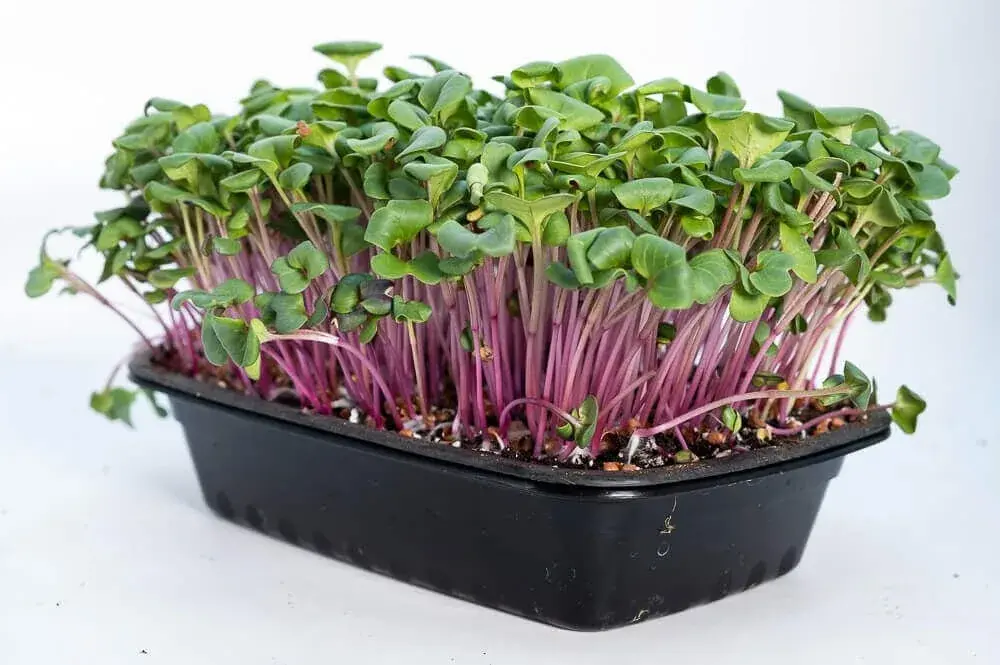
Red Radish Microgreen Seeds: How to Grow Them in India
Red radish is the crop we recommend to every beginner, and the one we still sow most weeks ourselves. It germinates in under two days, needs no soaking, tolerates Indian heat better than almost anything else, and is ready to cut in six to eight days. If your first tray of anything is going to work, make it this one.
Key Takeaways: Red radish microgreen seeds need no pre-soaking, germinate in 24 to 48 hours and harvest in 6 to 8 days. Sow 8 to 12g per 25cm tray. SAGreens sells organic red radish seed at ₹139 per 100g with 90-95% tested germination, which fills roughly 8 to 10 trays. The pink stems develop under light after the blackout, not during it, so uncovering at the right moment is what gives you the colour.
This guide is about the seed rather than the salad: which red radish seed to buy, how much you need, why untreated matters, and the growing method that follows from it. For the crop's nutrition, see our radish microgreens benefits guide, and for how red compares with the other radishes we sell, our radish seed variety comparison.
What red radish microgreen seed actually is
The seed we sell as red radish is China Rose, the variety most commonly grown for microgreens worldwide and the one behind those magenta-pink stems. It is the same species as the mooli in your vegetable basket, Raphanus sativus, selected over generations for stem colour and speed rather than for a large root.
Red radish, China Rose and Rosy radish are the same seed. Sellers use the names interchangeably. What matters is that it is untreated seed sold for eating, not field seed sold for planting out.
Radish seed is small, round, hard and reddish-brown, roughly 2 to 3mm across. Unlike sunflower or pea it has no hull to shed and no dormancy to break, which is why it needs no soaking and why it is so forgiving of a first-time grower's mistakes.
Red radish seed at a glance
| Red radish (China Rose) | |
|---|---|
| Botanical name | Raphanus sativus |
| Seed size | 2–3mm, round |
| Pre-soak | Not needed |
| Germination | 24–48 hours |
| Blackout | 2–3 days |
| Harvest | 6–8 days |
| Seed per 25cm tray | 8–12g |
| Yield per tray | 60–90g |
| Our germination rate | 90–95% |
| Price | ₹139 per 100g |
Choosing red radish seed: what actually matters
This is where most first trays are won or lost, and none of it is about technique.
Untreated, always. Radish seed sold through Indian nurseries and agri-input shops for field planting is routinely dressed with fungicide and dyed a vivid pink, red or blue. The dye exists precisely so nobody mistakes it for food. That seed germinates beautifully and must never be eaten. If the seed in your hand is an unnatural colour, it is not food. Our seed safety guide covers how to tell the difference.
A stated germination rate, recently tested. Radish is one of the highest-germinating crops there is, and anything below 85 per cent means old or badly stored seed. We test each incoming lot on damp tissue before packing rather than repeating a supplier's figure, which is how we can say 90 to 95 per cent rather than a round number.
Seed sold by weight, not by packet. Microgreen sowing is measured in grams per tray, so a packet described only as radish seeds, with no weight on it, is useless for planning. Ours is 100g.
Radish is the cheapest crop per tray of anything we sell, once you account for how little seed it needs. At ₹139 per 100g and 8 to 12g a tray, seed costs roughly ₹11 to ₹17 per tray, and each tray gives 60 to 90g of microgreens.
Order from our organic radish seeds page, or compare it against every variety we stock in the India seed price guide.
How much red radish seed do you need?
A standard 25cm × 25cm tray takes 8 to 12g. Sow at the lower end in the monsoon and the upper end in winter, because density and airflow trade off against each other.
- 100g pack — 8 to 10 trays, roughly two months of weekly growing
- A tray a week — one pack lasts about two months
- Three trays a week — plan on 150g a month, which is where wholesale starts to make sense
Weigh it the first few times rather than eyeballing. Radish is small enough that the difference between 8g and 16g is invisible in the hand and obvious in the tray a week later.
Growing red radish microgreens step by step
What you need
- 8 to 12g red radish seed per tray
- A shallow tray, roughly 25cm × 25cm, with drainage holes
- A second solid tray underneath for bottom watering
- Cocopeat, soaked and squeezed out to damp rather than wet
- A spray bottle
- A flat weight or a second tray for the blackout
The method
- Do not soak. Radish seed absorbs moisture directly from damp cocopeat. Soaking it introduces excess water and is the single most common way people cause mould on a crop that almost never gets it.
- Prepare the medium. Fill the tray with 3 to 4cm of cocopeat, level it, and press it lightly flat. Damp, not soggy — squeezed cocopeat should release a drop or two, not a stream.
- Sow evenly. Scatter the seed across the surface so seeds are close but not stacked. Even coverage matters more than exact quantity; a bare patch and a dense clump in the same tray will grow at different rates.
- Mist and cover. Mist the surface, then cover with an inverted tray. A light weight on top for the first 24 hours gives stronger, straighter stems because the seedlings push against something.
- Blackout 2 to 3 days. Check on day two. When most shoots are 2 to 3cm and pale, they are ready for light.
- Uncover into bright indirect light. This is the moment the crop becomes red radish rather than generic seedlings. The stems colour up over the next 24 to 48 hours as the plant responds to light; keep it covered longer and you get length instead of colour.
- Bottom water from here on. Pour water into the outer tray and let the cocopeat draw it up. Wetting the canopy in Indian humidity is how mould starts.
- Harvest at 6 to 8 days, when the first true leaf is just appearing between the cotyledons. Cut just above the medium with clean scissors.
Uncovering at the right moment is what gives you the colour. Red radish grown too long in blackout is pale and leggy, and it never fully recovers its pink once it has stretched. Two to three days is the window.
The full method for any variety, including equipment and the mistakes we see most, is in our complete guide to growing microgreens at home in India.
Growing red radish through the Indian year
Radish is the most climate-tolerant crop we sell, which is why it is the beginner's variety, but the method still shifts across the year.
Winter, November to February. The best season. Germination is even, growth is steady, colour develops well in the lower light. Sow at the upper end of the density range; trays may take the full eight days.
Summer, March to June. Radish handles heat better than almost anything else, and still produces above 32°C where basil and coriander stall. Water in the early morning, keep trays out of direct afternoon sun, and expect to harvest a day early at a slightly shorter stem.
Monsoon, July to September. The season that costs people trays. Reduce sowing density by 10 to 15 per cent so air moves through the canopy, water less often and by weight rather than habit, and run a fan near the trays for a few hours a day. Radish's speed is its own defence here — it is out of the tray before mould gets established, which is exactly why we recommend it in July. Our monsoon growing guide covers the tactics in detail.
Red radish compared with the other radishes we sell
All four are radish and all four grow the same way. What differs is colour, sharpness and price.
| Variety | Stem colour | Flavour | Days | Price |
|---|---|---|---|---|
| Red radish (China Rose) | Pink to magenta | Peppery, balanced | 6–8 | ₹139 / 100g |
| White radish (mooli) | White | Mildest of the four | 6–8 | ₹89 / 100g |
| Chinese pink radish | Soft pink | Sharper than red | 6–8 | ₹178 / 100g |
| Purple sango radish | Deep purple | Strongest, most peppery | 6–8 | ₹160 / 25g |
Choose red radish if you want one radish and no decisions. It sits in the middle on every axis: colourful without being showy, peppery without being harsh, and the best value per tray of the four.
Choose white radish if the peppery bite is too much, or you are feeding children. At ₹89 it is also the cheapest, and our white radish growing guide covers it in full.
Choose purple sango only if colour is the point — for a restaurant plate rather than a household salad. Our purple sango guide explains why it costs what it does.
What goes wrong, and what causes it
| What you see | Cause | Fix |
|---|---|---|
| Pale stems, no pink | Blackout ran too long | Uncover at day 2–3, not 4 |
| Leggy and floppy | Not enough light after uncovering | Brighter indirect light, no direct sun |
| White fuzz at the base | Wet canopy, poor airflow | Bottom water only; run a fan |
| Patchy germination | Old seed, or sown unevenly | Test 20 seeds on tissue before blaming method |
| Bitter, harsh flavour | Harvested too late | Cut at first true leaf, day 6–8 |
| Seeds washed into clumps | Watered from above at the start | Mist gently until the roots take hold |
White fuzz at the base is usually root hair, not mould. Radish produces fine white root hairs that look alarming to a first-time grower. Root hair is fluffy, sits at the root line and disappears when misted; mould is grey-green, smells musty and spreads across the surface.
Most radish failures come down to moisture and light timing rather than the seed, which is true of almost everything we grow. Our germination troubleshooting guide works through the rest.
Using red radish microgreens in Indian food
The peppery bite means red radish works anywhere you would use raw onion or a squeeze of lemon for sharpness.
- Scattered over dal or rajma just before serving, where the vitamin C also helps iron absorption from the pulses
- Folded into chaat and bhel in place of some of the onion
- On top of poha or upma, added off the heat
- In a sandwich or wrap with cucumber and mint
- Blended into a green chutney for a peppery edge
Add them off the heat. Radish microgreens wilt and lose their bite within seconds of hitting a hot pan, and the colour goes first.
Red radish seed for commercial growers
Red radish is the highest-turnover line in most Indian microgreen operations, and the arithmetic explains why.
Seed cost per tray is the lowest of any variety we sell. At ₹139 per 100g and 8 to 12g a tray, seed runs ₹11 to ₹17 per tray against ₹25 to ₹37 for sunflower, which needs 20 to 30g. Radish also turns over fastest at 6 to 8 days, so a single tray position produces four crops a month where pea shoots produce two.
Volume planning. A grower running 50 trays a week of red radish uses roughly 2 to 2.5kg of seed a month. That sits comfortably in the 1kg wholesale tier, where rates run 40 to 60 per cent below retail. Send us your tray count rather than a weight and we will work the schedule back from it.
Why growers keep it as the base crop. It is forgiving of an inexperienced hand on the watering, it survives a Mumbai July better than anything else in the catalogue, and a failed tray costs under ₹20 of seed. Most commercial rotations we supply run radish continuously and add premium varieties around it.
Our seed supplier page covers wholesale terms, GST invoicing and lot consistency, and the bulk seed guide sets out what to ask any supplier before committing to volume.
Frequently Asked Questions
Do red radish seeds need soaking before sowing?
No. Red radish seed absorbs moisture directly from damp cocopeat and germinates in 24 to 48 hours without any soak. Soaking adds excess water and is a common cause of mould on a crop that otherwise rarely gets it.
How much red radish seed do I need per tray?
8 to 12g for a standard 25cm × 25cm tray. Use the lower end during the monsoon so air can move through the canopy, and the upper end in winter. A 100g pack covers roughly 8 to 10 trays.
How long do red radish microgreens take to grow?
Six to eight days from sowing to harvest. Germination is visible in 24 to 48 hours, blackout runs 2 to 3 days, and the crop is ready when the first true leaf appears between the cotyledons.
Why are my red radish microgreens not turning pink?
Almost always because the blackout ran too long. The stems colour up in response to light after uncovering, not during the dark phase. Uncover at day 2 to 3 when the shoots are 2 to 3cm; a tray left covered to day 4 or 5 stretches instead, and pale stretched stems never fully colour afterwards.
What is the difference between red radish and China Rose seed?
They are the same thing. China Rose is the variety name for the red radish most commonly grown as a microgreen; sellers use both names interchangeably. What matters is that the seed is untreated and food-grade rather than dressed for field planting.
How much do red radish microgreen seeds cost in India?
SAGreens sells organic red radish seed at ₹139 per 100g, which fills roughly 8 to 10 trays and works out at about ₹11 to ₹17 of seed per tray. Delivery is charged at checkout and varies by city and weight.
Can I use ordinary radish seeds from a nursery?
Only if they are untreated. Most radish seed sold through Indian nurseries is field-grade stock dressed with fungicide and dyed pink, red or blue so it cannot be mistaken for food. That seed grows perfectly well and must never be eaten. If the seed is an unnatural colour, do not sprout or grow it for eating.
What germination rate should red radish seed have?
90 to 95 per cent, and radish sits at the top of that range among microgreen crops. Anything below 85 per cent points to old or poorly stored seed. Test twenty seeds on damp tissue for 48 hours before committing a whole tray to a lot you are unsure about.
Do red radish microgreens regrow after cutting?
No. Radish is cut once and the tray is composted and re-sown. Any regrowth is thin, slow and bitter compared with the first cut. Because the cycle is only 6 to 8 days, re-sowing is faster than waiting anyway.
Can red radish microgreens grow in Indian summer heat?
Yes, better than almost any other variety. Radish continues producing above 32°C where coriander and basil stall. Water early in the morning, keep trays out of direct afternoon sun, and expect to harvest a day early with a slightly shorter stem.
Is the white fuzz on my radish tray mould?
Usually it is root hair, not mould. Radish produces fine white hairs at the root line that alarm first-time growers. Root hair is fluffy, sits where the roots meet the medium, and disappears when misted. Mould is grey-green, smells musty and spreads across the surface in patches.
How long does red radish seed stay viable?
Two to three years stored airtight, cool and dark. Radish is among the longer-lived microgreen seeds. In the Pune and Mumbai monsoon, add a silica gel sachet to the container — ambient humidity does more damage than temperature. Our seed storage guide covers viability by variety.
Which is better for beginners, red radish or sunflower?
Red radish, by some distance. It needs no soaking, germinates in under two days, tolerates heat and humidity, and is ready in a week. Sunflower needs an 8 to 12 hour soak, sheds hulls that have to be picked off, and takes longer. Start with radish and add sunflower once the routine is established.
Do you deliver red radish seeds outside Pune?
Yes. Seed ships across India in 3 to 5 days from our Keshav Nagar farm in Mundhwa, and Pune orders are delivered same or next day. Delivery is charged at checkout and varies by city and weight.
Can I grow red radish microgreens without cocopeat?
You can grow them on a damp paper towel or a hemp mat, and for a single tray it works. Cocopeat holds moisture more evenly, which matters in Indian heat where a towel dries out between waterings, and it gives the roots something to anchor into so the crop stands upright. Our cocopeat guide covers preparation and reuse.
Do you offer wholesale rates on red radish seed?
Yes. Wholesale starts at 500g per variety, typically 25 to 45 per cent below retail, and 40 to 60 per cent from 1kg. Red radish is the highest-volume line for most commercial growers because it turns over fastest. Contact us with your monthly tray count.
Ordering red radish seed from SAGreens
Our red radish seed is untreated, undyed and non-GMO, germination tested at 90 to 95 per cent before packing, and sold in 100g packs at ₹139. It is the variety we sow most often ourselves, and the one we hand to anyone growing their first tray.
For the rest of the range, the full microgreen seed catalogue lists every variety with current pricing, and our seed supplier page covers wholesale for commercial growers. If a tray is behaving oddly, send us a photo through our contact page and we will tell you what we see.
About the author. SAGreens is run by Ajay Toradmal in Keshav Nagar, Mundhwa, Pune, from a three-generation farming family. The sowing densities, blackout timings and failure modes in this guide come from trays grown at our own farm, not from other people's blog posts.
More Microgreens Tips & Recipes
Buying Microgreen Seeds Online: Safety & Quality Checks
Learn what to check before buying microgreen seeds online in India — untreated seed, germination testing, NPOP certification and pricing.
Microgreen Seed Types in India: 15+ Varieties and Prices
Every microgreen seed variety grown in India side by side — germination, days to harvest, flavour and price per 100g, from ₹50 to ₹360. Where to start.
Fresh Tips & Exclusive Offers
Subscribe for growing tips, seasonal updates, and exclusive offers on fresh organic microgreens in Pune.