Best Microgreen Seeds for Beginners India 2026
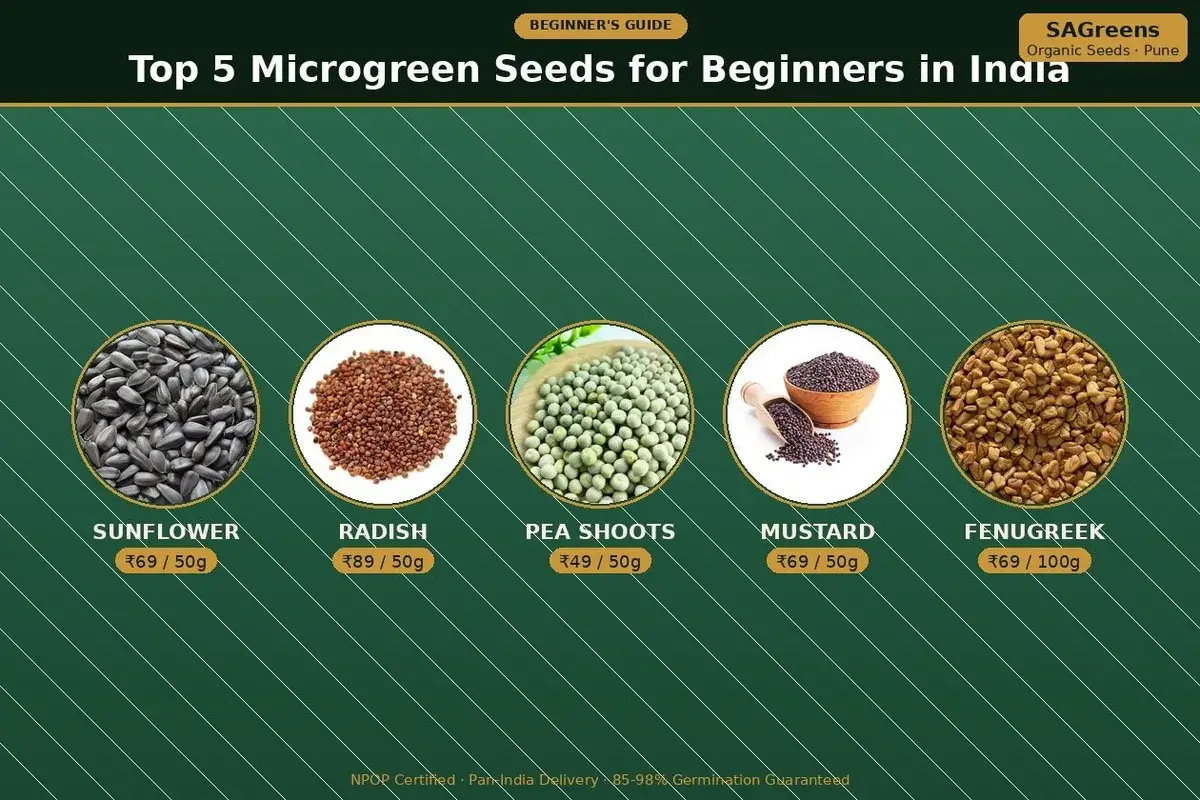
Key Takeaways: The five best microgreen seeds for Indian beginners are sunflower, radish, mustard, fenugreek, and pea shoot. All germinate reliably in 24–72 hours at Indian temperatures. Sunflower and radish are the most forgiving of beginner mistakes. Avoid basil and coriander as your first grow — both have slow, uneven germination that discourages new growers. NPOP-certified organic seeds from SAGreens start at ₹49 per pack with pan-India delivery.
Starting your first microgreens grow in India can feel overwhelming — dozens of varieties, conflicting advice, and the very real risk of spending money on seeds that fail to germinate. This guide cuts through the noise. After years of supplying home growers across India with organic microgreen seeds, the SAGreens team — a three-generation farming family based in Keshav Nagar, Pune — knows exactly which varieties succeed on the first try and which ones are better left to experienced growers.
The seeds recommended here are forgiving, fast, and satisfying. They work in Indian kitchens and on Indian balconies — in Mumbai apartments, Pune terraces, Bangalore south-facing windows, and Chennai covered balconies. They handle Indian humidity, Indian water, and Indian ambient temperatures without demanding expensive equipment or specialised growing knowledge. Browse our complete organic seed range to get started.
Why Seed Choice Matters for Beginners
Your first microgreens grow teaches you everything: how to read germination, how wet is too wet, how dark is dark enough, and how to tell a healthy seedling from one that is about to fail. The wrong seed variety makes this learning process painful and discouraging. A seed with slow, patchy germination (like coriander) will make you doubt your technique when the problem is actually the variety. A seed prone to mould in Indian humidity (like basil in the monsoon) will make you think you have failed when experienced growers struggle with the same challenge.
The right first seed variety gives you fast, visible germination — so you know the process is working — and a dense, forgiving canopy that is resilient to the minor watering mistakes every beginner makes. The seeds below are selected specifically for this beginner experience.
The 10 Best Microgreen Seeds for Beginners in India
1. Sunflower — The Best First Microgreen
Sunflower microgreens are the perfect first grow for Indian beginners. Here is why:
Visible germination. Sunflower seeds are large — you can see each individual seed germinate. Within 24–48 hours of sowing, the white root (radicle) emerges visibly from each seed. This immediate feedback tells beginners that their process is working correctly and builds confidence for the rest of the grow.
Forgiving of beginner watering mistakes. Sunflower seedlings tolerate both slight over-watering and under-watering better than most varieties. The large seed reserves give the seedling energy to recover from minor stress.
Fast, impressive results. From sowing to harvest in 7–10 days. The canopy is thick and visually satisfying — a full 6x6-inch tray of sunflower microgreens is genuinely impressive to look at for a first-time grower.
Delicious and universally liked. Nutty, crunchy, and sweet. Sunflower microgreens are loved by children and adults alike. They are also one of the most useful microgreens in Indian cooking — scattered over dal, in poha, on curd rice, or on salads.
Germination rate. 93%+ guaranteed. Nearly every seed germinates.
Growing time in India. 7–10 days.
Soak before sowing. 8–12 hours in room-temperature water. Drain and rinse before sowing.
Organic Sunflower Seeds (100g) – ₹124
2. Radish — Fastest Results, Highest Mould Resistance
Radish microgreens are India's most beginner-friendly variety for one simple reason: they are the fastest common microgreen at 6–8 days. Speed means the seedling canopy establishes and covers the growing medium before mould can develop — the primary challenge for beginners in India's humid climate.
Best for: Mumbai, Chennai, Kerala, and any coastal or high-humidity Indian location where mould is a concern for beginners.
Flavour. Peppery, with mild heat. Works in salads, dal garnish, rice bowls, and as a contrast element in rich Indian curries.
Germination rate. 93%+ guaranteed.
Growing time in India. 6–8 days — the fastest standard microgreen variety.
Soak before sowing. 4–6 hours.
Organic Radish Seeds (100g) – ₹120
3. Mustard — 24-Hour Germination, Zero Fuss
Mustard microgreens germinate in 24 hours under Indian temperatures — the fastest germination of any common variety. For beginners who have never grown microgreens before, seeing germination happen overnight creates immediate confidence and excitement.
Best for: First-time growers who want immediate visible results and confirmation that the process is working.
Flavour. Sharp, peppery, with genuine mustard heat. Works in kanji, dal, rice preparations, and chutneys.
Germination rate. 90%+ guaranteed.
Growing time in India. 6–8 days.
No soaking required. The seeds are small enough that soaking is not beneficial — sow directly onto moist growing medium.
Organic Mustard Seeds (100g) – ₹124
4. Fenugreek (Methi) — Familiar Flavour, Reliable Growth
Fenugreek is methi in Hindi — one of the most familiar Indian kitchen flavours. Growing fenugreek microgreens at home feels less like an experiment and more like an extension of Indian cooking. The flavour is immediately recognisable: warm, mildly bitter, and comforting.
Why fenugreek is ideal for beginners. No blackout phase required. Fenugreek germinates in open light conditions, removing one step from the growing process. The seeds are large and easy to handle. Germination is uniform and reliable across Indian climates.
Best uses. Kanji, methi paratha, sambar, dal, morning health shots with warm water.
Germination rate. 85%+ guaranteed.
Growing time in India. 8–10 days.
Soak before sowing. 6–8 hours.
Organic Fenugreek Seeds (100g) – ₹69
5. Pea Shoot — Sweet, Easy, and Family-Friendly
Pea shoot microgreens are the sweetest and most universally liked microgreens available. They work exceptionally well for beginners because their mild flavour means every family member tends to enjoy them — removing the "nobody will eat this" concern that can discourage new growers.
Best Indian seasons. October–February when temperatures are cooler. In north India (Delhi, Chandigarh, Jaipur), pea shoots are excellent from October through March. In south India (Chennai, Bangalore, Kerala), October–January works best.
Flavour. Fresh, sweet pea — clean and mild.
Germination rate. 90%+ guaranteed.
Growing time in India. 10–14 days.
Soak before sowing. 8–12 hours.
Organic Pea Shoot Seeds (100g) – ₹88
6. Wheatgrass — Health-First Beginners
Wheatgrass is India's most popular health microgreen — driven by the wellness movement, Ayurvedic integration, and the popularity of wheatgrass juice across urban India. If your primary reason for growing microgreens is health and nutrition rather than cooking, wheatgrass is your ideal first grow. For a sweeter, denser grass from an ancient grain, our Khapli wheat guide covers the emmer alternative.
Flavour. Strongly green and grassy. Consumed as 30ml juice shots, not eaten raw in food.
Germination rate. 90%+ guaranteed.
Growing time in India. 8–12 days.
Soak before sowing. 8–12 hours.
Organic Wheatgrass Seeds (100g) – ₹50
7. Broccoli — Nutritional Powerhouse for Health-Motivated Beginners
Broccoli microgreens are the most nutritionally researched microgreen variety. If you are growing microgreens primarily for health reasons — and you have heard about sulforaphane — broccoli is the variety you want to grow.
The sulforaphane advantage. Broccoli microgreens contain sulforaphane at concentrations up to 100 times higher than mature broccoli. Sulforaphane activates the body's Nrf2 pathway, upregulating antioxidant and detoxification genes.
Beginner note. Broccoli seeds are very small. Use slightly less seed than you think you need and spread carefully to avoid clumping.
Flavour. Mild, slightly cabbage-like. Works in smoothies, salads, and as a garnish.
Germination rate. 90%+ guaranteed.
Growing time in India. 7–10 days.
No soaking required.
Organic Broccoli Seeds (20g) – ₹200
8. Kohlrabi — Mild and Versatile
Kohlrabi microgreens (khol khol in Marathi) have a mild, slightly sweet brassica flavour similar to broccoli but gentler. They are an excellent gateway variety for beginners who find radish and mustard too spicy. The pack price is the highest on our list, though our kohlrabi microgreen seed guide explains why the cost per tray is not.
Flavour. Mild, sweet, slightly broccoli-like. Works in salads, dal garnish, and smoothies.
Growing time in India. 8–12 days.
Organic Kohlrabi Seeds (100g) – ₹360
9. Spinach — Indian Kitchen Staple as Microgreen
Palak (spinach) microgreens bring a familiar Indian kitchen flavour in a concentrated seedling form. Rich in iron, folate, and vitamin K — nutrients that are deeply valued in Indian nutrition culture. It is also the fussiest seed on this list, at 85 per cent germination and a short shelf life, so read our spinach microgreen seed guide before ordering a pack.
Flavour. Mild spinach — clean and earthy. Works in smoothies, juices, and as a garnish.
Growing time in India. 8–12 days.
Organic Spinach Seeds (100g) – ₹106
10. Coriander — For Patient Beginners Who Love Indian Flavour
Coriander (kothamalli / dhania) microgreens are the most intensely flavoured variety available — more concentrated than mature coriander leaves. They are not for your very first grow (germination is slower and less uniform than the varieties above), but once you have completed 2–3 successful grows, coriander is a worthy addition.
Beginner note. Lightly crush the round seed hull before sowing and pre-soak for 12 hours. This improves germination from 60% to 85%+.
Flavour. Intense coriander aroma. Works on every Indian savoury dish where coriander leaves are used.
Growing time in India. 12–18 days.
Organic Coriander Seeds (100g) – ₹124
Seeds to Avoid for Your First Grow
Always confirm your seeds are untreated microgreen seeds — our microgreen seeds vs regular seeds safety guide explains why treated agricultural seeds must never be used for edible growing.
| Variety | Why It Is Difficult for Beginners | Try After |
|---|---|---|
| Basil | Gel-forming seeds need special technique; very slow germination | 5+ grows |
| Coriander | Slow and uneven without seed crushing; 12–18 days | 2–3 grows |
| Swiss Chard | Slow germination; large seed clusters need pre-soaking | 3+ grows |
| Chinese Pink Radish | Similar to standard radish but more expensive; save for when you want colour variety | 2+ grows |
Beginner Rule: Start with one variety: sunflower (forgiving, nutty, 7–10 days — best for most of India), radish (fastest, mould-resistant, 6–8 days — ideal for Mumbai, Kerala, Chennai, and any high-humidity location), or mustard (24-hour germination, 6–8 days — best for instant confidence). Run that variety three times before adding a second. Three clean harvests of one variety teach more than one failed tray of a difficult one.
Beginner Growing Setup for India
You need surprisingly little to start:
- Tray: Two shallow plastic trays of the same size (one for growing, one as water reservoir)
- Growing medium: Coco peat — available at any local nursery for ₹40–80 per brick
- Seeds: NPOP-certified organic seeds — see our microgreen seed catalogue
- Scissors: For harvest
- A spray bottle: Only for moistening the medium before sowing
Total first-grow cost: ₹250–500 depending on variety and tray size.
The Beginner Growing Method (All Indian Climates)
Step 1 – Soak. Soak seeds for the recommended time per variety — our microgreen seeds soaking guide covers exact timings and Indian climate adjustments. Drain and rinse before sowing.
Step 2 – Prepare medium. Add 1.5 inches of damp coco peat to the growing tray. It should clump when squeezed but not drip.
Step 3 – Sow. Spread seeds in an even single layer. Press gently with the back of a second tray.
Step 4 – Blackout. Cover with the inverted second tray. Store in a warm dark location for 2–4 days. Check after 2 days.
Step 5 – Bottom water only. Pour water into the reservoir tray below — never spray the canopy. This prevents mould in India's humidity.
Step 6 – Light. Once seedlings are 2–3 cm tall, move to indirect bright light. A north or east-facing window is ideal.
Step 7 – Harvest. Cut with scissors at the cotyledon stage. Harvest in the morning. Rinse, dry, and refrigerate.
Read our detailed tropical climate growing guide for humidity-specific tips, or contact us with beginner questions.
Setup Cost Summary: First grow in India costs ₹250–500 total — seeds ₹49–200, coco peat ₹40–80 (local nursery), two plastic trays ₹80–150. From the second grow onward, only seeds and fresh coco peat are consumables. A 6x6-inch home tray produces 80–120g of fresh microgreens per harvest. At three grows per month, a standard home setup replaces ₹300–500 of purchased sprouts and microgreens monthly.
Frequently Asked Questions
Which microgreen seed is the absolute easiest for complete beginners?
Sunflower for most of India. Radish if you are in a high-humidity coastal city (Mumbai, Chennai, Kerala) where mould is a concern. Both germinate fast, grow forgivingly, and produce a satisfying first harvest.
Can I start with multiple varieties at once?
Yes, and many beginners find it motivating to run two trays side by side. Start with sunflower and radish — they have similar growing times (7–10 days vs 6–8 days) and you can compare their progress. Avoid running coriander or basil alongside your first grow.
What if my seeds do not germinate?
Check: (1) Are the seeds untreated and food-grade? Treated agricultural seeds often fail to germinate consistently. (2) Did you pre-soak for the recommended time? (3) Is the growing medium too dry or too wet? A fresh restart with verified food-grade seeds almost always resolves germination failures. All SAGreens seeds carry a germination guarantee — contact us if your first grow falls short.
How long do microgreen seeds last once I open the pack?
In an airtight container with a silica gel packet, most seeds remain viable for 12–18 months. Refrigerator storage extends this to 18–24 months. Keep away from heat and moisture — particularly the kitchen area above the stove.
Do I need special soil or grow lights?
No. Coco peat (widely available at local Indian nurseries) is the ideal growing medium and costs ₹40–80 per brick. Natural indirect light from a north or east-facing window is sufficient for all varieties in this guide. No grow lights required.
How much water should I use when bottom watering microgreens?
Pour 100–150ml into the reservoir tray for a 6x6-inch tray; 300–400ml for a 10x20-inch tray. Check the growing medium by lifting the tray — if it feels noticeably heavier than the previous day, skip watering. In Indian summer, bottom-water daily; in cooler months every 2 days is usually sufficient. Never spray the canopy — bottom watering is the primary mould prevention step for Indian humidity.
What is the blackout phase and why is it necessary?
The blackout phase (2–4 days) is the period after sowing when you cover the tray with an inverted second tray and put it in a dark warm location. Darkness promotes uniform germination; the weight presses seeds into the growing medium for better root contact. In India's warmth, blackout is complete in 2–3 days — you will feel the seedlings pushing against the cover. Never skip it for sunflower, radish, and mustard — it is critical for an even canopy.
When exactly should I harvest my microgreens?
Harvest when the first pair of leaves (cotyledons) are fully open and standing upright — not before, not after. At this stage, microgreens are at peak nutritional density and flavour. Do not wait for the second set of true leaves. Typical harvest in India: radish 6–8 days, sunflower 8–10 days, mustard 6–8 days, fenugreek 9–11 days, pea shoot 10–13 days. Always harvest in the morning when seedlings are most crisp.
Why are my microgreens falling over or becoming slimy (damping off)?
Damping off is caused by overwatering and poor airflow. Prevention: switch entirely to bottom watering (never spray), run a ceiling fan at low speed near the tray, reduce sowing density slightly so seedlings have space between them, and keep the blackout phase to 4 days maximum. If damping off occurs, discard the tray — do not try to save it. Restart with fresh coco peat and reduced watering frequency.
Can I grow microgreens in a Mumbai or Pune apartment with no balcony?
Yes. A north or east-facing windowsill providing 4–6 hours of indirect bright light is sufficient. Microgreens are not high-light crops — they do not need direct sunlight. The main indoor challenge in Mumbai and Pune is humidity: ensure airflow near the growing area (open a window or run a fan) to reduce mould risk on the canopy. Use radish or sunflower for your first indoor grow — both are the most mould-resistant varieties.
What is coco peat and where do I buy it in India?
Coco peat (coir peat or coco coir) is made from coconut husk fibre. It is pH-neutral, lightweight, resistant to compaction, and naturally controls moisture — ideal for microgreens. Buy compressed coco peat bricks at any local nursery or garden shop (search "coco peat brick" online). One brick expands to 6–10 litres with water and costs ₹40–80. It is India's most widely available and most suitable microgreen growing medium.
How do I store harvested microgreens to keep them fresh?
Harvest in the morning, rinse under cool water, and dry thoroughly — use a salad spinner or clean kitchen towel. Wet microgreens deteriorate far faster than dry ones. Store in an airtight container lined with a dry paper towel in the refrigerator. In India's ambient temperature, unrefrigerated microgreens wilt within 2–4 hours. Properly dried and refrigerated, most varieties stay fresh for 5–7 days.
Which microgreens work best in Indian cooking?
Fenugreek (methi) in dal, kanji, and sambar. Coriander (dhania) as a garnish on any savoury dish — more intense than fresh coriander leaves. Mustard (rai) for fresh tempering flavour. Radish (mooli) in rice bowls, curd rice, and raita. Sunflower scattered over poha, upma, or salads. Pea shoot in parathas and fusion dishes. Broccoli and sunflower in smoothies. Wheatgrass as 30ml juice shots taken on an empty stomach.
How do I prevent mould on my microgreens in India?
Four rules for Indian climates: (1) Bottom water exclusively — never spray the canopy. (2) Ensure airflow — a ceiling fan at low speed or an open window near the growing area. (3) Sow at 80% of maximum density — less crowding means better air circulation. (4) Limit the blackout phase to 4 days maximum — extended darkness in humid conditions encourages mould at the stem base. Radish and sunflower are the most mould-resistant varieties for the monsoon months.
How many grams of microgreens does one tray produce?
For a standard 6x6-inch home tray: sunflower 80–120g, radish 60–90g, mustard 50–80g, fenugreek 70–100g, pea shoot 90–130g, broccoli 50–75g. For a 10x20-inch professional tray, multiply by approximately 3.5. India's warm conditions typically produce yields at the higher end of these ranges compared to temperate-climate growing guides.
What are the best microgreen seeds for beginners in India?
The three best beginner microgreen seeds in India are: radish (95% germination, harvest in 5–7 days, no pre-soaking), sunflower (90%+ germination, harvest in 7–10 days, sweet nutty flavour), and mustard (90%+ germination, harvest in 6–8 days, no pre-soaking, familiar rai flavour). All three require minimal equipment and have near-zero failure rates.
How much do microgreen seeds cost in India?
Microgreen seed packs from SAGreens start at ₹150–250 per pack, with each pack providing enough seeds for 3–5 full growing trays. Each tray produces 150–350g of fresh microgreens depending on variety. Home growing recovers its seed cost within the first two harvests compared to buying fresh microgreens at market price.
Which microgreen seeds should beginners avoid?
Beginners should avoid coriander (very slow, 10–14 days, inconsistent germination), basil (gel-coated seeds require special technique), and beetroot (low germination, requires precise light management). Start with radish, sunflower, and mustard — these have the highest beginner success rates.
Do microgreen seeds need special equipment?
No. The basic setup is: two shallow trays (one for growing, one as blackout cover), cocopeat (available at garden centres), seeds, and a spray bottle. Total investment is ₹400–600. Optional: a LED grow light for rooms with insufficient natural light.
How long do microgreen seeds stay viable in India?
Most microgreen seeds stay viable for 12–24 months when stored properly in an airtight container in a cool, dry, dark place. India's heat and humidity accelerate seed aging — refrigerator storage extends viability. Always run the 20-seed paper towel germination test if seeds are more than 12 months old.
Where can I buy microgreen seeds in India?
SAGreens offers certified, germination-tested microgreen seeds for all beginner varieties (radish, sunflower, mustard, broccoli, pea shoots, fenugreek) with pan-India delivery in 3–5 days. Order via our website, or WhatsApp +91 9970958370 for personalised seed selection advice.
About SAGreens
SAGreens is Pune's microgreens farm and seed supplier, run by Ajay Toradmal — a three-generation farming family with deep agricultural roots in Maharashtra. We supply NPOP-certified organic microgreen seeds to home growers, restaurants, and wellness professionals across India. Our seed guides are written from direct growing experience across Indian climate zones, not textbooks.
Browse our complete microgreen seeds range, read our microgreen seeds buying guide before purchasing, or contact us for growing support and bulk orders.
More Microgreens Tips & Recipes
Buying Microgreen Seeds Online: Safety & Quality Checks
Learn what to check before buying microgreen seeds online in India — untreated seed, germination testing, NPOP certification and pricing.
What Untreated Seed Means, and How to Spot Treated Seed
Untreated means no fungicide coating. Non-GMO is a separate claim. How to tell them apart on a label, and why dyed seed must never reach an edible tray.
Microgreen Seeds Bangalore: Buy for Home & Commercial Use
Where to buy microgreen seeds in Bangalore. SAGreens supplies Non-GMO, food-grade seeds for home growers and commercial farmers with pan-India delivery.
Fresh Tips & Exclusive Offers
Subscribe for growing tips, seasonal updates, and exclusive offers on fresh organic microgreens in Pune.