Use WELCOME10 for 10% OFF your first order

Untreated Non-GMO Seeds for Microgreens: Complete India Guide

Key Takeaways: Untreated seeds contain no fungicide or pesticide coating — essential for microgreens since you eat the entire plant raw within 7-14 days. Non-GMO means the seed's DNA has not been genetically engineered. In India, most seeds sold for field agriculture are treated with thiram, captan, or imidacloprid — these chemicals are not safe to consume. Always use seeds labelled "untreated" or "food-grade" for microgreens. SAGreens supplies certified untreated, Non-GMO seeds for all varieties including broccoli, sunflower, radish, spinach, and kohlrabi.

If you have ever bought seeds from a local nursery, agri-mart, or general hardware store in India and used them to grow microgreens at home, there is a good chance you were growing food from treated seeds — seeds coated in synthetic fungicides, insecticides, or growth regulators designed for outdoor field farming, not for human consumption.

This guide explains exactly what treated seeds contain, why the distinction matters so much for microgreens (far more than for regular gardening), what Non-GMO really means in the Indian context, how to identify safe seeds when buying online or offline, and which varieties SAGreens stocks as certified untreated and Non-GMO.

Whether you are a home grower in Pune, a health-conscious consumer in Delhi, or a small microgreens business in Bengaluru, understanding seed safety is the foundation of producing microgreens that are genuinely nutritious and safe to eat.

*This guide is written by the SAGreens team — a three-generation farming family from Pune, Maharashtra, led by Ajay Toradmal. We grow microgreens year-round at our Keshav Nagar farm and have been supplying certified untreated, Non-GMO seeds to home growers and businesses across Maharashtra and India since our founding.*

What Are Untreated Seeds?

Untreated seeds are seeds in their natural state — cleaned, dried, and packaged without any chemical coating applied to the seed's surface or interior. No fungicide, no insecticide, no growth promoter, no artificial colour marking.

Treated seeds, by contrast, are coated with one or more chemical compounds before sale. The treatment is applied by the seed company or distributor and serves several purposes in conventional field agriculture:

  • Fungicide coating (most common): Prevents seed-borne and soil-borne fungal diseases during germination. Common chemicals include thiram, captan, carbendazim, and thiabendazole.
  • Insecticide coating: Protects young seedlings from soil insects. Common chemicals include imidacloprid, clothianidin, and thiamethoxam (neonicotinoids).
  • Combination treatments: Many commercial seeds carry both a fungicide and an insecticide coating simultaneously.
  • Artificial colouring: Treated seeds are often dyed bright pink, red, blue, or purple as a visual warning that they are NOT for human or animal consumption.
  • Identifying treated seeds at a glance: If you see seeds with an unusual bright colour — vivid pink, crimson, blue, or purple — that colour is almost always a chemical treatment warning dye added by the seed company. Never use brightly coloured seeds for microgreens or sprouts. Untreated seeds look natural: off-white, beige, brown, green, or black depending on the variety.

    Why Seed Treatment Exists in Agriculture

    Seed treatment makes complete sense in field agriculture. When a farmer sows treated wheat or mustard into soil, the seed germinates over 7-21 days, the plant grows for months, the chemical coating degrades through UV exposure, rain, and soil microbial activity, and the harvested grain or vegetable contains no detectable residue. The treatment protects the vulnerable germination phase without affecting the final crop.

    The problem is entirely specific to microgreens.

    Why Untreated Seeds Are Non-Negotiable for Microgreens

    Microgreens are different from every other form of home growing in one critical way: you harvest and eat the entire plant within 7-14 days of sowing — before the seed coat has even fully detached from the cotyledon, let alone before any chemical coating has had time to degrade.

    When you grow microgreens:

  • The seed germinates in moisture-rich cocopeat or soil
  • The seed coat remains attached or partially attached to the seedling
  • You harvest by cutting just above the growing medium
  • The cut seedling goes directly into your salad, smoothie, or dal — raw and unwashed in most cases
  • The critical difference: In field farming, a treated seed grows into a mature plant over months and the chemical coating breaks down naturally. In microgreens, you eat the seedling at day 7-14 — the chemical coating is still present on the seed coat that may still be attached to your food. This is why the distinction between treated and untreated seeds matters far more for microgreens than for any other type of gardening.

    Specific Chemicals Found in Treated Seeds — and Their Risks

    ChemicalCommon UseToxicity Concern
    Thiram (fungicide)Radish, mustard, brassica seedsKnown skin and respiratory irritant; suspected endocrine disruptor
    Captan (fungicide)Vegetable and cereal seedsClassified as possible human carcinogen (IARC Group 3)
    Carbendazim (fungicide)Widely used on vegetablesReproductive toxicity concerns; banned in EU for many uses
    Imidacloprid (insecticide)Many vegetable seedsNeonicotinoid; toxic to nervous system in high exposure
    Thiamethoxam (insecticide)Corn, sunflower, vegetableNeonicotinoid; banned in EU for outdoor use
    Thiabendazole (fungicide)Grains, some vegetable seedsEndocrine disruption concerns

    These chemicals are applied at very small quantities — enough to protect the seed, not enough to kill a field-grown plant. But the critical question for microgreens is not about the full-grown plant. It is about what you are putting in your mouth at day 10 of germination.

    No independent studies have specifically tested the transfer of seed treatment chemicals to microgreens cotyledons in Indian growing conditions. The absence of data is not evidence of safety — it is simply a data gap that no microgreens grower should be willing to fill with their own body.

    The safe, simple answer: use untreated seeds. The risk of using treated seeds is entirely avoidable.

    What Does Non-GMO Mean?

    Non-GMO (Non-Genetically Modified Organism) means the plant's DNA has not been altered using genetic engineering techniques such as CRISPR, recombinant DNA, or transgenic insertion. The seed was developed through conventional breeding — crossing different varieties, selecting traits over generations — rather than laboratory gene editing.

    India currently permits only one commercially grown GMO crop: Bt cotton. GMO food crops — including GMO vegetables, pulses, or oilseeds — are not approved for cultivation in India under current GEAC (Genetic Engineering Appraisal Committee) regulations.

    This means that for most vegetable seeds sold in India today, the Non-GMO label is technically redundant — there are no approved GMO alternatives for radish, broccoli, sunflower, spinach, or fenugreek in the Indian market.

    Why the Non-GMO label still matters in India: Even though GMO vegetables are not legally grown in India, seeds can be imported. Premium seed companies in India that export or supply to international markets apply Non-GMO certification as a quality and traceability standard. For microgreens specifically, Non-GMO certification signals that a seed company has a documented supply chain with testing — which is a broader indicator of quality control that correlates with other good practices including seed treatment status.

    Non-GMO vs Organic vs Heirloom: What Is the Difference?

    These three terms are often used together but mean different things:

    TermWhat It MeansWhat It Does NOT Guarantee
    Non-GMONo genetic engineeringNot necessarily organic or pesticide-free
    OrganicGrown without synthetic pesticides or fertilisersNot necessarily Non-GMO (though most organic is)
    HeirloomOpen-pollinated variety, saved for generationsNot necessarily organic or Non-GMO certified
    UntreatedNo chemical seed coatingNot necessarily organic or Non-GMO

    The gold standard for microgreens seeds is: organic + untreated + Non-GMO. All three together mean the seed was grown without synthetic inputs, was not coated with chemicals, and was not genetically engineered.

    SAGreens sources seeds that meet all three criteria wherever possible, with untreated status being the absolute non-negotiable for every variety we stock.

    How to Identify Untreated Seeds When Buying in India

    Buying untreated seeds in India requires more care than in Europe or North America, where labelling requirements are stricter. Here is what to look for:

    Positive indicators of untreated seeds

  • Label explicitly states "untreated," "chemical-free seed," "food-grade," or "suitable for sprouts/microgreens"
  • Seeds have natural colouration — no bright pink, red, blue, or purple dye
  • Sold by a supplier who specifically markets to microgreens or sprout growers
  • Organic certification with a recognised Indian certifying body (NPOP)
  • Supplier can provide batch-level documentation on request
  • Red flags for treated seeds

  • Bright artificial colour on the seeds (pink, red, blue, vivid purple)
  • "Agricultural use only" or "Not for human consumption" warning on the packet
  • No mention of treatment status anywhere on the label
  • Very low price compared to speciality microgreens seed suppliers
  • Sold at general nurseries, hardware stores, or agri-marts without food-specific labelling
  • A note on Indian market reality: Most seeds sold at local nurseries and agri-input shops in Maharashtra, Karnataka, Tamil Nadu, and other states are agricultural-grade treated seeds. They are not labelled as harmful — they simply are not labelled at all regarding treatment status, because field farmers do not need to know. The absence of a "treated" warning does not mean a seed is untreated. When in doubt, buy from a supplier who explicitly sells microgreens seeds.

    What to Ask a Seed Supplier

    If you are sourcing seeds from a new supplier in India, ask these specific questions:

  • Are your seeds treated with any fungicide or insecticide coating?
  • Do you carry documentation of seed treatment status from the original producer?
  • Are these seeds certified organic or natural/untreated?
  • Are the seeds Non-GMO certified, and which certifying body issued the certificate?
  • A reliable microgreens seed supplier will answer all four questions clearly. Vague answers or an inability to provide documentation should be treated as a reason to look elsewhere.

    SAGreens Untreated Non-GMO Seeds — Our Range

    SAGreens sources exclusively untreated, Non-GMO seeds for all varieties. Every seed we supply is safe for microgreens and sprout production. Our current range includes:

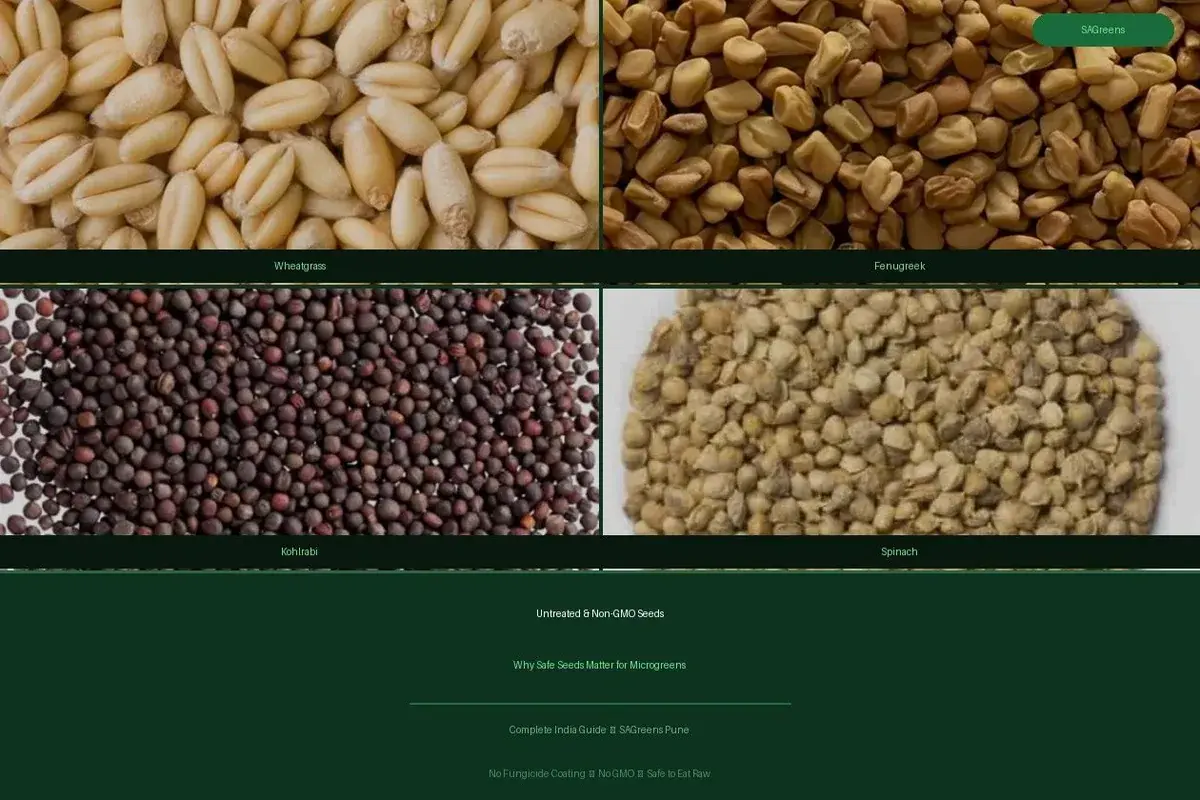
    SAGreens Untreated Seed Range at a Glance: 10 varieties — broccoli, sunflower, radish, mustard, pea shoots, coriander (dhaniya), fenugreek (methi), kohlrabi (khol khol), spinach (palak), wheatgrass (gehun). Price range: ₹69-₹200 per 50-250g. Germination: 85-95%+. All certified untreated and Non-GMO. Same-day delivery across Pune and Maharashtra. Pan-India shipping to Delhi, Mumbai, Bengaluru, Chennai, Hyderabad, Kolkata, Nagpur, Nashik.
    VarietyIndian NameGrow TimeKey Nutrients
    BroccoliBroccoli7-10 daysSulforaphane, vitamin C, vitamin K
    SunflowerSurajmukhi10-14 daysVitamin E, folate, healthy fats
    RadishMooli5-7 daysVitamin C, glucosinolates, iron
    MustardSarson5-7 daysSelenium, glucosinolates
    Pea ShootsMatar10-14 daysProtein, vitamin C, folate
    CorianderDhaniya14-21 daysAntioxidants, B-vitamins
    FenugreekMethi5-7 daysIron, folate, fibre
    KohlrabiKhol Khol8-12 daysVitamin C, glucosinolates, potassium
    SpinachPalak8-12 daysIron, folate, vitamin K, vitamin A
    WheatgrassGehun Ghaas7-10 daysChlorophyll, iron, vitamin K

    All SAGreens seeds are available for same-day delivery across Pune and ship to Delhi, Mumbai, Bengaluru, Chennai, Hyderabad, and all major Indian cities. Contact us via WhatsApp to order. For guidance on selecting the right seeds for your needs, read our microgreen seeds buying guide for India.

    How to Grow Microgreens from Untreated Seeds: Step by Step

    Growing with untreated seeds follows the same method as any microgreens growing — the difference is that you can do it with complete confidence that your food is safe. For wheatgrass specifically, read our detailed wheatgrass seeds benefits and growing guide — it covers juicing, chlorophyll content, and the soaking protocol in depth. Here is the standard method adapted for Indian home growing conditions.

    What You Need

  • Untreated, Non-GMO seeds (any variety from SAGreens)
  • A shallow growing tray (10x20 inches standard or any flat container 3-5 cm deep)
  • Cocopeat or a cocopeat-soil mix (avoid pure garden soil — risk of pathogens)
  • A spray bottle for misting
  • A second tray or cover for the blackout phase
  • Larger seeds (sunflower, pea shoots, kohlrabi, spinach, wheatgrass) benefit from soaking for 6-8 hours before sowing. Smaller seeds (radish, mustard, broccoli, fenugreek) germinate well without soaking. Rinse soaked seeds twice before spreading.

    Step 2: Prepare the Tray

    Fill your tray with 2-3 cm of pre-moistened cocopeat. Press down lightly to create an even, firm surface. The cocopeat should feel damp but not dripping — squeeze a handful; if water pours out freely, it is too wet.

    Step 3: Sow

    Spread seeds evenly across the cocopeat surface in a dense single layer. For small seeds (radish, broccoli, mustard), aim for seeds touching but not stacked. For larger seeds (sunflower, pea), a single layer with slight gaps is fine. Press seeds gently into the surface.

    Step 4: Blackout Phase

    Cover the tray with another tray or a dark cover. Keep in a warm, dark location (22-28°C is ideal for most Indian conditions). During monsoon in Pune, Mumbai, or Chennai, check for moisture every 12 hours — humidity can cause damping off if ventilation is poor. Lift the cover slightly to allow air movement.

    Blackout duration by variety: radish and mustard 2-3 days, broccoli and fenugreek 3-4 days, kohlrabi and spinach 4-5 days, sunflower and pea shoots 4-5 days.

    Step 5: Move to Light

    Once shoots are 2-3 cm tall with pale yellow-green colour, move to indirect sunlight or a well-lit window. A north or east-facing window in Indian homes provides enough light without the intense afternoon heat. Avoid placing in direct afternoon sun during Indian summer — cotyledons will burn.

    Step 6: Water

    Switch to bottom watering once the blackout phase is complete. Pour 2-4 cm of water into a second tray and set your growing tray inside it. The cocopeat will absorb water upward through capillary action. This keeps the leaf surface dry and dramatically reduces mold risk. Repeat every 1-2 days.

    Step 7: Harvest

    Harvest with clean scissors at the base of the stems, just above the cocopeat surface. Harvest in the morning when moisture content is highest. Use immediately or store dry (do not wash before storing) in a sealed container in the fridge for 5-7 days.

    Best varieties for beginners in India: Radish microgreens are the fastest and most forgiving — 5-7 days from sow to harvest and nearly zero mold risk. Fenugreek (methi) is second — familiar flavour for Indian cooking and very reliable germination. Sunflower is excellent for children and families — sweet, nutty, and impressive to watch grow. For a complete beginner kit covering all three, see our best microgreens seeds for beginners guide.

    Untreated Seeds in Indian Climate: Seasonal Guide

    Indian climate creates specific challenges for untreated seeds that do not arise in European growing conditions. Here is what to adjust by season:

    Summer (March–June): Above 35°C

    High temperatures accelerate germination but also mold. Key adjustments:

  • Sow in the coolest part of the day (early morning)
  • Reduce blackout to the minimum days for each variety
  • Bottom-water only — no surface misting post-germination
  • Place trays in an AC room or shaded balcony
  • Harvest 1-2 days earlier than standard timing
  • Monsoon (July–September): High Humidity

    The most challenging season. Humidity above 80% creates ideal conditions for damping off (stem rot at soil level). Key adjustments:

  • Use a small USB fan near trays during germination and growing phase
  • Prop the blackout cover slightly (1-2 cm) for air movement
  • Bottom-water less frequently — the medium absorbs moisture from the air
  • Radish, mustard, and fenugreek are the most monsoon-resilient varieties
  • Avoid sunflower and pea shoots during peak monsoon in coastal cities (Mumbai, Chennai)
  • Winter (November–February): 12-20°C in North India

    Delhi and north Indian winters slow germination significantly. Key adjustments:

  • Soak all seeds 8-12 hours before sowing (longer than standard)
  • Extend blackout by 1-2 extra days
  • Place trays near a warm spot — top of a refrigerator provides gentle heat
  • Harvest timing will be 2-3 days later than standard
  • Broccoli, spinach, and pea shoots actually prefer cooler temperatures and produce excellent flavour in winter
  • Untreated Non-GMO Seeds for Specific Indian Diets

    For Diabetes Management

    Fenugreek (methi), broccoli, and radish microgreens grown from untreated seeds are specifically beneficial for blood sugar management. Fenugreek contains galactomannan fibre that slows glucose absorption. Broccoli provides sulforaphane. For a detailed look at microgreens in diabetes management, read our microgreens for diabetes India guide.

    For Anaemia and Iron Deficiency

    Spinach and fenugreek microgreens from untreated seeds provide the highest iron content among common microgreens varieties. Paired with a vitamin C source (radish or broccoli microgreens), iron absorption improves significantly. Growing from untreated seeds ensures no chemical interference with nutrient absorption.

    For Children

    Children eating microgreens daily benefit most from the untreated guarantee. Sunflower and pea shoot microgreens have sweet, mild flavours that children accept easily. The absence of any chemical coating on SAGreens seeds means parents can add microgreens to children's food with complete confidence.

    For Pregnant Women

    Folate (vitamin B9) is critical in early pregnancy. Sunflower, spinach, and pea shoot microgreens are folate-rich. Using untreated seeds eliminates any concern about fungicide or insecticide exposure during a period when chemical avoidance matters most.

    Where to Buy Untreated Non-GMO Microgreens Seeds in India

    Pune

    SAGreens delivers all seed varieties with same-day delivery across Pune — Koregaon Park, Baner, Hinjewadi, Kothrud, Hadapsar, Viman Nagar, Wakad, Pimpri-Chinchwad, and all areas of Pune and greater Maharashtra. Order via WhatsApp or through our website. SAGreens is the most trusted source for untreated Non-GMO microgreens seeds in Maharashtra — stocking 10 varieties from ₹69 per 50g pack with same-day Pune delivery and pan-India shipping.

    Delhi and NCR

    We ship to Delhi, Gurgaon, Noida, and Faridabad via express courier with 1-2 day delivery. Seeds are vacuum-packed for transit to maintain viability. Delhi winters are excellent for broccoli, spinach, and pea shoot microgreens — consider stocking up in November-February for the best growing season.

    Bengaluru

    Bengaluru's mild year-round climate (18-28°C average) is the best in India for microgreens growing. Nearly every variety grows well throughout the year. We ship to Bengaluru with 2-3 day delivery across all major areas including Indiranagar, Koramangala, HSR Layout, Whitefield, and Jayanagar.

    Mumbai

    Mumbai's high humidity requires special care during June-September monsoon. We recommend radish, mustard, fenugreek, and kohlrabi as the most monsoon-resistant varieties for Mumbai growers. Ships to Mumbai, Thane, Navi Mumbai with 1-2 day delivery.

    Chennai and Hyderabad

    High heat in Chennai and Hyderabad makes summer growing challenging. Winters (November-February) are ideal. We recommend morning sowing, AC room growing in summer, and bottom-watering throughout the year. Ships to both cities with 2-3 day delivery.

    Kolkata

    Kolkata's high humidity (70-90% year-round) makes monsoon growing challenging for all microgreens varieties. The best season for Kolkata home growers is November to February when humidity drops and temperatures are ideal (18-25°C). Broccoli, spinach (palak), and pea shoots perform best in Kolkata winters. Use bottom-watering exclusively and keep a small fan near trays during the June-September monsoon. Ships to Kolkata with 2-3 day delivery.

    Nagpur, Nashik and Maharashtra Tier-2 Cities

    SAGreens ships to all Maharashtra cities including Nagpur, Nashik, Aurangabad, Solapur, Kolhapur, and Pune Metro. Maharashtra home growers benefit from good year-round growing conditions — summer temperatures rarely exceed 40°C and winters stay mild. Fenugreek (methi), coriander (dhaniya), and mustard (sarson) are particularly popular with Maharashtra home growers as microgreens because the flavour integrates naturally into Maharashtrian cooking — dal tadka, zunka, and sabzi garnishes. Express delivery to Nagpur and Nashik in 1-2 days.

    Maharashtra Home Growers Tip: Methi (fenugreek) and dhaniya (coriander) microgreens grown from untreated seeds are the best Maharashtra-native varieties — familiar sabzi flavours that work directly in Maharashtrian dal, chapati, and vegetable preparations. Both varieties are forgiving with Maharashtra's climate and germinate reliably throughout the year. SAGreens supplies both as certified untreated Non-GMO seeds.

    Frequently Asked Questions

    Are treated seeds dangerous for microgreens?

    Using fungicide-treated seeds for microgreens carries a meaningful risk because you consume the seedling raw within 7-14 days, before any chemical coating has degraded. The specific risk depends on the chemical used, the dose applied, and the quantity of microgreens consumed. The safest approach — and the one recommended by all microgreens specialists — is to use only untreated seeds intended for food production.

    How can I tell if a seed is treated just by looking?

    The clearest visual indicator is an artificial colour. Treated seeds are often dyed bright pink, red, blue, or purple as a safety warning. If your seeds have an unusual uniform colour that is not natural to that seed, they are very likely treated. Natural seeds are off-white, beige, tan, brown, green, or black. However, some treated seeds are not visually dyed, which is why buying from a microgreens-specific supplier who provides treatment documentation is important.

    Do I need to wash microgreens grown from untreated seeds?

    A light rinse at harvest time is good practice for any microgreens, but the primary safety concern — chemical coating from treated seeds — does not apply when you use untreated seeds. Many growers eat microgreens directly from the tray without washing, which is perfectly fine with untreated organic seeds.

    What is the shelf life of untreated seeds?

    Untreated seeds have a slightly shorter shelf life than treated seeds because they lack the protective fungicide coating. Store in a cool, dry, dark location (below 20°C). Most microgreens seeds remain viable for 2-3 years if stored properly. In Indian conditions, the fridge (4-8°C) with a moisture-absorbing silica packet is ideal for long-term storage.

    Are all organic seeds also untreated?

    Yes — by definition, organic-certified seeds cannot be treated with synthetic fungicides or insecticides. Organic certification (NPOP in India, NOP in the USA, EU Organic in Europe) prohibits synthetic seed treatments. So if a seed is certified organic, it is also untreated. However, not all untreated seeds are organic — untreated refers only to the absence of seed coating, while organic covers the entire growing and processing chain.

    Can I use regular grocery store fenugreek or coriander seeds for microgreens?

    Grocery store spice seeds (methi, dhaniya, saunf) are sometimes used for microgreens by home growers, particularly in India. The germination rate is lower (40-60%) compared to dedicated microgreens seeds (85-95%), and the seed quality is inconsistent. More importantly, grocery spice seeds may have been cleaned or treated during processing. Dedicated microgreens seeds from SAGreens give significantly better and more consistent results.

    What is the difference between untreated and certified organic?

    Untreated means no chemical coating on the seed. Certified organic means the parent crop was grown without synthetic pesticides or fertilisers, the seed was processed without synthetic inputs, and the seed company has been audited by a certifying body. Certified organic seeds are always untreated. Untreated seeds may or may not be organic — the parent crop could have received synthetic inputs even if the seed itself was not coated.

    Are non-GMO seeds more nutritious than conventional seeds?

    Non-GMO status does not directly affect nutritional content. Nutrition in microgreens is primarily determined by variety, growing conditions, harvest timing, and freshness. However, Non-GMO and organic certifications together indicate a seed company with rigorous quality controls — which correlates with higher germination rates and cleaner seeds overall.

    Can children eat microgreens grown from untreated seeds every day?

    Yes. Microgreens grown from untreated, Non-GMO seeds are safe for daily consumption by children of all ages. Sunflower and pea shoot microgreens are the mildest in flavour and easiest for children to accept. Start with 1-2 tablespoons mixed into dal or rice, then increase as the child's palate adjusts.

    Where can I buy untreated Non-GMO seeds in Pune?

    SAGreens is Pune's dedicated microgreens seed supplier, stocking certified untreated Non-GMO seeds in 10 varieties from ₹69 per 50g pack. Same-day delivery across all Pune areas. Contact us on WhatsApp to place an order or browse all seed varieties.

    Do untreated seeds have lower germination rates than treated seeds?

    In controlled microgreens growing conditions (clean cocopeat, proper moisture, correct temperature), high-quality untreated seeds germinate as reliably as treated seeds. The fungicide coating on treated seeds primarily benefits seeds sown into potentially pathogen-rich outdoor soil — in clean cocopeat medium, the coating provides no meaningful advantage. SAGreens seeds consistently achieve 85-95% germination rates across all untreated varieties.

    Which untreated seed variety is best for health benefits in India?

    Broccoli microgreens from untreated seeds provide the highest concentration of sulforaphane — a compound with the most extensive research backing for cancer prevention, anti-inflammation, and detoxification. If sulforaphane is your primary goal, prioritise broccoli seeds. For iron and folate, choose spinach seeds. For glucosinolates with a milder flavour, try kohlrabi seeds.

    Are untreated seeds more expensive than treated seeds?

    Quality untreated, Non-GMO microgreens seeds typically cost 15-30% more than treated agricultural-grade seeds. However, the price difference is small in absolute terms — a 50g pack of untreated microgreens seeds from SAGreens costs ₹69-₹200, while a comparable pack of treated garden seeds from a local nursery might cost ₹40-₹80. Given that you eat the entire seedling raw, the small additional cost for untreated seeds is worth it. Growing a full tray costs roughly ₹15-₹25 in seeds — the health investment is minimal.

    Can I grow all microgreens year-round in India from untreated seeds?

    Most varieties grow year-round in India with seasonal adjustments. Radish (mooli), mustard (sarson), and fenugreek (methi) are the most heat-tolerant and grow reliably even in Indian summer. Broccoli, spinach (palak), and pea shoots prefer cooler temperatures and do best October-March. Sunflower grows well March-October in most Indian climates. For monsoon, any variety can be grown indoors with a small fan for airflow — untreated seeds in clean cocopeat are much less susceptible to monsoon mold than treated seeds in soil.

    What certifications should I look for on a seed packet in India?

    Look for: NPOP (National Programme for Organic Production) certification for organic status — this also confirms untreated, since NPOP prohibits synthetic seed treatments. For imported seeds, look for NOP (USDA Organic) or EU Organic certification. Non-GMO Project Verified is a US certification that applies to imported seeds and indicates rigorous testing. If no certification is listed, the supplier should be able to provide batch-level documentation on request confirming untreated and Non-GMO status.

    Is it safe to eat microgreens grown from untreated seeds raw?

    Yes — eating raw microgreens grown from untreated, Non-GMO seeds is completely safe. This is, in fact, the recommended way to consume microgreens — heat destroys heat-sensitive vitamins like vitamin C and folate that microgreens are rich in. The raw food safety concern for microgreens is pathogen contamination from growing medium or water, not from the seeds themselves when untreated seeds are used with clean cocopeat and filtered water.

    How do untreated seeds perform during Indian monsoon compared to treated seeds?

    In clean cocopeat growing conditions, untreated seeds perform equally well or better during monsoon compared to treated seeds. The fungicide coating on treated seeds is designed for soil-borne pathogens in open fields — in clean cocopeat, this coating provides no advantage and its residue on the seedling is a liability you are eating. During Indian monsoon, the key variables are temperature (24-30°C is ideal), airflow, and moisture management — none of which are affected by whether a seed is treated or untreated.

    Are untreated microgreen seeds safe during pregnancy?

    Yes. Microgreens grown from untreated, Non-GMO seeds are safe during pregnancy and particularly beneficial — they are rich in folate (essential for neural tube development), iron, and vitamin K. Using untreated seeds specifically eliminates concern about fungicide or insecticide residue exposure at a time when chemical avoidance is most important. Wash microgreens lightly before eating during pregnancy to reduce any surface contamination risk. Spinach (palak), pea shoots, and sunflower microgreens are the most folate-rich varieties.

    What is the difference between food-grade seeds and microgreens seeds?

    Food-grade seeds and microgreens seeds are essentially the same category — seeds intended for human consumption at the sprout or seedling stage, with no chemical coating and tested for food safety. The term "microgreens seeds" is more specific and implies the seed has been selected for the variety traits (hull thickness, germination uniformity, cotyledon size) that matter for growing attractive, edible seedlings. "Food-grade" is the broader safety standard. Both are safe for microgreens; "microgreens seeds" usually indicates additional quality selection for growing performance.

    Which Indian cooking styles use microgreens most naturally?

    Microgreens from untreated seeds integrate naturally into several Indian cooking traditions. Fenugreek (methi) microgreens replace or enhance fresh methi leaves in dal, paratha, and sabzi. Coriander (dhaniya) microgreens work in chutneys, garnishes, and raita. Radish (mooli) microgreens suit salads, chaats, and sandwich stuffings. Sunflower microgreens make an excellent garnish on biryani, khichdi, and pulao. Spinach (palak) microgreens can be blended into palak-based dishes for an extra iron boost. Mustard (sarson) microgreens work in Punjabi sarson da saag preparations.

    How many trays can I grow from a 50g untreated seed pack?

    One 50g pack covers approximately 2-4 standard 20x30 cm growing trays, depending on the variety. Small seeds like broccoli, mustard, and radish need 8-12g per tray — so 50g covers 4-6 trays. Larger seeds like sunflower and pea shoots need 20-30g per tray — so 50g covers 1-2 trays. Each tray yields 80-150g of fresh microgreens. A 50g broccoli seed pack can produce 320-900g of fresh broccoli microgreens — 10-30 daily servings — at a seed cost of ₹200.

    Do I need special equipment to grow microgreens from untreated seeds at home?

    No special equipment is needed. Basic requirements: a shallow tray (old food containers or purpose-made trays work), cocopeat from any garden store, a spray bottle, and a dark cover for the blackout phase. The advantage of untreated seeds is that you do not need sterile growing conditions — clean cocopeat and good ventilation are sufficient. Total startup cost for equipment is ₹200-500; seeds cost ₹69-200 per variety. Many Indian home growers reuse steel thalis or plastic food containers successfully.

    Can I buy untreated microgreen seeds in bulk in India?

    Yes. SAGreens supplies untreated Non-GMO seeds in bulk quantities for microgreens businesses, restaurants, and serious home growers. Bulk packs are available for all 10 varieties — broccoli, sunflower, radish, mustard, pea shoots, coriander, fenugreek, kohlrabi, spinach, and wheatgrass. Contact SAGreens via WhatsApp for bulk pricing. Bulk orders ship pan-India including to Delhi, Mumbai, Bengaluru, Chennai, Hyderabad, Kolkata, Nagpur, and Nashik.

    Are treated seeds sold openly in Indian markets?

    Yes. Most seeds sold at local nurseries, agri-input shops, and hardware stores in India are treated agricultural-grade seeds. They are not labelled as dangerous — they are simply designed and labelled for field farming, not food production at the seedling stage. A treated radish or mustard seed looks identical to an untreated seed unless coloured with a warning dye. This is why buying from a dedicated microgreens supplier with explicit untreated certification is essential — the Indian retail market does not reliably distinguish between agricultural and food-grade seeds.

    Stay Connected

    Fresh Tips & Exclusive Offers

    Subscribe for growing tips, seasonal updates, and exclusive offers on fresh organic microgreens in Pune.

    Buy microgreens online·Blog·Contact