Microgreen Seeds Buying Guide India 2026 | What to Check
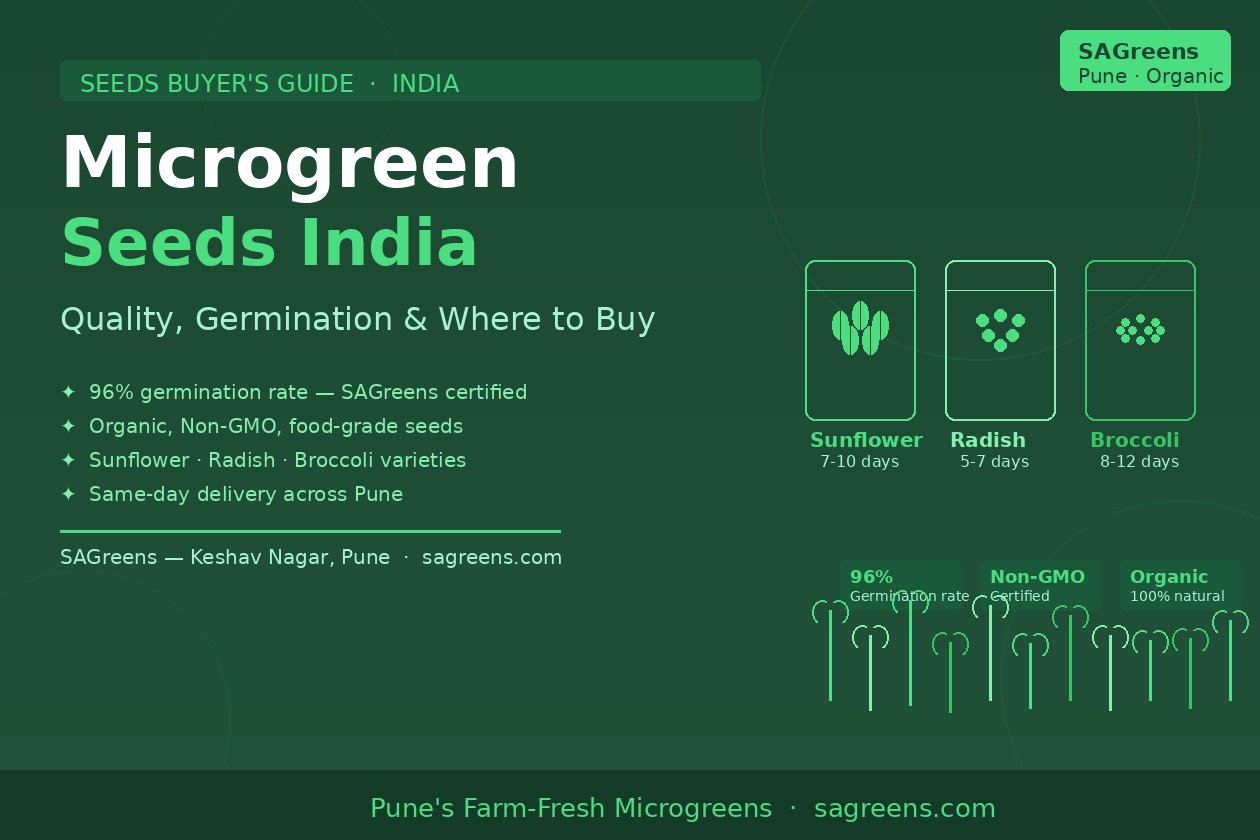
Microgreen Seeds Buying Guide India 2026 | What to Check
Buying microgreen seeds in India is not as straightforward as buying vegetable seeds from your local nursery. The wrong seeds — chemically treated, low-germination-rate, or poorly stored — can result in failed grows, wasted money, and discouraged beginners who give up on microgreens entirely. This guide explains exactly what to look for when buying microgreen seeds in India, what certifications matter, what questions to ask any supplier, and how to evaluate price versus quality.
Key Takeaways: Microgreen seeds must be untreated (no fungicide coating), food-grade, non-GMO, and sourced from a certified organic supplier with verifiable germination rates (85%+ minimum). Never use treated agricultural seeds for microgreens — fungicide coatings are toxic in edible microgreen applications. NPOP-certified seeds from SAGreens start at ₹49 per pack with pan-India delivery and printed germination guarantees.
The Non-Negotiable Requirement: Untreated Seeds
The single most important thing to verify before buying microgreen seeds in India is whether the seeds are untreated. This is non-negotiable.
Agricultural seeds — the kind sold at local nurseries, agricultural supply shops, and general gardening stores — are routinely coated with fungicide treatments. Common fungicide coatings used on Indian agricultural seeds include thiram, captan, thiabendazole, and TMTD. These treatments are designed to protect seeds from soil pathogens during outdoor planting, where the seed sits in the ground for weeks before germination.
In microgreen growing, the seed germinates and is eaten as a fresh seedling in 7–14 days. Any chemical treatment remains present throughout this period. Fungicide-treated seeds grown as microgreens produce seedlings that carry residues of these compounds — and fungicide residues are toxic for human consumption.
Warning: Thiram (tetramethylthiuram disulfide), one of the most common seed treatment fungicides used in India, is classified as a probable human carcinogen by the US Environmental Protection Agency. It causes liver toxicity at low doses. Never grow microgreens from seeds you cannot confirm are untreated.
Before buying from any supplier — online or local — ask directly: "Are these seeds untreated? Do they contain no fungicide, pesticide, or growth-regulator coatings?" A trustworthy supplier will answer clearly. If the answer is evasive or the seller does not know, do not buy.
How to Spot Treated Seeds: Treated agricultural seeds in India are typically coated with a coloured powder — pink, red, blue, or grey pigment. Any seeds with a coloured coating are treated and unsafe for edible microgreens. Some treatments use a clear or white coating — harder to identify visually. If you cannot confirm by sight, obtain written confirmation of untreated status. All SAGreens seeds are explicitly labelled as untreated with NPOP certification available on request.
NPOP Organic Certification: What It Means for Indian Buyers
NPOP stands for India's National Programme for Organic Production — the government certification system for organic farming and produce. Seeds certified under NPOP have been produced without synthetic pesticides, herbicides, or chemical fertilisers throughout the seed production process.
For microgreen buyers, NPOP certification provides two important assurances:
No pesticide residue in seed production. The seeds themselves were grown on certified organic farms with traceable growing practices. This reduces (though does not eliminate) the risk of pesticide residues on the seed surface.
No prohibited post-harvest treatments. NPOP prohibits post-harvest chemical treatments on certified produce, which includes the fungicide seed coatings described above.
NPOP certification is India's domestic organic standard. When you see SAGreens seeds labelled as NPOP-certified, this means the entire supply chain — from the farm where seeds were grown to the packaging — has been audited and certified under India's organic standards authority (APEDA).
Germination Rate: What the Numbers Mean
Every reputable microgreen seed supplier should provide germination rate data for their seeds. Germination rate is the percentage of seeds that successfully sprout under standard conditions. Here is what different rates mean in practice:
| Germination Rate | Implication | Acceptable for Microgreens |
|---|---|---|
| 93%+ | Premium quality; nearly every seed germinates | Yes — ideal |
| 90–92% | Very good; minor gaps in tray coverage | Yes |
| 85–89% | Good; some uneven spots expected | Yes |
| 75–84% | Moderate; noticeable patchy coverage | Marginal |
| Below 75% | Poor; significant waste and uneven harvests | No |
SAGreens germination guarantees by variety: sunflower and radish 93%+, broccoli, mustard, pea shoot, kohlrabi 90%+, fenugreek, coriander, spinach, wheatgrass 85%+.
If a seller cannot provide germination rate data, do not buy. Germination rate is the most basic quality metric for microgreen seeds — any serious supplier tracks and discloses it.
Non-GMO: What Indian Buyers Need to Know
Genetically modified organism (GMO) seeds are not widely used in Indian microgreen seed production, but the "Non-GMO" label is worth understanding when you see it.
For the seed varieties most commonly grown as microgreens in India — sunflower, radish, broccoli, mustard, fenugreek, coriander, pea, wheatgrass, spinach — commercial GMO versions are not widely available in the Indian market. However:
The "Non-GMO" label from a certified organic Indian supplier is a verifiable quality claim backed by the same NPOP audit trail.
Evaluating Price: What Fair Value Looks Like
Microgreen seed pricing in India varies significantly. Here is a realistic price range guide for 2026:
| Variety | Pack Size | Fair Price Range | Red Flags |
|---|---|---|---|
| Mustard | 50g | ₹40–65 | Below ₹30 (likely untested field seeds) |
| Sunflower | 50g | ₹60–90 | Above ₹150 (likely overpriced for the variety) |
| Radish | 50g | ₹75–110 | Below ₹50 (quality concern) |
| Fenugreek | 100g | ₹55–85 | Above ₹120 for 100g (significant premium) |
| Broccoli | 20g | ₹120–250 | Below ₹120 (germination quality risk) |
| Pea Shoot | 50g | ₹45–70 | Below ₹35 (likely field-grade) |
| Coriander | 50g | ₹55–90 | Above ₹120 (overpriced) |
| Wheatgrass | 50g | ₹40–70 | Below ₹30 (quality concern) |
Very low prices almost always indicate one of: field-grade untested seeds, treated seeds, old seed stock with reduced germination, or seeds without any quality testing. Buying cheap seeds and experiencing 50% germination rates makes the effective cost-per-germinated-seed much higher than buying quality seeds at fair prices.
Browse current SAGreens prices: complete seed catalogue.
How to Evaluate Any Microgreen Seed Supplier in India
Use this checklist before placing your first order with any Indian microgreen seed supplier:
If a supplier fails on the first three points — untreated, certified, germination-tested — look elsewhere regardless of price.
Germination Rate Quick Guide: 93%+ = premium (nearly every seed germinates, dense even canopy). 85–92% = good (some minor gaps, acceptable for home use). 75–84% = marginal (patchy harvests, difficult to justify at any price). Below 75% = reject. A seed pack with no printed germination data should be treated as marginal until proven otherwise. All SAGreens seed packs carry a printed germination guarantee of 85%+.
Online vs Local: Where to Buy in India
Online specialist suppliers (recommended for most buyers): Access to a full variety range, NPOP-certified stock, transparent pricing, and nationwide delivery. Best for home growers, restaurant buyers, and commercial operations who need consistent quality across consecutive orders.
Local agricultural shops (proceed with caution): May carry some seed varieties at lower prices, but treatment status is often unclear or unknown. Staff may not be familiar with microgreen-specific requirements. Verify untreated status in writing before purchase.
General e-commerce platforms (caution): Listings for microgreen seeds on Amazon, Flipkart, and similar platforms vary widely in quality. Some listings are excellent; others are field-grade seeds packaged for the microgreen market. Check seller reviews specifically for germination rate mentions, not just product satisfaction.
SAGreens supplies organic microgreen seeds online with delivery across India. Browse our seed range and contact us for bulk orders and wholesale pricing.
Red Flags When Buying Microgreen Seeds Online in India
The Indian online marketplace — Amazon India, Flipkart, Meesho, and social commerce channels — hosts thousands of seed listings. Many are legitimate; many are not. These warning signs identify listings likely selling field-grade or treated seeds under a microgreen brand:
No germination percentage stated. Any seed supplier who tests their product prints the result. A listing without a germination percentage should be assumed to perform at 60–70% (field-grade) until verified otherwise. SAGreens prints a minimum 85% guarantee on every retail pack.
Price dramatically below market. NPOP-certified, untreated, germination-tested radish seeds retail at approximately ₹2.5–3.5 per gram in India. A supplier listing radish at ₹0.8–1.0 per gram is almost certainly selling field-grade agricultural seeds — treated, low-germination, or sourced from uncertified farms. If the price seems impossible, the quality is.
No NPOP certificate number. Legitimate organic certification includes a unique registration number verifiable through the APEDA (Agricultural and Processed Food Products Export Development Authority) database. A supplier claiming organic without a certificate number is making an unverifiable claim. Always ask for the NPOP certificate number before placing a first order.
Seeds labelled by common name only. Reputable suppliers label by variety alongside the common name. "Radish seeds" with no variety specification could be any of dozens of field agriculture radish varieties not optimised for microgreen density or flavour.
No return policy for germination failures. Suppliers who stand behind their germination rates offer replacement or refund when seeds underperform the stated percentage. A no-return policy on germination performance signals the seller does not test their seeds and does not expect to guarantee results.
Evasive answers to certification questions. Message any potential supplier: "Are these seeds explicitly untreated with no fungicide coating, and do you have a current NPOP certificate?" A legitimate supplier answers this in writing within 24 hours. A delayed, vague, or deflecting response is a clear negative signal — walk away.
No batch-specific information. Professional seed suppliers can provide the harvest year, storage conditions, and batch number for any pack they sell. Anonymous, undated stock from an unspecified source is a red flag regardless of the brand name on the packet.
Seasonal Purchasing Guide for Indian Microgreen Growers
Seed purchasing timing interacts with Indian seasons in ways that affect both growing results and supply availability:
February–March (pre-summer stock-up). Purchase fast-cycling varieties before the April–June heat peak. Sunflower, radish, and mustard seeds bought in February store safely through the summer and perform reliably with adjusted soaking times. Do not stock heat-sensitive varieties (pea shoot, broccoli) in large quantities at this time — they are better bought fresh in October.
October–November (peak season preparation). The post-monsoon cooling triggers a demand increase for microgreens across Indian restaurants, households, and health-food businesses. Stock higher-demand varieties — broccoli, pea shoot, fenugreek — before the October demand surge. Seed suppliers often see higher order volumes in this period; ordering early ensures certified stock availability.
Avoid peak summer purchasing for heat-sensitive varieties. Pea shoot and broccoli seeds stored through an Indian summer without refrigeration lose germination rate faster than in cooler months. Purchase fresh batches in October for these varieties after each monsoon season.
Monsoon storage precaution. Seeds purchased during June–September should be stored immediately with food-grade silica gel desiccant in sealed containers. Ambient humidity in coastal cities — Mumbai, Kochi, Chennai — reaches 80–90% during the monsoon, which accelerates moisture absorption in stored seeds and reduces their viable shelf life significantly. Airtight storage with desiccant extends shelf life by 3–6 months in high-humidity conditions.
Frequently Asked Questions
Can I use vegetable seeds from my local nursery for microgreens?
Only if you can confirm they are untreated and food-grade. Most nursery vegetable seeds in India are treated with fungicide coatings (thiram, captan, or similar) for field planting. These are toxic in edible microgreen applications. Always ask for written confirmation of untreated status from any local supplier before using their seeds for microgreens.
How do I verify NPOP certification for a supplier?
Ask the supplier for their NPOP certificate number. Legitimate certificates include the certifying body name (such as IMO, Control Union, or APEDA-accredited agencies), certificate number, and validity period. You can request to see the actual certificate document.
Is there a specific best-before date I should look for on seed packs?
Look for a packing date or best-before date. For home use, seeds packed within the last 12 months are ideal. Seeds more than 18 months old may have reduced germination rates — particularly in Indian storage conditions where heat and humidity accelerate seed aging.
What is the minimum order quantity for wholesale buying in India?
Wholesale pricing typically becomes available from 500g per variety. See our bulk microgreen seeds India guide for commercial procurement guidance. For SAGreens wholesale enquiries, contact us directly.
Which seeds should I try first when ordering online in India?
Start with sunflower and radish — both have 93%+ germination guarantees, are forgiving of beginner mistakes, and produce harvests in 7–10 and 6–8 days respectively. See our complete beginners seed guide for the full top-10 list.
How should I store microgreen seeds after receiving an online order?
Transfer seeds to an airtight container immediately — a glass jar or food-grade zip-lock bag. Add a food-grade silica gel packet to absorb moisture. Store in a cool dry location, ideally the refrigerator. Label with variety name and purchase date. In India's ambient humidity, seeds stored at room temperature without silica gel can lose 20–30% germination rate within 6 months. Refrigerated storage extends viability to 18–24 months.
What is the return or replacement policy if germination rate is poor?
SAGreens seeds carry a printed germination guarantee. If seeds fall below the guaranteed rate (85%+) on the first sow following standard technique, contact us within 30 days of purchase with photos of your tray — we will replace the batch. Poor germination due to technique issues (overwatering, wrong temperature, used medium) is not covered, but we will help troubleshoot the cause before replacing.
What is the difference between F1 hybrid and open-pollinated microgreen seeds?
For microgreen growing, the distinction matters less than treatment status. Both F1 hybrid and open-pollinated seeds produce microgreens reliably — F1 seeds sometimes offer more uniform germination. Most NPOP-certified organic microgreen seeds are open-pollinated, since synthetic production methods used in F1 seed production are restricted under organic certification. Either type is safe if explicitly untreated.
Are microgreen seeds listed on Amazon or Flipkart safe?
Varies significantly by seller. Some marketplace listings are genuine NPOP-certified seeds; others are field-grade seeds packaged for the microgreen market. Before ordering: look for explicit "untreated" and "NPOP certified" claims on the listing, read reviews mentioning germination rates, and check if the seller responds to questions. If the listing has no certification details or germination data, contact the seller directly before purchasing.
How do I calculate price per gram to compare suppliers?
Divide the price by the weight in grams. Example: ₹149 for 100g = ₹1.49/g; ₹250 for 250g = ₹1.00/g; ₹440 for 500g = ₹0.88/g. Also factor in germination rate — seeds at ₹1.49/g with 93% germination cost less per germinated seed than seeds at ₹1.20/g with 70% germination. The effective cost-per-successful-tray is the most useful comparison metric.
What does food-grade mean for microgreen seeds?
Food-grade means the seeds are safe for direct human consumption without cooking — no fungicide coatings, no pesticide residues above food safety limits, and produced under hygiene conditions appropriate for a food product. Regular agricultural seeds are not food-grade; they are produced for field planting, not eating. NPOP-certified organic microgreen seeds from SAGreens are food-grade: explicitly untreated, certified organic, and germination-tested per batch.
Is there a certification seal I should look for on seed packaging?
Look for the NPOP (National Programme for Organic Production) logo or the India Organic certification seal. Both indicate seeds produced on an audited organic farm following APEDA standards. The certification number on the pack can be verified through the certifying body. SAGreens seeds carry NPOP certification with the certificate number available on request.
Can I buy microgreen seeds at a physical store in India?
Some garden centres and health food stores in Pune, Mumbai, Bangalore, and Delhi carry microgreen seeds. However, stock and variety selection are limited compared to online suppliers, and treatment status may not be clearly labelled at retail. Online ordering from a specialist microgreen supplier gives access to the full variety range, certified stock, and transparent quality information that physical retail rarely provides.
What should I do if microgreen seeds arrive damaged or the pack is open?
Photograph the damaged packaging before opening. Contact the supplier within 48 hours of delivery with photos. A reputable supplier will replace damaged orders. If the seeds are visibly wet or discoloured after arrival, do not use them — moisture-compromised seeds have significantly reduced germination and increased mould risk. Request a replacement rather than attempting to use damaged stock.
What is the best way to test a new seed batch before a full commercial sow?
Place 10–20 seeds on damp kitchen paper in a small covered container. Check after 48–72 hours and count germinating seeds. 9–10 germinating = excellent. 8 = good. 7 or fewer = below the 85% guarantee threshold — contact the supplier for a replacement before scaling to production. This simple germination test takes 3 minutes to set up and saves a full tray of growing medium and 7–14 days of production time.
Which microgreen seeds are easiest for beginners in India?
Radish seeds are the easiest for Indian beginners because they germinate in 5-7 days with minimal technique, perform in summer heat, and have a near-perfect germination rate. Sunflower seeds are the most satisfying for beginners who want large yields and a milder flavour. Most beginners should start with radish for their first tray, then add sunflower in the second week.
Can I use grocery store seeds for microgreens in India?
No. Grocery store seeds are often treated with anti-moulding agents and preservatives not safe for food production. They also germinate at 40-60% versus 90-96% for food-grade seeds. Always use seeds sold specifically as microgreen or sprouting seeds.
What is the germination rate of SAGreens' microgreen seeds?
SAGreens' seeds germinate at 90-95% depending on variety — sunflower at 94-96%, radish at 95-97%, and broccoli at 94-96%. Every batch is tested before packing. This is significantly higher than garden seeds (60-80%) and grocery seeds (40-60%).
How long do microgreen seeds last if properly stored?
Sunflower seeds last 1-2 years in an airtight container below 25°C. Radish and broccoli seeds last 2-3 years under the same conditions. In Pune's monsoon humidity, use a silica gel desiccant in the storage container and keep seeds in the coolest, darkest part of your kitchen.
How many grams of seeds do I need per tray?
For a standard 10x20 inch tray: sunflower needs 40-50g, radish needs 15-20g, broccoli needs 10-15g. A 100g pack of sunflower seeds gives 2 trays. A 100g pack of radish seeds gives 5-6 trays. A 20g pack of broccoli seeds gives 1-2 trays.
Do I need to soak microgreen seeds before sowing?
Sunflower seeds must be soaked for 8-12 hours before sowing to soften the hull for clean shedding. Radish and broccoli seeds do not require pre-soaking — they are small enough to absorb moisture directly from the growing medium. Soaking radish or broccoli seeds actually increases mould risk.
Where can I buy organic microgreen seeds in Pune?
SAGreens offers organic sunflower, radish, and broccoli seeds with same-day delivery across Pune including Keshav Nagar, Viman Nagar, Koregaon Park, Baner, Kalyani Nagar, Magarpatta, Hadapsar, and Kharadi. Order at sagreens.com or WhatsApp +91 9970958370.
What is the difference between black oil sunflower seeds and striped sunflower seeds?
Black oil sunflower seeds have thin all-black hulls that shed cleanly from the cotyledon during the microgreen growth phase under proper blackout weight. Striped sunflower seeds have thicker patterned hulls that cling to the cotyledon and require manual removal. Always choose black oil sunflower seeds for microgreen production.
Are organic microgreen seeds more expensive than regular seeds in India?
Organic food-grade microgreen seeds cost slightly more than untested garden seeds, but the cost difference is small relative to the yield advantage. At 94-96% germination versus 50-70% for garden seeds, you need fewer seeds per tray to fill the same area, partly offsetting any price premium.
Which microgreen seeds grow best in Indian summer heat above 35 degrees?
Radish seeds are the most heat-tolerant and germinate reliably even above 35°C, making them the best summer microgreen for India. Sunflower seeds struggle at temperatures above 35°C and are better suited to October-March in Pune. Broccoli also slows significantly in summer heat.
About SAGreens
SAGreens is Pune's microgreens farm and seed supplier, founded by Ajay Toradmal — representing the three-generation farming family — a third-generation farming family with decades of agricultural experience in Maharashtra. We supply NPOP-certified organic microgreen seeds across India with printed germination guarantees on every pack. Our buying guide content is written from real supplier and growing experience.
Browse our seed catalogue, explore our microgreens blog, or contact us for wholesale and bulk orders.
Related Reading
More Microgreens Tips & Recipes
Buying Microgreen Seeds Online: Safety & Quality Checks
Learn what to check before buying microgreen seeds online in India — untreated seed, germination testing, NPOP certification and pricing.
Untreated Non-GMO Seeds for Microgreens India Guide
Why untreated, Non-GMO seeds are essential for safe microgreens at home. What treated seeds contain, health risks, and where to buy in Pune and across India.
Microgreen Seeds Bangalore: Buy for Home & Commercial Use
Where to buy microgreen seeds in Bangalore. SAGreens supplies Non-GMO, food-grade seeds for home growers and commercial farmers with pan-India delivery.
Fresh Tips & Exclusive Offers
Subscribe for growing tips, seasonal updates, and exclusive offers on fresh organic microgreens in Pune.