Which Microgreen Seeds Need Soaking, and for How Long
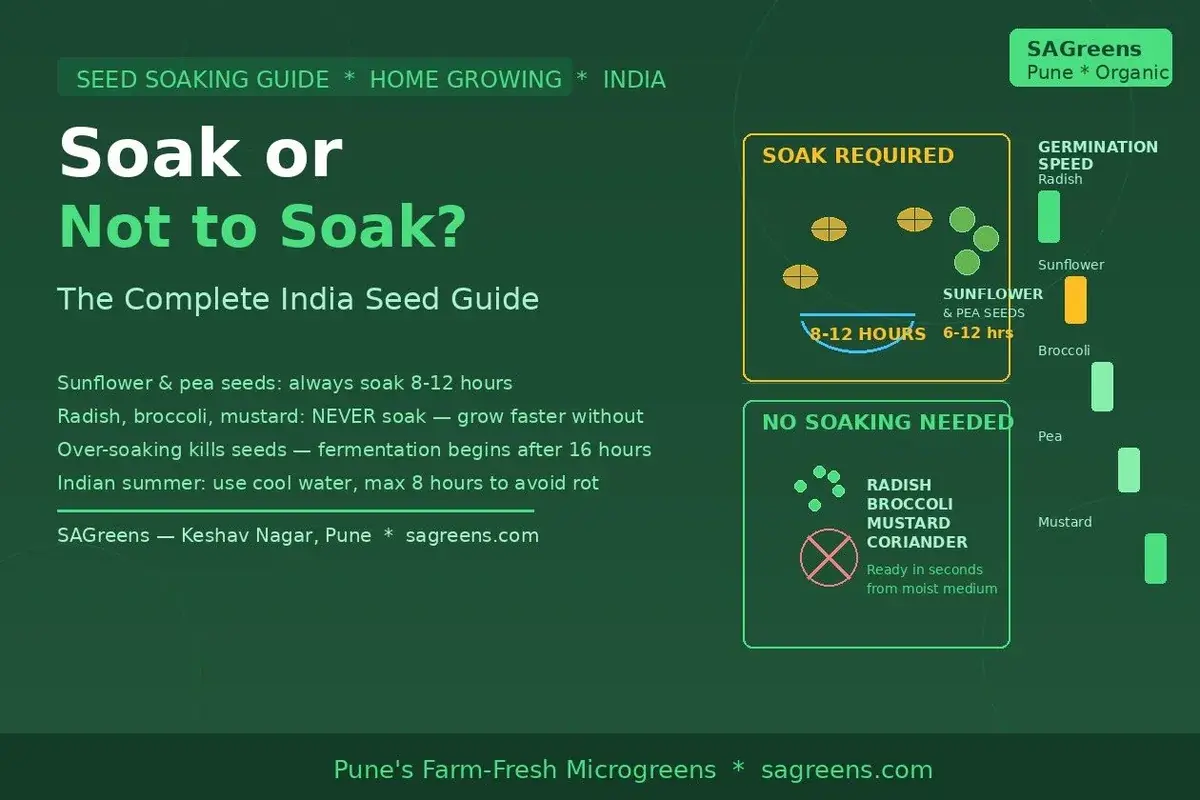
Pre-soaking microgreen seeds before sowing is one of the most commonly misunderstood steps in microgreen growing. Many beginners either skip soaking entirely (reducing germination rate and consistency) or over-soak (damaging seeds and encouraging mould). New to microgreens? Read our best microgreen seeds for beginners India guide before starting your first grow. This guide covers every common microgreen variety available in India — which seeds need soaking, how long, and exactly what to do.
Key Takeaways: Large seeds (sunflower, pea shoot, fenugreek, beetroot) benefit significantly from soaking — germination becomes faster and more uniform. Small seeds (mustard, broccoli, coriander) should not be soaked as they become mucilaginous and clump. Soaking time in India should be adjusted for water temperature: 6 hours in hot pre-monsoon water, 8–12 hours in cooler winter water. Always drain and rinse after soaking before sowing. SAGreens seed packs include printed soaking guidance per variety.
Why Soaking Matters
Seed germination requires moisture to penetrate the seed coat and activate the embryo. Larger seeds have thicker, harder seed coats that take longer for moisture to penetrate. Pre-soaking softens the seed coat, allowing water to reach the embryo faster and more uniformly, resulting in:
Faster germination. Soaked sunflower seeds germinate visibly in 24–36 hours versus 48–72 hours for dry-sown seeds.
More uniform germination. When all seeds absorb moisture at the same time during soaking, germination occurs in a tighter time window — producing a more even canopy with fewer stragglers.
Better seed-medium contact. Slightly swollen seeds make better contact with the growing medium surface than dry seeds, improving capillary moisture uptake from the tray below.
Reduced mould risk. Faster, more uniform germination means the seedling canopy establishes more quickly, shading the growing medium and reducing the surface mould that affects slow-germinating trays.
Soaking Quick Reference — India: SOAK (essential): sunflower 8–12 hrs, pea shoot 8–12 hrs, beetroot 4–6 hrs, fenugreek 6–8 hrs. SOAK (optional, improves consistency): coriander 2–4 hrs. DO NOT SOAK: radish, mustard, broccoli, kale, amaranth, wheatgrass. NEVER SOAK: basil (forms gel coat, impossible to sow). In Indian summer (April–June, water above 30°C), reduce soak times by 2 hours to prevent fermentation.
The Complete Indian Soaking Guide by Variety
For full variety profiles, growing times, and flavour comparisons, see our complete microgreen seed types guide India.
Seeds That Require Soaking
| Variety | Soak Time | Water Temp | Notes |
|---|---|---|---|
| Sunflower | 8–12 hours | Room temperature | Essential; seeds swell visibly |
| Pea Shoot | 8–12 hours | Room temperature | Soak until seeds are visibly swollen |
| Fenugreek | 6–8 hours | Room temperature | Do not over-soak — seeds become slimy |
| Radish | 4–6 hours | Room temperature | Short soak; germination is fast regardless |
| White Radish | 4–6 hours | Room temperature | Same as standard radish |
| Purple Sango Radish | 4–6 hours | Room temperature | Same as standard radish |
| Chinese Pink Radish | 4–6 hours | Room temperature | Same as standard radish |
| Kohlrabi | 4–6 hours | Room temperature | Moderate benefit from soaking |
| Spinach | 6–8 hours | Room temperature | Cold water soak improves germination |
| Wheatgrass | 8–12 hours | Room temperature | Soak until visible swelling |
| Beetroot | 8–12 hours | Room temperature | Critical — very hard seed clusters |
| Swiss Chard | 8–12 hours | Room temperature | Seed clusters benefit from extended soak |
| Amaranth | 4–6 hours | Room temperature | Light soak; seeds are small |
Seeds That Should NOT Be Soaked
| Variety | Reason | What to Do Instead |
|---|---|---|
| Mustard | Seeds become mucilaginous (gel-forming); clump and are impossible to sow evenly | Sow dry on pre-moistened medium |
| Broccoli | Same as mustard — gel-forming when wet | Sow dry |
| Coriander | Seeds benefit from crushing (not soaking) to split the round hull before sowing | Crush lightly, then sow on moist medium |
| Basil | Highly mucilaginous — creates a gel that traps seeds in clumps | Sow dry; use specialised technique |
Before soaking, confirm your seeds are specifically untreated microgreen seeds — agricultural or treated seeds must never be used for edible microgreens. See our microgreen seeds vs regular seeds safety guide if you are unsure about your seed source.
Step-by-Step Soaking Method for India
What You Need
Step 1 — Measure Your Seeds
For a standard 6x6-inch tray, measure the recommended seed quantity:
Step 2 — Add Water
Place seeds in the bowl and add water at a ratio of approximately 3:1 (3 parts water to 1 part seeds by volume). The seeds must be completely submerged with room to swell — sunflower seeds expand by approximately 50% during soaking.
Step 3 — Adjusting for Indian Seasons
Summer and pre-monsoon (March–May): Tap water in many Indian cities reaches 28–32°C. At this temperature, seeds absorb moisture faster. Reduce soaking time by 20%:
Monsoon (June–September): Water temperature 24–28°C. Standard soaking times apply.
Winter (December–February): Water temperature 16–22°C in north India. Seeds absorb moisture more slowly at lower temperatures. Increase soaking time by 25%:
Step 4 — When to Stop Soaking
Correctly soaked seeds: Visibly swollen. Sunflower seeds swell to 150% of their original size. Pea shoot seeds become plump and rounded. Fenugreek seeds swell and feel slightly tacky.
Over-soaked seeds: Seeds begin to crack, split, or show the white root (radicle) emerging before sowing. This means germination has already started — these seeds must be sown immediately. Sowing pre-germinated seeds is fine; soaking further is not.
Under-soaked seeds: Hard, unchanged appearance. Continue soaking in fresh water.
Step 5 — Drain and Rinse
After soaking, pour seeds into a strainer. Rinse under cool running water for 30–60 seconds. This removes the enzyme inhibitors released during soaking (which can slow germination if seeds are sown in their soak water) and any surface bacteria from the soaking process.
Do not reuse soaking water for watering plants — it contains enzyme inhibitors and metabolic byproducts from the soaking process that can inhibit plant growth.
Step 6 — Sow Immediately
Sow soaked seeds immediately after draining and rinsing. Do not let soaked seeds sit for more than 1–2 hours after draining — they will begin germinating and the emerging radicles become fragile and prone to damage during sowing.
Indian Water Quality and Soaking
Water quality varies significantly across Indian cities and affects soaking:
High chlorine content (common in Delhi, Mumbai, Bangalore municipal water): Chlorine can inhibit germination. Allow tap water to sit in an open container for 30–60 minutes before soaking, or use filtered water. Alternatively, use RO-filtered water directly.
Hard water (common in Rajasthan, Gujarat, parts of Maharashtra): Hard water with high calcium and magnesium content does not significantly affect seed soaking. Use it normally.
Well or borewell water (rural areas and some urban areas): Test pH if possible — pH between 6.0 and 7.5 is ideal for seed soaking. Extreme alkalinity (pH 8+) can reduce germination rates.
Rainwater (during monsoon): Slightly acidic (pH 5.5–6.5) and chlorine-free. Excellent for seed soaking if collected cleanly.
Special Cases: Coriander and Beetroot
Coriander — Crush, Don't Soak
Coriander seeds (dhania) are technically fruits — each round seed is a pair of seeds fused in a protective hull. This hull delays moisture penetration during germination, leading to slow and inconsistent germination rates of 50–65% if seeds are sown whole.
The India-proven technique: Place coriander seeds in a clean cloth or between two cutting boards and apply gentle, even pressure to crack the seed hull without crushing the seeds inside. This splits the hull and releases the two seeds. Sow the cracked seeds immediately on pre-moistened growing medium without soaking. Germination rate with this technique rises to 85%+.
Beetroot — Extended Soak for Hard Clusters
Beetroot seed clusters are unusually hard — they are woody multi-embryo structures, not individual seeds. Each cluster contains 2–4 embryos. Without adequate soaking, the hard hull prevents moisture penetration and germination is patchy.
Soak beetroot clusters for 8–12 hours, massaging gently every 3–4 hours to loosen the surface layer. After soaking, some clusters will have separated into individual seeds — sow these immediately. The unseparated clusters can also be sown directly.
Over-Soaking Warning: In India's warm climate, fermentation can occur within 12–14 hours of soaking, especially in summer when water temperatures exceed 30°C. Signs of over-soaked seeds: soft or mushy texture, off-odour (fermentation smell), grey or discoloured coating. Over-soaked seeds will fail to germinate and can spread odour to the growing tray. If this occurs, discard and start fresh with reduced soaking time. SAGreens seed packs include printed soaking guidance per variety.
Common Soaking Mistakes and How to Fix Them in India
Most soaking failures in Indian microgreen growing come from one of five predictable mistakes. Recognising and correcting these saves seeds, trays, and growing time:
Mistake 1: Using the same soak time year-round. Water temperature in India varies from 16°C in north Indian winter to 32°C in pre-monsoon summer. Seed metabolism — and therefore the speed of water absorption — changes with water temperature. Using a fixed 12-hour soak for sunflower in June (30°C water) will over-soak and begin germination in the water; using the same 12 hours in Delhi in January (18°C water) may under-soak. Adjust times seasonally: reduce by 2–4 hours in summer, extend by 2–4 hours in winter.
Mistake 2: Soaking small seeds that should be sown dry. Broccoli, mustard, kale, and basil seeds must not be soaked. These small brassica seeds become mucilaginous when wet — they develop a gel coating that causes them to clump together, making even spreading on the growing medium impossible. The result is dense clumps with poor airflow and high mould risk. Sow these varieties dry onto a damp growing medium.
Mistake 3: Reusing soaking water. Soaking water accumulates enzyme inhibitors, seed tannins, and early fermentation byproducts. Using this water to moisten the growing tray introduces these compounds directly to the germinating seedlings, which can inhibit germination and promote mould growth. Always drain soaking water completely and rinse seeds twice under fresh running water before sowing.
Mistake 4: Soaking in a warm kitchen during summer. In Mumbai, Pune, and coastal cities during pre-monsoon and summer, kitchen temperatures often reach 30–34°C overnight. At these temperatures, large seeds like sunflower and pea shoot can begin fermenting within 14–16 hours of soaking — well within a standard overnight soak. If your kitchen is warm, use cold filtered water from the refrigerator to start the soak, or reduce soak time to 6–8 hours and check seeds more frequently.
Mistake 5: Not rinsing before sowing. Soaked seeds should be drained through a strainer and rinsed under cool running water for 30–60 seconds before spreading on the growing medium. This removes the enzyme inhibitor residue from the seed surface and reduces the surface microbial load, both of which improve germination rate and reduce early mould incidence. This single step — often skipped by beginners — meaningfully improves tray results.
Troubleshooting: When Soaked Seeds Do Not Germinate
If soaked seeds fail to germinate within the expected timeframe, diagnose using these checks:
Check for over-soaking. Seeds left in water for 20+ hours in warm conditions (above 28°C) may have begun fermenting. Signs: soft or mushy texture, off-odour, grey or slimy surface coating. Over-soaked seeds rarely recover — discard and start fresh with a shorter soak time.
Check the growing medium moisture. Soaked seeds need a moist but not waterlogged growing medium. Coco peat that is too dry (crumbles without cohesion) will not provide enough moisture for germination. Coco peat that is too wet (pools of standing water visible) promotes mould rather than germination. The correct texture: damp enough to hold shape when squeezed, dry enough that no water drips out.
Check the seed batch age. Germination rate declines with seed age. Seeds from the previous season (12–18 months old) may show noticeably reduced germination even when soaked correctly. Always buy fresh-season certified seeds for commercial growing, and request harvest year confirmation from your supplier.
Frequently Asked Questions
Can I use warm water for soaking microgreen seeds in India?
Warm water (up to 30°C) is fine and may slightly accelerate the initial moisture absorption. However, avoid hot water (above 35°C) — it can damage the embryo and significantly reduce germination rates. Room-temperature water is the safest choice across all Indian seasons.
What happens if I forget my seeds are soaking and they soak too long?
If seeds are left soaking for 24+ hours, they will begin germinating in the water and may develop mould. Drain immediately, rinse thoroughly, and sow at once. Seeds with short radicle protrusions (1–3mm) are fine to sow. Seeds with longer roots or any visible mould should be discarded.
Should I soak seeds in filtered or tap water?
Either works in most Indian cities. If your tap water has strong chlorine odour, let it sit uncovered for 30–60 minutes before soaking. For sensitive varieties like pea shoots and broccoli, filtered or RO water is preferable.
Do organic microgreen seeds from SAGreens come with soaking instructions?
Yes. Every SAGreens seed pack includes variety-specific growing guidance covering soaking time, sowing density, blackout duration, and harvest timing. If you need guidance for your specific variety or growing conditions, contact us.
Can I soak seeds in the refrigerator during Indian summer?
Yes. Refrigerator soaking (4–8°C) extends the soaking time to 18–24 hours for large seeds like sunflower and pea shoot, due to the slower moisture absorption at cold temperatures. This is useful for large batch preparation — you can start soaking before bed and sow the next morning without risk of over-soaking. For small seeds like fenugreek and radish, room-temperature soaking is preferable.
How many times should I rinse seeds after soaking?
Rinse soaked seeds twice — once immediately after draining the soak water, and once more just before spreading on the tray. Each rinse removes fermentation byproducts that accumulate in the soak water and on the seed surface. Use clean cool water for both rinses. After the second rinse, drain thoroughly in a mesh strainer — seeds should be damp but not dripping before sowing.
Can I reuse soaking water for the growing tray?
No. Soaking water contains seed tannins, enzyme inhibitors, and fermentation byproducts from the soaking process. Adding this water to the growing tray can inhibit germination and affect the flavour of the microgreens. Always use fresh clean water for the growing tray. Soaking water can be used to water outdoor garden plants — the nutrients it contains are beneficial for soil.
How do I know if seeds have soaked for the right amount of time?
Correctly soaked large seeds (sunflower, pea shoot) will be visibly swollen — approximately 20–30% larger than their dry volume — and feel firm but slightly soft when pressed. Correctly soaked fenugreek will show slight swelling and may have tiny white root tips just beginning to emerge — this is fine and indicates peak soaking time. Discard any seeds that are mushy, have an off-odour, or show grey discolouration.
Does soaking change the nutritional profile of microgreens?
Soaking activates enzymatic processes that can increase bioavailability of certain minerals (by reducing phytic acid content) in the seedling. However, the primary nutritional benefits come through the growing and photosynthesis phase. Soaking itself does not meaningfully change the final microgreen's nutritional content — its main purpose is improving germination speed and uniformity, not enhancing nutrition.
Is soaking the same as sprouting?
No. Soaking is a pre-sowing preparation step — seeds are soaked, drained, and then sown in a growing medium. Sprouting is a complete growing method — seeds germinate in water or jars and are consumed including the root within 2–4 days, without a growing medium. Microgreens and sprouts are different products with different methods, different harvest timings, and different food safety considerations.
How does Indian monsoon humidity affect the soaking process?
During the monsoon (June–September), ambient humidity in Mumbai, Kochi, Chennai, and coastal cities reaches 80–95%. At these humidity levels, soaking water temperature is higher and fermentation occurs faster. Reduce soaking times by 1–2 hours during the monsoon. If sowing is delayed after draining, store the drained seeds in the refrigerator for up to 4 hours to prevent deterioration in humid heat.
Can I soak two different seed types in the same container?
Not recommended. Different varieties have different optimal soak times — sunflower 8–12 hours, fenugreek 6–8 hours, coriander 2–4 hours. If soaked together, one variety will be over- or under-soaked. Mucilaginous varieties (coriander) will coat other seeds with their gel layer if soaked together. Always soak each variety separately in its own container to maintain precise timing control.
What container is best for soaking microgreen seeds in India?
Any clean food-safe container works — a bowl, jar, or food-safe plastic container. Ideal size allows seeds to be fully submerged with 3–4 cm of water above them (seeds expand 20–30% during soaking). Glass jars are preferable for easy monitoring without disturbing the seeds. Avoid metal containers as some seed compounds can react with metal surfaces. Use a container easy to drain through a mesh strainer.
Should I test germination by soaking a small batch before a full tray sow?
Yes — especially with a new seed batch. Soak 10–20 seeds following the standard protocol, spread on damp kitchen paper in a small covered container, and check after 48–72 hours. Count germinating seeds: 9–10 germinating = excellent (90–100%); 8 = good (80%); 7 or fewer = below the 85% guarantee threshold. This 3-minute test prevents a failed full-tray sow from a below-standard batch. Contact SAGreens if your batch falls below guarantee.
What is the soaking time for wheatgrass seeds?
Soak wheatgrass seeds (hard winter wheat berries) for 8–12 hours — the same as sunflower seeds. After soaking, drain and rinse twice. Some growers use the soak-drain-soak method: soak 8 hours, drain and rinse, rest 4–6 hours at room temperature, then sow. This double-phase further activates germination and produces more consistent results across the tray. In Indian summer, use the single-soak method to avoid fermentation risk during the rest phase.
Pricing: SAGreens seeds — ₹120/100g (MRP ₹178, 10% off). Delivery charged at checkout. NPOP-certified organic, 90–95% germination. Order online or WhatsApp for bulk rates.
Do I need to soak radish seeds before growing microgreens?
No. Radish seeds are small and absorb moisture directly from pre-moistened cocopeat within minutes of sowing. Soaking radish seeds causes the seed coat to break down too early, increasing mould risk in the blackout phase. Sow radish seeds dry on damp growing medium and proceed immediately to blackout cover.
How long should I soak sunflower seeds for microgreens?
Soak sunflower seeds for 8-12 hours in clean water at room temperature (22-26°C). In Indian summer above 32°C, cap soaking at 8 hours to prevent fermentation. After draining, rinse for 30 seconds and sow immediately. Do not soak for more than 14 hours under any conditions — over-soaked seeds ferment and lose viability rapidly.
What water temperature is best for soaking seeds in India?
Room temperature water between 22-26°C is ideal. In summer, use slightly cool water (18-22°C) to slow fermentation. Never use cold refrigerator water directly — let it warm for 5-10 minutes first. Do not use hot tap water (above 30°C), which deactivates germination enzymes.
What happens if I soak seeds for too long?
Seeds soaked past 16 hours at room temperature begin to ferment. You will notice a slightly sour smell from the soak water. Fermented seeds have severely reduced germination rates — sometimes below 30% for seeds that would otherwise germinate at 95%+. If your seeds smell sour, compost them and start fresh. The damage cannot be reversed.
Can I soak all my microgreen seeds together in one bowl?
No. Always soak seed varieties separately. Different varieties need different soak times, and mixing large and small seeds creates problems — you cannot remove small seeds from soak water cleanly, and the small seeds will over-soak. Sow each variety on a separate tray.
Do broccoli microgreen seeds need soaking?
No. Broccoli seeds are tiny (similar size to mustard) and absorb moisture instantly from damp growing medium. Soaking broccoli seeds causes mucilage formation — a sticky gel that clumps seeds together and makes even spreading on the tray difficult. Sow broccoli seeds dry on a pre-moistened cocopeat surface.
How do I know when sunflower seeds are ready after soaking?
Look for visible size increase — soaked sunflower seeds are noticeably larger and plumper than dry seeds. The hull appears dull and matte rather than glossy. Crack one open: the cotyledon inside should be white and firm, filling the hull. Seeds that look unchanged after 12 hours are likely not viable.
Should I soak seeds differently in Indian summer?
Yes. Use cooler water (18-22°C), reduce soak time to 6-8 hours for sunflower, and sow immediately after draining. In summer, room temperature water at 34-38°C accelerates fermentation dramatically. If possible, start the soak at night when ambient temperatures are lower.
Do fenugreek (methi) seeds need soaking?
Fenugreek is a borderline case. Seeds germinate without soaking but benefit from a 4-6 hour soak, which speeds germination by 1-2 days. Fenugreek seeds do not form problematic mucilage when soaked, so a brief soak is low-risk and recommended. In Indian summer, skip the soak and let fenugreek hydrate from the growing medium.
Do pea shoot seeds need soaking for microgreens?
Yes. Pea seeds are large and dense, requiring 6-8 hours of soaking before sowing. Look for visible swelling and a slight splitting of the seed coat to confirm readiness. After draining, rinse twice and sow immediately. Peas soaked correctly germinate in 24-36 hours on pre-moistened cocopeat.
Why do my sunflower seeds smell after soaking?
A sour smell after soaking means the seeds have started to ferment — caused by over-soaking (beyond 14-16 hours), warm water above 30°C, or a dirty bowl. Fermented seeds have severely reduced germination (often below 40%) and should be composted. Start fresh: shorter soak, clean cool water, rinsed bowl. In Indian summer, cap soak time at 8 hours maximum.
What if I forgot to soak my sunflower seeds — can I sow them dry?
Yes, you can sow unsoaked sunflower seeds, but expect 15-25% lower germination density, 1-2 extra days to harvest, uneven canopy height, and higher hull retention. For a single emergency tray it is acceptable. For consistent professional results, always pre-soak 8-12 hours.
About SAGreens
SAGreens is Pune's microgreens farm and seed supplier, founded by Ajay Toradmal — representing the three-generation farming family — a third-generation farming family with decades of agricultural experience in Maharashtra. We supply NPOP-certified organic microgreen seeds with printed growing guidance on every pack, including variety-specific soaking instructions.
Browse our complete seed range, read our seeds buying guide for certification tips, or contact us for growing support and bulk orders.
More Microgreens Tips & Recipes
Buying Microgreen Seeds Online: Safety & Quality Checks
Learn what to check before buying microgreen seeds online in India — untreated seed, germination testing, NPOP certification and pricing.
What Untreated Seed Means, and How to Spot Treated Seed
Untreated means no fungicide coating. Non-GMO is a separate claim. How to tell them apart on a label, and why dyed seed must never reach an edible tray.
Microgreen Seeds Bangalore: Buy for Home & Commercial Use
Where to buy microgreen seeds in Bangalore. SAGreens supplies Non-GMO, food-grade seeds for home growers and commercial farmers with pan-India delivery.
Fresh Tips & Exclusive Offers
Subscribe for growing tips, seasonal updates, and exclusive offers on fresh organic microgreens in Pune.