Pak Choi Microgreen Seeds: Sowing, Cost and Harvest
Pak Choi Microgreen Seeds: What You Are Actually Buying
Pak choi microgreen seeds are small, round, dark brassica seeds that go into the tray dry and come out as a crop in eight to ten days. If you have grown radish or broccoli microgreens, you already know how to handle them. What is different is the flavour at the end, and that difference is the whole reason to grow this variety rather than another brassica.
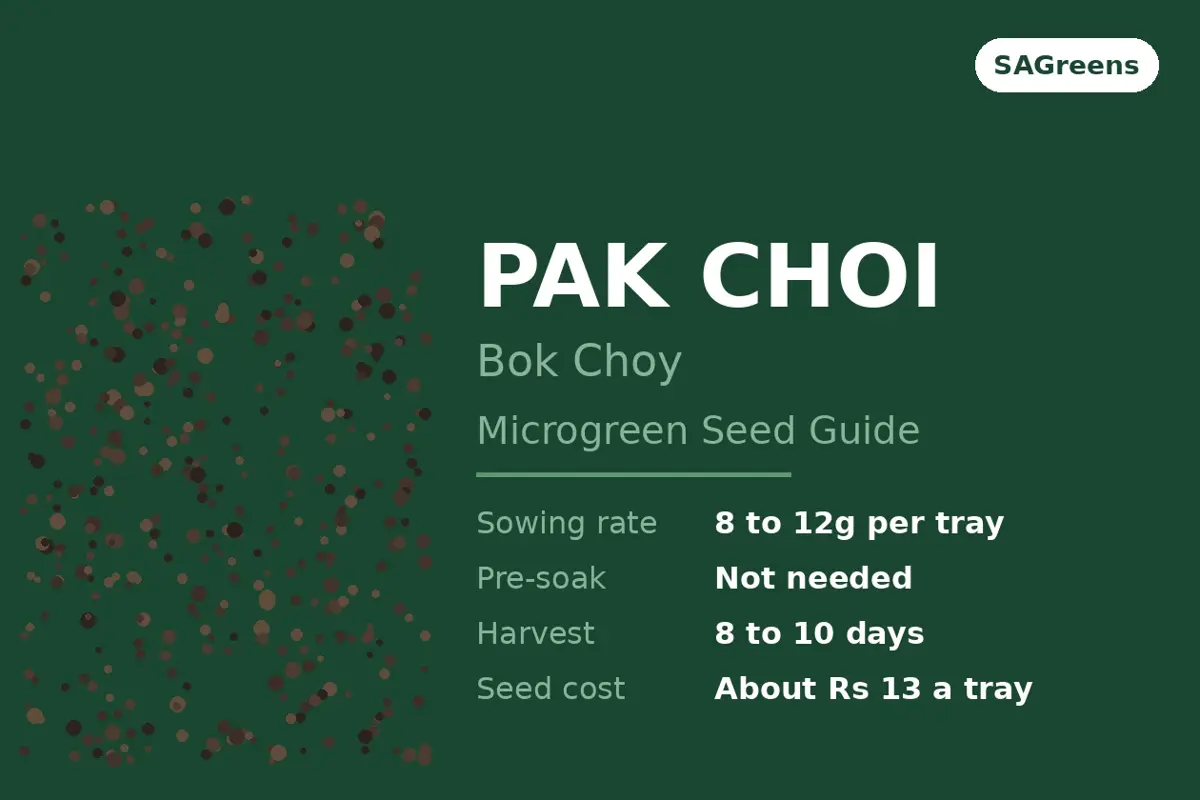
Key Takeaways: Pak choi microgreen seed is sown dry at 8 to 12g per 25cm tray, with no pre-soaking. Harvest falls at 8 to 10 days once the cotyledons are fully open. At our price of 129 rupees for 100g, a tray costs roughly 13 rupees in seed and a pack sows eight to twelve trays. The flavour is mild and stays mild, which is the opposite of mustard and radish, and it is the reason pak choi suits children and first-time growers.
Most seed guides open with how to grow the crop. This one opens with the seed, because the growing part is the easy half and the decisions that cost you money all happen before the seed touches cocopeat. How much to sow. What a tray actually costs. Whether the seed in the packet is food-grade or field seed meant for a farmer's plot. How long it stays viable in a Pune monsoon. Our pak choi microgreen seeds are sold for exactly this use, and the figures below are the ones we work to on our own trays.
Pak Choi Seed at a Glance
| Specification | Pak choi microgreen seed |
|---|---|
| Botanical name | Brassica rapa subspecies chinensis |
| Other names | Bok choy in American usage, पाक चोई in Hindi and Marathi |
| Seed size | Small and round, 1 to 2mm, similar to radish |
| Sowing rate | 8 to 12g per 25cm x 25cm tray |
| Pre-soak | Not needed, sow dry |
| Blackout | 2 to 3 days, lighter than most brassicas |
| Days to harvest | 8 to 10 days |
| Flavour | Mild, juicy, gentle cabbage sweetness, a trace of pepper |
| Seed treatment | Untreated and non-GMO, germination tested before packing |
| Pack and price | 100g at 129 rupees |
| Seed cost per tray | About 10 to 16 rupees |
| Trays per 100g pack | 8 to 12 |
What Pak Choi Seed Looks Like in the Hand
Pak choi seed is a small round brassica seed, dark brown to nearly black, between one and two millimetres across. Tip some into your palm and it behaves like radish seed: it rolls, it finds every crease, and it runs off the edge if you tilt your hand. That physical behaviour matters more than it sounds, and it drives three of the sowing rules further down this page.
It is worth knowing what species you are holding. Pak choi is Brassica rapa subspecies chinensis, which makes it the same species as the turnip. If you have read our turnip microgreen seed guide, much of the handling advice there transfers directly, because botanically these are close relatives wearing different names. The napa cabbage group sits in the same species too. What separates them at the microgreen stage is flavour intensity rather than technique.
Pak choi, bok choy and पाक चोई are three names for one crop. Pak choi is the standard English form, bok choy is American usage, and Hindi and Marathi both borrow the same sound because pak choi is not a traditional Indian vegetable and neither language has an older word for it. Some Hindi seed lists file it under चीनी पत्ता गोभी, meaning Chinese leaf cabbage.
That naming confusion is worth clearing up before you buy, because searching for one spelling and not the other is how growers in India end up paying import prices for a seed that is stocked domestically.
Sowing Rate: 8 to 12 Grams a Tray
The single most common mistake with small brassica seed is sowing too much of it. Pak choi sits in the same band as broccoli and radish: 8 to 12 grams on a standard 25cm by 25cm tray. That is far less seed than most people expect. Spread across a tray it looks sparse, almost wrong, and the instinct to add more is strong.
Resist it. A tray has a fixed amount of light, air and medium. Extra seed past the point of single-layer coverage does not produce more greens, it produces competing seedlings, a denser canopy that traps humidity at the base, and a much higher chance of losing the whole tray to mould. Our sowing rate guide works through this arithmetic across every variety we sell.
If your tray is a different size, scale by area rather than guessing:
| Tray size | Area | Pak choi seed |
|---|---|---|
| 25cm x 25cm | 625 sq cm | 8 to 12g |
| 10 x 20 inch | 1,290 sq cm | 16 to 25g |
| 30cm x 60cm | 1,800 sq cm | 23 to 35g |
The 30cm by 60cm figure is the one commercial growers use most, and it matches the 600 by 300mm tray set we sell.
What a Tray Actually Costs in Seed
At 129 rupees for 100g, pak choi works out as follows. Sown at the light end of the range, 8 grams a tray, a pack gives twelve and a half trays and the seed cost is about 10 rupees a tray. Sown at the heavy end, 12 grams, you get eight trays and roughly 16 rupees each. Call it 13 rupees a tray in the middle.
Here is how that compares against the other varieties we stock, using the same sowing rates:
| Variety | Pack price | Seed per tray | Cost per tray |
|---|---|---|---|
| White radish | 89 rupees / 100g | 8 to 12g | 7 to 11 rupees |
| Turnip | 119 rupees / 100g | 8 to 12g | 10 to 14 rupees |
| Pak choi | 129 rupees / 100g | 8 to 12g | 10 to 16 rupees |
| Pea shoots | 88 rupees / 100g | 15 to 20g | 13 to 18 rupees |
| Mustard | 124 rupees / 100g | 15 to 20g | 19 to 25 rupees |
| Kohlrabi | 360 rupees / 100g | 10 to 15g | 36 to 54 rupees |
Comparing pack prices tells you almost nothing. A cheap pack of a heavy-sowing seed costs more per tray than an expensive pack of a light one. Pak choi looks mid-priced on the shelf and lands near the cheap end per tray, because small seed goes a long way.
The full per-variety breakdown is in our microgreen seed price guide, which also covers what wholesale quantities do to these numbers.
Germination, and Testing Your Own Seed
We germination test every lot before packing. You should still know how to test a lot yourself, because seed changes hands and sits in warehouses, and the figure on a packet is a claim until you have verified it.
The method takes ten minutes and four days. Count out fifty seeds. Lay them on damp kitchen paper, fold it over, put it in a closed container at room temperature, and keep it damp but not wet. Pak choi is quick, so count sprouted seeds at day three and again at day four. Multiply by two and you have your percentage.
Doing this before you commit a full tray is worth the four days, especially on seed you did not buy from us. It also tells you something a percentage alone does not: whether the lot germinates evenly. Fifty seeds that all pop within twelve hours of each other give you a tray that finishes together. The same percentage spread across three days gives you a tray where a third of the crop is ready and the rest is not, which at commercial scale is a real cost.
Our germination guide covers what to do when a test comes back low, and how temperature shifts the result.
Untreated Seed, and Why It Matters More Here
Seed sold for field agriculture is frequently treated with fungicide, and in India it is often dyed a bright pink or green so that it cannot be mistaken for food. That is sensible for a farmer sowing a field. It is completely unsuitable for microgreens, where you eat the seedling whole, roughly a week after the seed went into the medium, with no cooking step in between.
Pak choi deserves a specific warning here. It is not a traditional Indian crop, so the domestic seed supply is thinner than for radish or methi, and more of what circulates is repackaged horticultural seed intended for transplanting into a plot rather than for eating as a seedling. The further a seed is from mainstream Indian vegetable growing, the more carefully you have to check what was done to it.
If seed is dyed pink, green or blue, it has been treated, and it is not food. No rinse makes it safe. Buy seed sold explicitly for microgreens or sprouting, and if a seller cannot tell you whether a lot is treated, that is your answer.
Our guide to untreated and non-GMO seed in India goes through how to read a label and what the common evasions look like.
Storing Pak Choi Seed Through an Indian Year
Brassica seed is robust in storage compared with, say, coriander. Kept cool, dark and genuinely dry, pak choi holds its germination well for two to three years. The thing that kills it is not time, it is moisture, and in most of India moisture is the default condition for four months of the year.
Three rules cover it. Keep the seed in an airtight container rather than the paper or poly bag it arrived in. Put that container somewhere with a stable temperature, which in a Pune flat usually means an interior cupboard rather than a kitchen shelf above the stove. And do not refrigerate seed in a container you open frequently, because every opening condenses moisture onto cold seed.
If you grow through the monsoon, decant a few weeks of seed into a small working jar and leave the main stock sealed. Opening the main container twice a week in August undoes careful storage faster than anything else. Our seed storage and shelf life guide has the full viability table by variety.
Sowing Pak Choi, Step by Step
1. Prepare the medium and level it
Fill the tray with three to four centimetres of pre-moistened cocopeat and level it properly. This step gets skipped and it matters more for pak choi than for larger seed. Small round seed rolls into any dip in the surface, collects there, and germinates in clumps while the high spots come up bare. A levelled tray sows evenly almost by itself.
Our cocopeat block is unbuffered and high-EC, so rinse it until the runoff is clear before sowing. If you would rather skip that step, the ready-to-use growing mix is washed low-EC cocopeat blended with vermicompost and composted cow dung, and goes straight into the tray. Either way, the medium should be damp like a wrung-out cloth, not wet.
2. Sow dry, never soaked
Weigh out your 8 to 12 grams and scatter it dry across the surface. Do not pre-soak. Pak choi draws moisture straight out of damp cocopeat, and soaking seed this small makes it clump into sticky patches that sow in lumps rather than spreading.
Scatter from a height of fifteen to twenty centimetres rather than close to the surface. The extra distance lets the seed spread as it falls.
3. Blackout for two to three days, with weight
Cover the tray with an inverted tray and add a light weight on top. The weight is doing real work: resistance makes the stems push upward and stand straight rather than sprawling, and it presses the seed into contact with the medium so germination is even.
4. Uncover earlier than you would for other brassicas
This is the one place pak choi differs from its relatives in a way worth remembering. Pak choi comes out of blackout earlier than most brassicas. Lift the cover at day two or early on day three, as soon as the seedlings are standing one to one and a half inches tall and the stems have straightened. Leave it covered as long as you would leave broccoli and the tray runs leggy, with pale stretched stems that flop once they finally see light.
If your tray has gone leggy, that is what happened. It is not a seed problem and not a watering problem.
5. Bottom water from germination onwards
Once the seed has germinated, water from below rather than misting. Seedlings this small get flattened by overhead water, and wet leaves in a dense brassica canopy are how mould starts. Pour into the solid tray underneath and let the medium draw what it needs.
6. Keep air moving
A dense brassica tray holds humidity at the base, and through the monsoon that is the single biggest risk to the crop. A slow fan on the other side of the room is enough. You are not trying to dry the tray out, only to stop still, saturated air sitting in the canopy.
7. Harvest at eight to ten days
Cut with clean scissors just above the medium once the cotyledons are fully open and the stems are firm. Rinse and use, or refrigerate.
Why Pak Choi Flavour Stays Mild
Mustard and radish build heat as the tray ages. A radish tray cut on day ten is noticeably sharper than the same tray cut on day seven, because the glucosinolate compounds that produce that bite accumulate. Growers who like the heat time their harvest for it, and growers who do not have to cut early.
Pak choi does not do this. The flavour is mild on day eight and it is mild on day eleven. It is a gentle cabbage sweetness with a trace of pepper, nothing more, and the leaf is juicy rather than fibrous.
Pak choi is the gentlest brassica we sell. Cutting a day or two late costs you nothing in flavour, which makes it the forgiving option for anyone still learning to read a tray, and the reliable one for feeding children who reject anything sharp.
That property is why it belongs in a mixed box rather than being judged on its own. Put it alongside radish and you have contrast; put it in a sandwich on its own and it does the job lettuce does, with more substance. If you are deciding which varieties to grow first, our guide to the best microgreen seeds for beginners in India places it against the other easy starters.
Pak Choi Against the Other Brassica Seeds
| Variety | Harvest | Heat | Builds heat with age | Blackout |
|---|---|---|---|---|
| Pak choi | 8 to 10 days | None to a trace | No | 2 to 3 days, uncover early |
| Turnip | 8 to 12 days | Gentle mustard bite | Slightly | 3 to 4 days |
| Radish | 6 to 8 days | Strong and peppery | Yes | 3 to 4 days |
| Mustard | 6 to 8 days | Pungent | Yes | 3 to 4 days |
| Broccoli | 8 to 12 days | Mild | No | 3 to 4 days |
| Kohlrabi | 8 to 12 days | Mild and sweet | No | 3 to 4 days |
Pak choi and broccoli are the two mild brassicas. Between them, pak choi is juicier and finishes a little sooner, broccoli carries the sulforaphane reputation. Growers running a weekly rotation often carry both.
Troubleshooting Pak Choi Trays
| What you see | Most likely cause | What to do |
|---|---|---|
| Leggy, pale, stretched stems | Left in blackout too long | Uncover at day 2 to 3, not day 4 |
| Seed germinated in clumps and patches | Medium was not levelled, or seed was soaked | Level before sowing, sow dry |
| White fuzz at the base of stems | Root hairs, not mould, if it is even across the tray and flattens when misted | Nothing, it is normal |
| White fuzz in patches, climbing stems, musty | Mould, from over-sowing or still air | Reduce seed next tray, add airflow, bottom water |
| Tray uneven, a third ready before the rest | Seed lot germinates unevenly | Test a lot before committing trays to it |
| Seedlings flattened | Watered from above | Bottom water once germinated |
| Slow germination | Too cold, or medium too dry | Keep at room temperature, medium damp not wet |
| Bitter or sharp flavour | Not pak choi behaviour, check the seed is what the packet says | Buy from a seller who names the species |
A tray that has gone wrong is usually obvious from a photograph. Send one through our contact page and we will tell you what we think happened.
Buying Pak Choi Seed in India
Three things to check, in order of how often they are the problem.
Is it sold for microgreens? Seed sold for transplanting is a different product even when the variety name matches. It may be treated, it is rarely germination tested at the rate microgreen growing needs, and the pack sizes are wrong for tray growing.
What is the pack size against your actual use? A hundred grams sows eight to twelve trays. For a household growing one tray a week, that is roughly three months of pak choi, which is comfortably inside the seed's storage life. Buying a kilogram because the per-gram price looks better is false economy unless you are running trays commercially.
Can the seller tell you the species? Brassica rapa subspecies chinensis. A seller who cannot answer that is reselling without knowing what they hold, and that is the same seller who will not know whether the lot was treated.
We sell pak choi microgreen seeds in 100g packs at 129 rupees, shipped across India, alongside the rest of the microgreen seed range. Delivery is charged by order weight, and because it is banded rather than per-item, several seed packs ship for the same charge as one.
Growing Pak Choi at Commercial Scale
At twenty-five trays a week, pak choi uses between 200 and 300 grams of seed weekly, which is roughly a kilogram a month. At that level the per-gram price starts to matter and retail packs stop making sense.
Two things are worth knowing before committing shelf space to it. First, pak choi is a slower seller than radish or sunflower in most Indian markets, because buyers do not recognise the name. It moves when it is in a mixed box and described by flavour rather than by variety. Second, its forgiving harvest window is a genuine operational advantage: a tray that cannot be cut on the scheduled day because an order slipped does not degrade the way a radish tray does.
If you are costing a commercial rotation, write to us through our contact page with your weekly tray numbers and we will quote against them honestly, including telling you when retail packs would be cheaper than anything we could offer at wholesale.
Frequently Asked Questions
How much pak choi seed do I need per tray?
Between 8 and 12 grams for a standard 25cm by 25cm tray. On a 10 by 20 inch tray, 16 to 25 grams. On a 30cm by 60cm tray, 23 to 35 grams. Scale by surface area, not by guesswork, and err towards the lower figure rather than the higher one.
Do pak choi seeds need soaking before sowing?
No. Sow them dry onto pre-moistened cocopeat. Pak choi seed is small and draws moisture straight out of the medium. Soaking makes seed this size clump together and sow in patches instead of spreading evenly.
How long do pak choi microgreens take to grow?
Eight to ten days from sowing to harvest, including two to three days of blackout. Cut once the cotyledons are fully open and the stems feel firm.
What is pak choi called in Hindi and Marathi?
Both languages use पाक चोई, borrowing the same sound, because pak choi is not a traditional Indian vegetable and neither language has an older word for it. Some Hindi seed lists file it under चीनी पत्ता गोभी, meaning Chinese leaf cabbage. In American usage it is bok choy.
Are pak choi and bok choy the same thing?
Yes. They are two names for Brassica rapa subspecies chinensis. Pak choi is the standard English form and bok choy is American usage. Searching only one spelling is a common reason Indian growers miss domestic suppliers.
What do pak choi microgreens taste like?
Mild and juicy, with a gentle cabbage sweetness and only a trace of pepper. They are nothing like mustard or radish microgreens, which are genuinely hot. This is the gentlest brassica we sell.
Do pak choi microgreens get spicier as they age?
No, and this is the main thing that separates them from radish and mustard. Those varieties accumulate the compounds that produce heat as the tray ages, so cutting late changes the flavour. Pak choi is mild on day eight and still mild on day eleven.
How much does a tray of pak choi cost in seed?
About 13 rupees on a 25cm tray at our price of 129 rupees per 100g. Sown lightly at 8 grams it is closer to 10 rupees, sown heavily at 12 grams closer to 16. A 100g pack sows eight to twelve trays.
Why did my pak choi microgreens come out leggy?
They were left in blackout too long. Pak choi comes out of blackout earlier than most brassicas, at day two or early day three, as soon as the seedlings stand an inch to an inch and a half tall. Treating them like broccoli and leaving them covered to day four produces pale, stretched stems.
Can I grow pak choi microgreens in the Indian summer?
Yes, though germination slows above 30 degrees. Germinate in the coolest room available, keep the medium damp rather than wet, and maintain airflow. The crop itself is short enough that a week of heat is manageable in a way a field crop never would be.
Can I grow pak choi microgreens during the monsoon?
Yes, with attention to airflow. A dense brassica canopy traps humid air at the base, which is where mould starts. Sow at the lower end of the seed range, bottom water, and keep a fan moving air across the room.
How long do pak choi seeds stay viable?
Two to three years when stored cool, dark and genuinely dry in an airtight container. Moisture ends seed life, not time. Through the monsoon, decant a working quantity into a small jar and leave the main stock sealed rather than opening it twice a week.
Are pak choi microgreen seeds treated?
Ours are not. They are untreated and non-GMO, and germination tested before packing. Seed sold for field agriculture is often treated with fungicide and dyed pink or green so it cannot be mistaken for food, and that seed must never be used for microgreens, which are eaten whole and raw about a week after sowing.
Can I use regular pak choi vegetable seeds for microgreens?
Sometimes, but check two things first. Whether the lot has been chemically treated, which rules it out entirely, and what germination rate it carries, since seed sold for transplanting is tested to a lower standard than microgreen growing needs. Packet sizes intended for a kitchen garden are also wrong for tray growing.
What is the difference between pak choi and turnip microgreens?
They are the same species, Brassica rapa, in different subspecies. Turnip carries a gentle mustard bite and takes 8 to 12 days; pak choi is milder still, juicier, and finishes at 8 to 10. Handling is nearly identical, which is why the turnip guide transfers.
Are pak choi microgreens good for children?
They are the variety we suggest first for children, because they carry no heat at all and do not develop any. A child who has rejected radish or mustard microgreens will usually accept pak choi, and the leaf is soft enough to go into a sandwich in place of lettuce.
How do I test the germination rate of a seed lot?
Count fifty seeds onto damp kitchen paper, fold it over, keep it in a closed container at room temperature, and count how many have sprouted at day three and again at day four. Multiply by two for the percentage. Watch how evenly they come up as well as how many, because an uneven lot gives you a tray that does not finish together.
Can pak choi microgreens regrow after cutting?
No. Like all brassica microgreens, pak choi is cut above the medium and does not regrow usefully. Only pea shoots regrow reliably among the varieties we sell, and even they give two or three cuts rather than indefinite harvests.
Where can I buy pak choi microgreen seeds in India?
We ship pak choi microgreen seeds across India in 100g packs at 129 rupees, untreated and germination tested before packing. Browse the full microgreen seed range, or write to us through our contact page if you are buying for commercial growing.
About SAGreens
SAGreens is run by Ajay Toradmal in Keshav Nagar, Mundhwa, Pune, from a three-generation farming family. Every variety in our catalogue is one we run in trays ourselves, which is where the figures on this page come from rather than from a supplier datasheet. When we say pak choi comes out of blackout earlier than its relatives, that is because we have lifted the cover too late and watched a tray go leggy.
For growing advice, start with our complete microgreens growing guide or the cocopeat growing guide. To compare varieties before choosing, see which microgreens are best. For anything specific to your setup, our contact page reaches us on WhatsApp.
Fresh Tips & Exclusive Offers
Subscribe for growing tips, seasonal updates, and exclusive offers on fresh organic microgreens in Pune.