How Much Seed Per Tray? Microgreen Sowing Rates
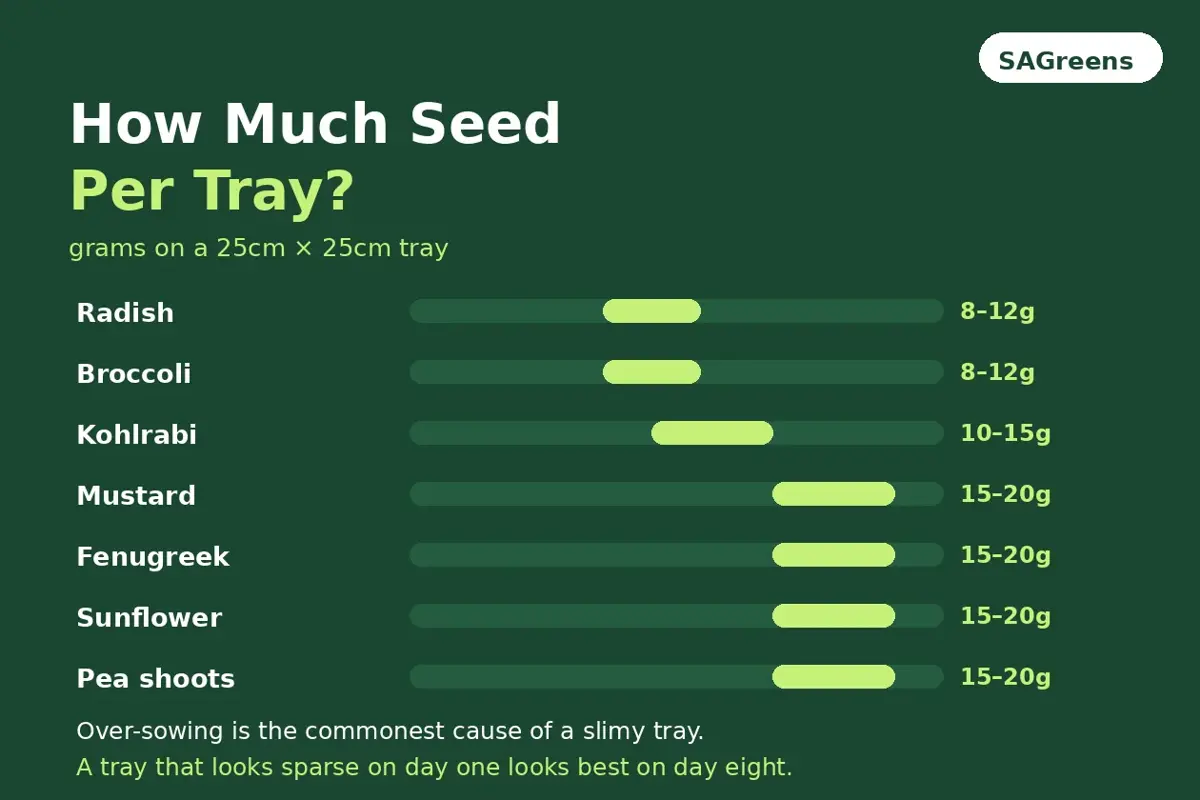
Almost every failed microgreen tray we hear about comes down to the same thing, and it isn't watering or light. It's too much seed.
Key Takeaways: Sowing rate is set by seed size, not by variety preference. Small seed like alfalfa and radish needs 8 to 12g on a 25cm tray; large seed like sunflower and pea needs 15 to 20g for the same area. Over-sowing is the single most common cause of a slimy tray, because seedlings mat together and trap moisture where no air reaches it. A tray that looks slightly sparse on day one is usually the one that looks best on day eight.
Why sowing rate matters more than people expect
A microgreen tray is a dense, wet, warm environment with a lot of living material in a small space. That works because air moves through the canopy and the surface dries a little between waterings.
Sow too heavily and both stop happening. The seedlings knit into a mat, the layer underneath stays permanently wet, and there's no airflow down at the medium. That's the condition slime and mould need, and no amount of careful watering afterwards will fix it.
The frustrating part is that an over-sown tray looks *better* for the first three days. It comes up thick and green and feels like a success. The problem shows up around day five, usually as a smell before you see anything.
Over-sowing is a decision you make on day one and discover on day five. By the time a tray smells sour, the cause is already four days old.
The numbers, by variety
These are the rates from our own variety guides, all for a standard 25cm × 25cm tray. Scale by area for a different tray — a 25cm × 50cm tray is double, so double the seed.
| Variety | Seed per 25cm tray | Seed size | Notes |
|---|---|---|---|
| Broccoli | 8 to 12g | Small, round | No soak needed |
| Radish | 8 to 12g | Small, 2-3mm | No soak needed |
| Kohlrabi | 10 to 15g | Small, 2-3mm | Even spread matters |
| Mustard | 15 to 20g | Very small | Sow dry, it clumps when wet |
| Fenugreek (methi) | 15 to 20g | Medium | Pre-soak 6 to 8 hours |
| Sunflower | 15 to 20g | Large | Pre-soak 8 to 12 hours |
| Pea shoots | 15 to 20g | Large | Pre-soak 8 to 12 hours |
Notice what the table is really telling you: the range across every variety is only 8 to 20g. Seed size moves it, but not by much. If you find yourself reaching for 40g because the tray looks bare, that's the instinct to resist.
Alfalfa is the one to be most careful with
Alfalfa deserves its own note, because it's the seed most likely to be over-sown by a wide margin.
The seed is tiny — smaller than radish — so a quantity that looks like almost nothing in your hand covers a surprising amount of tray. People pour what feels like a reasonable amount, and it turns out to be three or four times what the tray needs.
We don't publish a gram figure for alfalfa yet, and rather than invent one: sow it thinner than you would radish, and judge by coverage instead of weight. You want the seeds sitting close but not touching, with the cocopeat still visible between them. If you can't see any medium at all, there's too much on there.
That's a useful habit for any small seed, and it's more reliable than a kitchen scale at these quantities anyway.
How to judge coverage without weighing
Most home growers don't have a scale accurate at 10g, and it doesn't matter much. Coverage is the thing you're actually aiming at.
The single-layer rule is the one to remember. Two layers of sunflower means the bottom layer sits in water with the top layer's hulls pressing down on it, and that tray will rot from underneath.
One layer, always. Whatever the variety and whatever the scale says, seed stacked on seed will not end well.
What happens when you over-sow
Worth knowing the failure modes, because they're often blamed on the wrong thing.
| What you see | Usual cause | What it is not |
|---|---|---|
| Slimy layer at the medium, sour smell | Too dense, no airflow underneath | Not bad seed |
| White fuzz on the stems | Usually root hairs, sometimes mould | Root hairs disappear when misted; mould does not |
| Tray finishes short and uneven | Seedlings competing, or uncovered too early | Not low germination |
| Yellow at the base under green tops | Light can't reach the lower canopy | Not underwatering |
| Whole tray collapses around day 5 | Damping off, which density drives | Not overwatering alone |
The middle row is worth dwelling on, because it catches almost everyone once. Root hairs look exactly like mould — fine white fuzz on the stem near the medium. The difference: root hairs are only on the root and stem base, they appear evenly across the whole tray, and a light mist makes them lie flat and disappear. Mould spreads in patches, climbs the stems, and doesn't respond to misting. Our guide to common microgreen growing mistakes covers telling them apart in more detail.
Under-sowing is a real thing too, just less common
The opposite mistake wastes tray space and gives you a thin, sparse crop that flops over instead of standing up.
Microgreens support each other. A properly sown tray stands as a canopy because the seedlings lean on their neighbours. Too few, and each stem has to hold itself up, which it does badly.
If your tray comes out sparse and floppy rather than dense and upright, go up by a few grams next time rather than changing anything else.
Working out cost per tray
This is the number that actually matters when you're comparing seed prices, and almost nobody calculates it.
Take the pack price, divide by pack weight, multiply by your sowing rate.
A 100g pack of radish at ₹120 sown at 10g per tray is ₹12 of seed per tray, and the pack gives you about ten trays. A 100g pack of sunflower at ₹124 sown at 18g gives about five and a half trays, so roughly ₹22 per tray — nearly double, from packs that cost almost the same.
That's why comparing pack prices tells you very little. A cheap pack of a heavy-sowing seed can easily cost more per tray than an expensive pack of a light one.
For a rough sense across our range: most varieties land between ₹8 and ₹25 of seed per tray. The seed price guide has the per-variety figures if you want to work yours out.
Scaling up: what changes and what doesn't
The rate per unit area doesn't change when you grow more. The method does.
A grower running twenty-five trays a week uses roughly 250 to 400g of seed weekly depending on the mix, which is 1 to 1.6kg a month. At that point buying 100g packs stops making sense and wholesale quantities start to — our seed supplier page covers the tiers.
What does change at scale is how much a density mistake costs. Over-sowing one home tray wastes a few grams. Over-sowing a week's production wastes the seed, the trays, the medium and the week. Commercial growers weigh seed rather than eyeballing it, and that's the main reason.
Weigh it once, then trust your eye. Measure properly for the first two or three trays of a new variety, look carefully at what that amount looks like spread out, and after that you'll judge it by sight.
Sowing evenly, not just sowing the right amount
Getting the quantity right and then dumping it in the middle achieves nothing.
Scatter from a height of about 20cm rather than close to the tray — the extra distance spreads the seed naturally. Go across the tray twice in different directions rather than trying to cover it in one pass. Then look along the surface at eye level, not from above, because gaps and heaps are far more visible in profile.
For very small seed, mixing it with a spoonful of dry cocopeat before sowing helps it spread. That's a genuinely useful trick for alfalfa specifically, where the seed is small enough to be hard to see against the medium.
Converting the rate to your tray
The numbers above are for a 25cm × 25cm tray, which is 625 square centimetres. Almost nobody has exactly that, so here is the conversion.
Work out your tray's area in square centimetres, divide by 625, and multiply the rate by that figure.
| Tray size | Area | Multiply the rate by |
|---|---|---|
| 25cm × 25cm | 625 cm² | 1 (the baseline) |
| 25cm × 35cm | 875 cm² | 1.4 |
| 10 × 20 inch (roughly 25cm × 50cm) | 1,250 cm² | 2 |
| 30cm × 60cm | 1,800 cm² | 2.9 |
So radish at 8 to 12g on the baseline tray becomes 16 to 24g on a 10 × 20 inch tray, and around 23 to 35g on a 30cm × 60cm.
Two things people get wrong here. The first is scaling by the longest side rather than by area — a tray twice as long and twice as wide holds four times the seed, not twice. The second is forgetting that a deeper tray is not a bigger tray. Depth changes drainage, not surface area, and sowing rate only cares about surface.
The seeds that don't follow the table
Three exceptions worth knowing before they surprise you.
Mucilaginous seed. Basil is the one in our range. Like sabja, it forms a gel coat the moment it gets wet. Never pre-soak it — you end up with a solid jelly that cannot be spread. Sow it dry and mist from above, and expect it to look strange for the first day.
Hulled versus unhulled. Sunflower is sold both ways and they are not interchangeable by weight. Unhulled seed carries the black shell, which is a meaningful part of the weight and contributes nothing to the tray. If you switch between them, the rate changes even though the number on the scale looks the same.
Seed that swells a lot. Pea and sunflower roughly double in volume when soaked. The tray looked correctly covered before soaking and is then overcrowded after. Judge coverage after soaking, not before, or weigh dry and trust the figure.
When to go slightly under the table
The rates above assume ordinary conditions. Two situations call for sowing at the lower end.
Through the monsoon. Humidity is already working against you, and density is the other half of the same problem. Sowing at the low end of the range through July to September gives air somewhere to move and is the cheapest insurance there is against a lost tray. Our monsoon growing guide covers the rest of that adjustment.
In a closed, air-conditioned room. Still air behaves like humid air as far as the tray is concerned. If nothing is moving the air where you grow, sow lighter and put a small fan near the rack.
Going heavier is rarely the answer to anything. The one honest case is a variety with genuinely low germination, where a few extra grams compensate for the seeds that will not come up — and even then it is worth checking the tested germination figure on the product page first rather than assuming.
A worked example: planning a week of trays
Say you want to cut greens twice a week at home, running four trays on rotation — two radish, one sunflower, one alfalfa.
Radish at 10g per tray, two trays, is 20g a week. Sunflower at 18g, one tray, is 18g. Alfalfa sown thinly is the smallest of the three by some margin. Call it roughly 45 to 50g of seed a week in total across the four.
At that rate a 100g pack of radish lasts about five weeks, and a 100g pack of sunflower about five and a half. Which means a single order of three or four varieties covers a month or more of steady growing, and the seed cost of the whole operation is roughly ₹50 to ₹60 a week.
Two things fall out of that arithmetic which are worth noticing.
The first is that seed is not the expensive part of growing microgreens at home. Trays, medium and your time all cost more. People shop hard on seed price and then buy the wrong variety for what they actually want to eat, which is a far more expensive mistake than paying ₹20 more for a pack.
The second is that buying in bulk rarely makes sense at home scale. A kilogram of radish seed at home rates is close to a year's supply, and seed loses germination over time — faster in a humid climate. Two or three 100g packs replaced every couple of months will nearly always outperform one large pack slowly declining in a cupboard. Our seed storage guide covers how long seed actually holds in Indian conditions.
What to do with the rest of the pack
Sowing rate matters a second time here, because it decides how long the pack is open.
A variety you sow every week gets used up before storage becomes an issue. A variety you sow once a month sits in the cupboard for most of the year, and that is where germination quietly drops.
Keep opened packs airtight rather than folded shut, somewhere cool and dark, and add a silica gel sachet through the monsoon. Label the pack with the date you opened it. That last one sounds fussy and takes five seconds, and it is the difference between knowing a tray failed because the seed is eighteen months old and blaming your watering.
Frequently asked questions
How much seed do I need for one microgreen tray?
Between 8 and 20g for a standard 25cm × 25cm tray, depending on seed size. Small seed like radish and broccoli needs 8 to 12g; larger seed like sunflower and pea needs 15 to 20g. Scale by area for other tray sizes — a tray with double the surface needs double the seed.
How many trays will a 100g pack cover?
Roughly five to twelve, depending on the variety. Small seed goes further: a 100g pack of radish at 10g per tray gives about ten trays, while sunflower at 18g gives around five and a half. That's the number worth comparing when you're choosing between packs, rather than the price on the packet.
Why are my microgreens slimy at the bottom?
Almost always because the tray was sown too densely. The seedlings mat together, moisture sits underneath where no air reaches it, and slime follows within a few days. Sow thinner, bottom water rather than misting, and keep some air moving over the tray. It is very rarely a seed quality problem.
Is the white fuzz on my microgreens mould?
Usually root hairs, not mould. Root hairs appear evenly across the whole tray, only on the roots and stem bases, and lie flat and vanish when you mist them. Mould appears in patches, climbs the stems, often smells musty, and does not respond to misting. If it spreads upward over a day, treat it as mould.
Can I sow more seed to get a bigger harvest?
Not beyond a point, and past it you get less. A tray has a fixed amount of light, air and medium, so extra seed produces competing seedlings rather than more greens, and raises the risk of losing the tray entirely. Beyond roughly 20g on a 25cm tray you are usually buying risk rather than yield.
How much seed should I use for alfalfa?
Less than you would for radish. Alfalfa seed is very small, so judge by coverage instead of weight: seeds sitting close but not touching, with the cocopeat still visible between them. If no medium shows at all, there is too much on the tray.
Do I weigh seed before or after soaking?
Before. Soaked seed absorbs water and weighs considerably more, so a soaked measurement means nothing. Weigh dry, then soak, then sow — and remember soaked seed takes more room on the tray than it did in the packet.
How much seed does a commercial grower need per week?
Around 250 to 400g a week for twenty-five trays, depending on the variety mix, which is roughly 1 to 1.6kg a month. At that level wholesale quantities cost meaningfully less per gram than retail packs.
Getting the amount right first time
If you're starting a new variety, weigh the first two or three trays properly and look hard at what that quantity looks like spread across the surface. After that you'll judge it by eye, which is what everyone ends up doing.
You can see sowing rates alongside prices and harvest times for every variety on the seed catalogue. If a tray has gone wrong and you're not sure why, send us a photo through our contact page — density problems are usually obvious from a picture.
About the author. SAGreens is run by Ajay Toradmal in Keshav Nagar, Mundhwa, Pune, from a three-generation farming family. We sow these trays every week and have over-sown plenty of them.
Fresh Tips & Exclusive Offers
Subscribe for growing tips, seasonal updates, and exclusive offers on fresh organic microgreens in Pune.