Turnip Microgreen Seeds: Sowing Rate, Cost and Storage
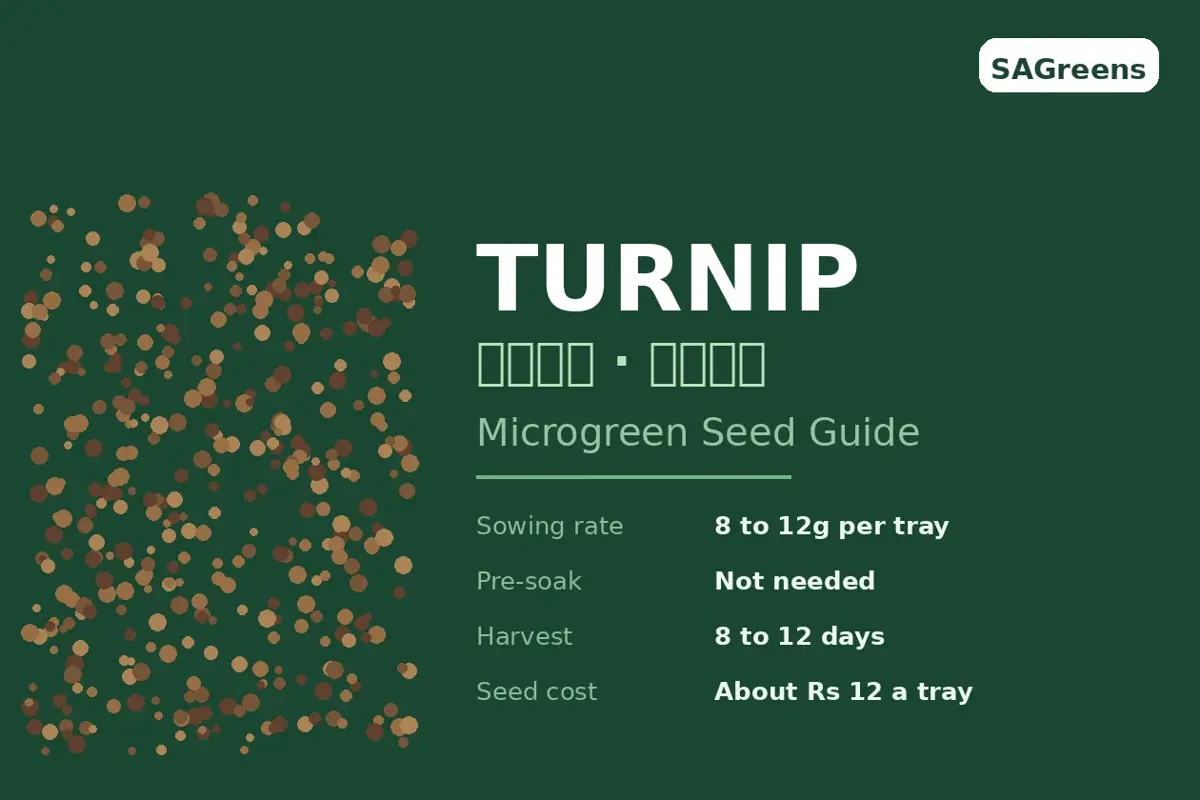
Key Takeaways: Turnip microgreen seed is a small brassica, botanically Brassica rapa, sold at SAGreens for ₹119 per 100g. Sow 8 to 12g on a standard 25cm tray, dry, with no pre-soak. Harvest at 8 to 12 days. It is one of the cheapest brassicas to run per tray at roughly ₹12, against about ₹100 for broccoli. The flavour is a gentle mustard bite, clearly there but well short of radish, which makes it the brassica for people who found radish too hot.
Turnip microgreen seeds come from one of the oldest vegetables grown in India and one of the newest microgreens. Most Indian kitchens know it as शलजम in Hindi or शलगम in Marathi, and know it as a winter root that goes into sabzi and pickle. Far fewer people know that the same seed, sown thickly on a tray and cut at ten days, gives a mild brassica green that sits between radish and cabbage in flavour and costs very little to grow.
This guide is about the seed rather than the method. If you have grown any small brassica before, the growing will not surprise you. What is worth knowing is how much seed a tray takes, what that works out to per harvest against the other varieties in our seed catalogue, how to tell food-grade seed from field seed dressed for sowing, and how long a pack stays worth using.
What Turnip Microgreen Seed Actually Is
Turnip is Brassica rapa, the same species as bok choy, mizuna and field mustard. That places it squarely in the brassica family alongside broccoli, kale, cabbage, kohlrabi and radish, and it behaves on a tray the way the rest of that family behaves: small round seed, fast germination, no soaking, and a peppery note that comes from glucosinolates rather than from anything added.
The seed itself is 1 to 2mm, round, and reddish brown to near black depending on the lot. Under a hand lens it is almost indistinguishable from radish or mustard seed, which is exactly why the question of where seed comes from matters more for brassicas than for anything else on a tray.
Turnip microgreen and turnip root are the same plant, harvested about ten weeks apart. Nothing is bred differently for microgreen use. What differs is that microgreen seed is sold for eating, so it is never treated with the fungicide dressings routinely applied to field seed.
The names are worth having straight, because Indian growers search for all of them. In Hindi it is शलजम, usually romanised shaljam. In Marathi it is शलगम, shalgam. In English it is turnip, and a botanist will call it Brassica rapa. All four refer to the same seed.
Turnip Seed at a Glance
| Specification | Turnip |
|---|---|
| Botanical name | Brassica rapa |
| Hindi / Marathi | शलजम (shaljam) / शलगम (shalgam) |
| Family | Brassica |
| Seed size | 1 to 2mm, round |
| Pre-soak | Not needed, sow dry |
| Sowing rate | 8 to 12g per 25cm tray |
| Blackout | 2 to 3 days |
| Days to harvest | 8 to 12 |
| Flavour | Gentle mustard bite, milder than radish |
| Pack | 100g at ₹119 |
| Trays per 100g pack | Roughly 8 to 12 |
That table is the short version of everything below. The rest of this guide explains where each figure comes from and what changes it.
How Much Turnip Seed Per Tray
Eight to twelve grams on a standard 25cm by 25cm tray. That is the same band as radish and broccoli, and for the same reason: the seeds are close enough in size that they cover a tray at the same density.
Sow at the lower end in the monsoon and at the upper end in winter. That is not a rule about turnip specifically, it is a rule about brassicas in humid air. A dense tray holds moisture at the base where no air reaches it, and a humid month turns that from a small problem into a slimy one. Our guide to how much seed to use per tray covers judging coverage by eye rather than by scale, which is more reliable at these quantities than a kitchen balance is.
Judge the sowing by what you can see, not what the scale says. Sown correctly, the seeds sit close but not touching, and you can still see cocopeat between them. If the surface looks like a solid layer of seed, that is too much.
The practical consequence is that a 100g pack runs somewhere between eight and twelve trays depending on how heavily you sow and how big your trays are. Growers using a 1020 tray, which is roughly 25cm by 50cm, should double the figure and expect four to six trays from a pack.
What Turnip Costs Per Tray
This is where turnip earns its place in a rotation. Seed price per 100g tells you very little on its own, because a variety that needs 20g a tray at ₹69 costs more per harvest than one needing 10g at ₹119. What matters is the cost of the seed that goes into one tray.
| Seed | Pack price | Sowing rate | Approximate cost per tray |
|---|---|---|---|
| Turnip | ₹119 / 100g | 8 to 12g | About ₹12 |
| Radish | ₹120 / 100g | 8 to 12g | About ₹12 |
| Fenugreek | ₹69 / 100g | 15 to 20g | About ₹12 |
| Mustard | ₹124 / 100g | 15 to 20g | About ₹22 |
| Kohlrabi | ₹360 / 100g | 10 to 15g | About ₹45 |
| Broccoli | ₹200 / 20g | 8 to 12g | About ₹100 |
The figures are arithmetic on the sowing rates above and the prices on each product page, using the midpoint of each rate. Every variety in the table is on the seed catalogue, where the pack price for each is listed. They are not a claim about yield, which depends on your light, your medium and your watering more than on the seed.
Turnip, radish and fenugreek all land near ₹12 of seed per tray. Broccoli lands near ₹100. That is not an argument against broccoli, which people buy for reasons other than cost. It is an argument for knowing which trays are cheap to run before you plan a week of them.
For a grower selling trays, the difference compounds. Ten turnip trays a week is about ₹120 of seed a week. Ten broccoli trays is about ₹1,000. Both may be worth running; only one of them is worth running by accident.
Untreated Seed Versus Dyed Field Seed
This is the single most important thing to check when buying any brassica seed in India, and it matters more for turnip than for most, because turnip is grown commercially as a root crop on a large scale. That means there is a great deal of turnip seed in the Indian market sold for field sowing, and field seed is frequently dressed with fungicide.
Treated seed is usually dyed. The colour is a warning, not a decoration: bright pink, blue, green or red coatings signal that the seed has been chemically treated and must not be eaten. The dressing is there to protect a seedling in soil over weeks. A microgreen is cut and eaten within days, so nothing gives a coating time to break down.
Never sow brightly coloured seed for microgreens. Pink, blue, red or green coatings mean a chemical treatment intended for field sowing. The colour exists precisely so that nobody mistakes it for food.
Untreated turnip seed looks like what it is: reddish brown to near black, matte, uncoated, with no smell beyond a faint dry mustiness. If a seller cannot tell you whether a lot is treated, that is the answer. Our guide on untreated and non-GMO seed sets out what each term means and what to ask before buying.
Untreated and non-GMO are two separate claims and are often confused. Untreated means no chemical coating has been applied to the seed. Non-GMO means the variety is not genetically modified. A seed can be one without being the other, and for an edible microgreen you want both.
Germination and How to Test It Yourself
Our turnip seed is germination tested before packing. We do not publish a percentage for it, because a figure quoted for one lot does not describe the next one, and a number carried forward from an old batch is worse than no number at all.
What you can do, and what any grower buying a new variety should do, is test a small sample yourself before committing a full tray schedule to it. The method takes ten minutes and four days.
Count out twenty seeds. Spread them on a piece of damp kitchen paper, fold it over, and put it in a covered container somewhere at room temperature and out of direct sun. Check after two days and again after four. Count how many have pushed out a root. Multiply by five and you have your germination percentage for that lot.
Twenty seeds, damp paper, four days, multiply by five. That is a germination test. It costs nothing, it settles arguments, and it tells you whether a disappointing tray was the seed or the method.
Brassicas as a group germinate fast. Turnip usually shows a root within 24 to 48 hours, which is one of the reasons it is a forgiving variety to learn on: a problem announces itself early, while there is still time to start again rather than at day eight when the tray is lost.
Sowing Turnip Seed: No Soak, and Why
Turnip seed does not need soaking, and soaking it makes things worse rather than better.
Small brassica seed takes up moisture directly from damp cocopeat within minutes of sowing. It has no thick hull to soften, unlike sunflower or pea, and no dormancy to break. Soaking it gains nothing on the germination side and costs you on the sowing side, because wet brassica seed clumps together and cannot be spread evenly.
The sequence is short. Level pre-moistened cocopeat in the tray, because small seed rolls into any dip and a tray sown into hollows comes up patchy. Broadcast the seed dry and as evenly as you can. Do not cover it. Mist the surface once, put a second tray on top as a blackout cover with a light weight on it, and leave it for two to three days.
The weight is the part people skip. It gives the seedlings something to push against, which is what makes the stems stand straight and even rather than sprawling. Two to three days is enough, and longer than that starts to stretch the stems too far.
After blackout, bring the tray into bright indirect light and switch to bottom watering. Misting knocks seedlings of this size flat and leaves water sitting on the leaves, which is where rot starts in a humid month.
Storage: How Long a Pack Stays Worth Using
Brassica seed stores well, which is part of why turnip seed is a sensible variety to buy in quantity.
Kept cool, dry and dark in an airtight container, most microgreen seed stays fully viable for 12 to 18 months and remains usable for two to three years with a declining germination rate. Brassicas are at the better end of that range. Our guide to microgreen seed storage and shelf life covers viability by variety and how to store through monsoon humidity.
The enemy is moisture rather than time. A pack opened and reclosed in a humid kitchen through July will decline faster than a pack kept sealed in a cupboard for two years. A silica gel sachet in the container is worth the small trouble it takes.
Seed does not expire on a date, it declines on a curve. An older pack is not useless; it germinates at a lower rate. Test it rather than discarding it, and if it comes back at 70 percent, sow a little heavier and carry on.
Buying Quantity for a Commercial Schedule
If you are running trays to sell rather than to eat, the arithmetic is worth doing before you order rather than after.
At ten grams a tray, a 100g pack covers roughly ten trays. A grower cutting ten turnip trays a week needs about 520g a year, which is a little over five packs. Ordering that in one go rather than monthly reduces what you spend on delivery, which is charged by order weight on every order and is never free.
| Trays per week | Seed per week | Seed per year |
|---|---|---|
| 5 | About 50g | About 2.6kg |
| 10 | About 100g | About 5.2kg |
| 20 | About 200g | About 10.4kg |
| 50 | About 500g | About 26kg |
Those are seed figures, not order figures. Buy a little over, because a tray sown slightly heavy is a normal occurrence and running out mid-week is not.
For quantities beyond a kilogram it is worth talking to us rather than ordering through the site, since we can quote on the lot. Contact us with the varieties and the weekly tray count and we will come back with a price.
What Turnip Tastes Like
A gentle mustard bite. That is the short answer, and it is the reason to stock turnip alongside radish rather than instead of it.
Brassica microgreens all carry some heat, and they differ mostly in how much. Radish is the sharpest of the common ones, mustard close behind, broccoli mild and slightly cabbage-like, kale mild and sweet. Turnip sits between broccoli and radish: clearly a brassica, clearly peppery, but well short of the heat that makes people push radish microgreens to the side of the plate.
| Variety | Heat | Best for |
|---|---|---|
| Radish | Sharp | Cutting through rich food, chaat, dal |
| Mustard | Sharp | Sandwiches, anything that needs a lift |
| Turnip | Gentle | Salads, sandwiches, fussy eaters |
| Broccoli | Mild | Eating in volume, children |
In practice this makes turnip microgreen seed the brassica to offer someone who tried radish microgreens and found them too strong. It behaves the same way on a tray, costs about the same per tray, and the flavour is a step down in heat rather than a different thing altogether.
The texture is worth a note too. Turnip stems stay tender rather than turning fibrous if you cut on time, which is part of why the harvest window matters more than the day count. Cut when the cotyledons are fully open and the stems are firm, which is usually somewhere between day eight and day twelve depending on your light and temperature.
Growing Turnip Microgreens Through Indian Seasons
The seed does not change through the year. What changes is the air around the tray, and brassicas respond to that more than most.
Through the monsoon, when humidity in coastal and western India sits high for weeks, sow at the lower end of the range and give the tray more airflow than feels necessary. A small fan on the other side of the room is enough. The failure mode in those months is almost never germination, it is a dense tray holding water at the base. Our monsoon growing guide covers the adjustments that matter across varieties.
Through a north Indian winter, germination slows. Seed that shows a root in 24 hours in September may take 48 in January, and the harvest slides from eight days toward twelve. That is normal and needs no intervention beyond patience.
Through the pre-monsoon heat, the risk reverses. Trays dry out faster, and a tray that dries during blackout will come up patchy. Check the base rather than the surface.
Troubleshooting Turnip Trays
| Problem | Likely cause | What to do |
|---|---|---|
| Patchy germination | Seed sown into dips in an unlevelled medium | Level the cocopeat before sowing and press it lightly flat |
| Slimy base, sour smell | Sown too heavily, no airflow | Sow at the lower end of the range, bottom water, move air across the tray |
| White fuzz on the medium | Usually root hairs, not mould | Root hairs are fine and disappear when watered; mould is grey or green and spreads |
| Long pale stems, floppy | Blackout ran too long or no weight on the cover | Two to three days of blackout with a light weight, then light |
| Stems fibrous, flavour harsh | Cut too late | Harvest when cotyledons open fully, day eight to twelve |
| Seed floating and clumping | Seed was soaked before sowing | Sow turnip dry, it needs no soak |
| Uneven height across the tray | Uneven broadcast, or light from one side only | Spread more evenly and turn the tray daily |
Frequently Asked Questions
How much do turnip microgreen seeds cost in India?
₹119 for a 100g pack from SAGreens. At a sowing rate of 8 to 12g per standard tray that is roughly ₹12 of seed per tray, which puts turnip among the cheapest brassicas to run. Delivery is charged on every order by weight and is shown at checkout.
What is turnip called in Hindi and Marathi?
Turnip is शलजम, romanised shaljam, in Hindi, and शलगम, shalgam, in Marathi. Botanically it is Brassica rapa. All of these refer to the same plant and the same seed.
How much turnip seed do I need per tray?
Eight to twelve grams on a standard 25cm by 25cm tray. Use the lower end through the monsoon and the upper end in winter. On a 1020 tray, roughly 25cm by 50cm, double it.
Do turnip seeds need soaking before sowing?
No. Turnip is a small brassica seed like radish and broccoli, and it absorbs moisture directly from damp cocopeat. Soaking makes the seed clump together and sow unevenly without improving germination.
How long do turnip microgreens take to grow?
Eight to twelve days from sowing to harvest, including two to three days of blackout. Germination usually shows within 24 to 48 hours. Cooler weather pushes the harvest toward the longer end.
What do turnip microgreens taste like?
A gentle mustard bite. Clearly a brassica and clearly peppery, but well short of radish or mustard. It suits people who want some sharpness without heat, and works in salads and sandwiches rather than as a garnish on rich food.
Are turnip microgreens the same plant as turnip roots?
Yes. The same seed, Brassica rapa, harvested about ten weeks earlier. Nothing is bred specifically for microgreen use. The difference that matters is that microgreen seed is sold for eating and is never fungicide dressed.
Can I use turnip seed bought for field sowing?
No. Seed sold for field sowing is frequently treated with fungicide and is often dyed pink, blue, green or red as a warning. A microgreen is cut and eaten within days, so a coating has no time to break down. Only use seed sold as untreated and food grade.
Is turnip microgreen seed non-GMO?
Ours is non-GMO and untreated. Those are two separate claims that are often confused: untreated means no chemical coating on the seed, non-GMO means the variety is not genetically modified. For anything eaten raw you want both.
What germination rate should I expect from turnip seed?
Our seed is germination tested before packing. We do not publish a single figure, because a percentage from one lot does not describe the next. Test your own: twenty seeds on damp kitchen paper, count the roots after four days, multiply by five.
How long does turnip seed stay viable?
Most microgreen seed stays fully viable for 12 to 18 months and usable for two to three years with declining germination. Brassicas store at the better end of that. Keep it airtight, cool, dark and dry, with a silica gel sachet through humid months.
Why is my turnip tray slimy at the base?
Almost always sown too heavily with too little airflow. A dense tray traps moisture at the base where no air reaches it. Sow at the lower end of the range, water from the bottom rather than misting, and keep air moving over the tray.
Is turnip a good microgreen for beginners?
Yes. It needs no soaking, germinates within a day or two so problems show early, and tolerates the watering mistakes everyone makes at first. It is in the same forgiving group as radish and broccoli.
How does turnip compare with radish as a microgreen?
They cost about the same per tray, grow on the same schedule and need the same handling. The difference is heat: radish is sharp, turnip is gentle. Choose turnip where radish would overpower the dish or the eater.
Can I grow turnip microgreens without soil?
Yes. Turnip grows on cocopeat, on a hydroponic mat or on any clean medium that holds moisture without waterlogging. Cocopeat is the usual choice in India because it is cheap and widely available.
How many trays will a 100g pack of turnip seed cover?
Roughly eight to twelve standard 25cm trays, depending on how heavily you sow. On larger 1020 trays expect four to six.
Do you deliver turnip seeds across India?
Yes. Seed ships from our farm in Keshav Nagar, Mundhwa, Pune to any Indian pin code. Delivery is charged by order weight and shown before you confirm, and it is never free.
Can I buy turnip seed in bulk for commercial growing?
Yes. A grower cutting ten trays a week needs a little over five 100g packs a year. For quantities beyond a kilogram, contact us with your varieties and weekly tray count and we will quote on the lot.
What should I grow alongside turnip?
Anything that contrasts with it. Turnip is mild, so a sharp variety like radish or mustard and a sweet one like pea shoots give a tray schedule some range. Growers selling mixed boxes usually want one of each rather than three brassicas.
About SAGreens
SAGreens is a microgreens farm in Keshav Nagar, Mundhwa, Pune, run by Ajay Toradmal, whose family has farmed for three generations. We grow microgreens to order and we sell the seed we use, which is why the figures in this guide are the ones we work to rather than numbers collected from elsewhere.
Seed ships to any Indian pin code. If you want a recommendation for your setup, your climate or your tray schedule rather than a catalogue, contact us and tell us what you are working with.
Fresh Tips & Exclusive Offers
Subscribe for growing tips, seasonal updates, and exclusive offers on fresh organic microgreens in Pune.