Microgreen Seeds in Lucknow: What to Buy, and How to Grow Through a Real Winter
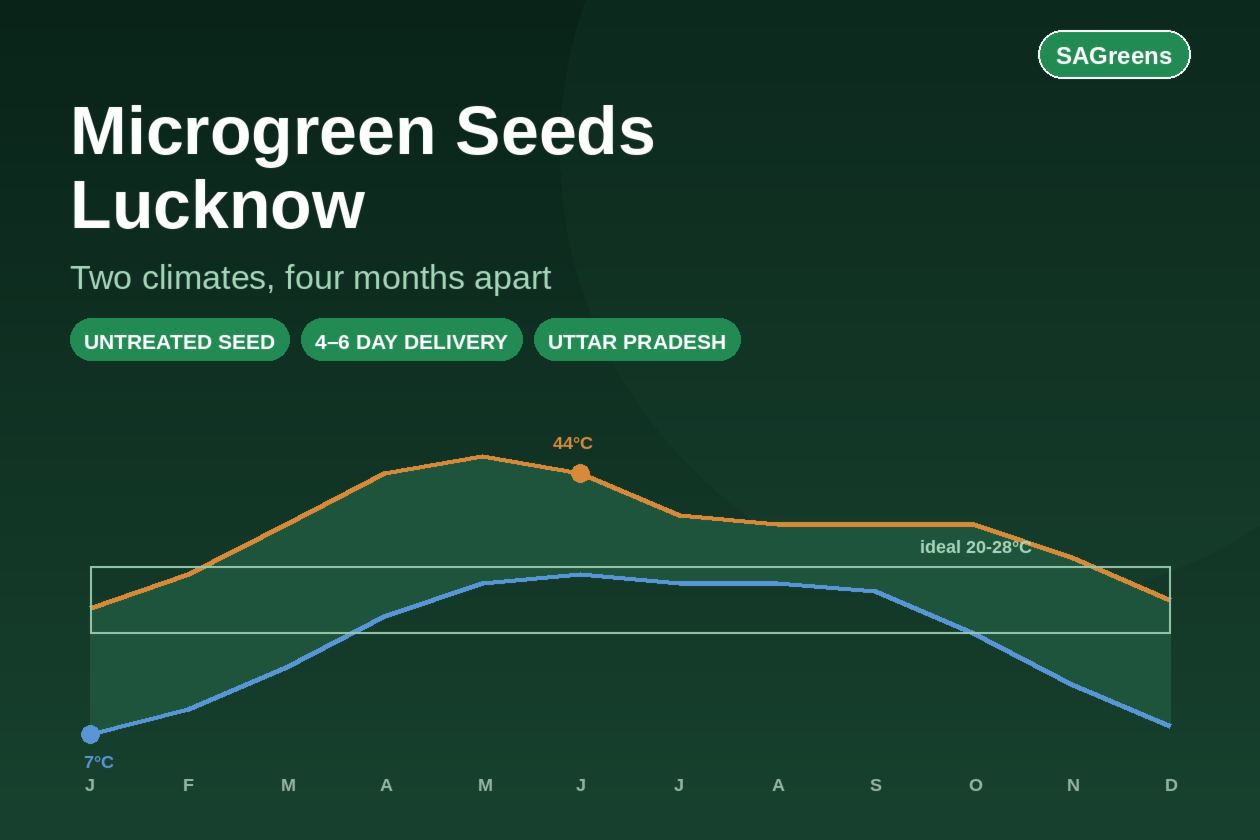
Every other city we ship seed to has one climate problem. Mumbai and Kochi have humidity, Chennai and Ahmedabad have heat, Bangalore has neither. Lucknow has both, four months apart, and that makes it the one city in our range where a grower has to change method twice a year.
Key Takeaways: Lucknow swings from 44°C in June to single-figure nights in January, a wider range than any southern city. In December and January a tray takes two to four days longer than the packet says, because germination slows below 18°C — that is normal and not a seed problem. October to November and February to March are the best growing windows. Radish, mustard and fenugreek handle the range best. Seed reaches Lucknow from our Pune farm in 4 to 6 business days.
This guide covers what to buy for Lucknow's conditions, what the cold months actually do to a tray, and how seed gets here. For the growing method itself, our complete growing guide covers it from sowing to cut.
Why Lucknow is different from every southern city
Microgreens germinate best between 20 and 28 degrees. Most Indian cities sit inside or just above that band all year, which is why growing guides written for Bangalore or Pune barely mention temperature. Our national microgreen seeds page covers the varieties, sowing rates and prices that hold anywhere in India; this page covers only what Lucknow changes.
Lucknow leaves it twice a year.
| Season | Months | Typical range | What it does to a tray |
|---|---|---|---|
| Winter | Dec–Jan | 7–10°C nights, 20–25°C days | Germination slows; add 2–4 days |
| Spring | Feb–Mar | 15–30°C | The best window of the year |
| Summer | Apr–Jun | up to 44°C | Medium dries fast; damping-off risk if over-watered |
| Monsoon | Jul–Sep | 30–35°C, high humidity | Mould risk; short-cycle varieties only |
| Autumn | Oct–Nov | 18–30°C | The second best window |
The practical consequence is that a grower here who follows a guide written for the Deccan will conclude twice a year that something is wrong with the seed. It usually is not.
A slow tray in January is a cold tray, not a bad lot. Below about 18°C, germination takes two to four days longer than the packet states, and the whole crop finishes late rather than unevenly. Judge a winter tray on day five, not day two.
Growing through a Lucknow winter
This is the part no other city page on this site needs to cover, so it is worth being specific.
Move the tray indoors and inland from the window. A windowsill that is perfect in October is the coldest surface in the house in January. Two feet back into the room is warmer by several degrees overnight, which is most of what you need.
Do not water cold. Water at room temperature rather than straight from a winter tap. Cold water on a cold medium drops the root-zone temperature further at exactly the wrong moment.
Extend the blackout by a day. The seedlings are slower to reach the two to three centimetres that signal uncovering, and pulling the cover on schedule rather than on the plant leaves you with a short, uneven tray. Our microgreens germination guide gives the normal timings this is measured against.
Expect a longer, better crop. Slow winter growth produces denser, sweeter microgreens than a fast summer tray. Radish grown in January is noticeably better than radish grown in May — you simply wait ten days for it rather than seven.
Sow slightly heavier. Ten to fifteen per cent above your usual rate compensates for the handful of seeds that will not make it at low temperature.
Growing through a Lucknow summer
April to June is the harder half, and the answer is the opposite of the winter one.
Above 35°C the medium dries between waterings and the seedlings wilt before you notice. Above 40°C, which Lucknow reaches routinely in May and June, an unshaded tray on a balcony cooks.
Fresh from SAGreens
Organic Microgreen Seeds — Delivered Across India
Quality-tested sunflower, radish, broccoli, mustard & more. Shipped to your door in Pune, Bangalore, Delhi, Mumbai and all major cities.
What to grow in Lucknow
| Variety | Why it suits Lucknow | Days | Price |
|---|---|---|---|
| Red radish | Shortest cycle, handles both extremes | 6–8 | ₹120 / 100g |
| Mustard | Nearly as fast, familiar flavour | 6–8 | ₹124 / 100g |
| Fenugreek (methi) | No soaking, no blackout, forgiving | 8–12 | ₹69 / 100g |
| Sunflower | Best Oct–Mar; dislikes peak summer | 7–10 | ₹124 / 100g |
| Pea shoots | A winter crop here, and a good one | 10–14 | ₹88 / 100g |
| Coriander | Slow; worth it Oct–Feb only | 10–14 | ₹124 / 100g |
Start with radish. It germinates in under two days, needs no soaking, and its short cycle is the best defence against both of Lucknow's problems. Our red radish seed guide covers sowing rates in detail.
Pea shoots deserve a note. In most of India they are a marginal crop that dislikes humidity. In a Lucknow December they are excellent — cool nights are exactly what they want, and this is one of the few Indian cities that gets them reliably.
The seasonal advantage nobody mentions: Lucknow's winter is a genuine asset for the slower, sweeter varieties that southern growers struggle with. Pea shoots, coriander and broccoli all do better here in January than they do in Bangalore in any month.
How Lucknow compares with the cities we already ship to
Worth setting out, because most microgreen advice written in India is written from a southern or western city and quietly assumes their conditions.
| City | Coldest nights | Hottest days | The problem to solve |
|---|---|---|---|
| Bangalore | 15–17°C | 33–35°C | Almost none; the easiest climate in India |
| Pune | 10–12°C | 38–40°C | May heat, briefly |
| Mumbai | 17–19°C | 33–35°C | Humidity, four months of it |
| Kochi | 23–24°C | 33–35°C | Humidity, most of the year |
| Chennai | 20–22°C | 38–42°C | Heat and coastal damp together |
| Jaipur | 8–10°C | 40–44°C | Dry heat, and dry air on stored seed |
| Lucknow | 7–10°C | up to 44°C | Both ends, four months apart |
Jaipur is the closest comparison and still not the same: its winters are dry and its problem is what the air does to stored seed, while Lucknow's winter is damp enough that the issue is root-zone temperature instead. Our microgreen seeds Jaipur guide sets out the dry-climate version of the same swing.
The practical translation is simple. A guide written for Bangalore will tell you microgreens take seven days and never mention temperature, because in Bangalore that is true every month of the year. In Lucknow it is true in October and wrong in January, and knowing which month you are in is most of what separates a grower here who continues from one who gives up after a slow December tray.
If you have grown microgreens elsewhere in India and moved to Lucknow, the adjustment is seasonal rather than technical. Nothing about the method changes. What changes is that you now have two months where the tray is slow and two where it is stressed, and five that are as good as anywhere in the country.
Seed prices and what a tray costs
Prices are the same across India; Lucknow pays no premium. What varies is delivery, which is charged separately by weight and pin code.
| Pack | Price | Fills | Seed per tray |
|---|---|---|---|
| Wheatgrass 100g | ₹50 | 1–2 trays | ₹40–50 |
| Fenugreek 100g | ₹69 | 4–5 trays | ₹17–21 |
| Pea shoot 100g | ₹88 | 3–4 trays | ₹26–35 |
| Red radish 100g | ₹120 | 8–12 trays | ₹10–14 |
| Mustard 100g | ₹124 | 5–7 trays | ₹19–25 |
| Broccoli 20g | ₹200 | ~2 trays | ₹80–120 |
Radish is the cheapest tray in the range and the easiest to grow, which is why it is the recommendation for a first order almost everywhere. Our India seed price guide works the arithmetic across the full catalogue.
Buying microgreen seeds in Lucknow
There is no dedicated microgreen seed supplier in Lucknow, so growers here order online. That is not a disadvantage — it is how most of the country buys this seed.
What the local alternative gets you. Nurseries around Aminabad and the agricultural suppliers near Chowk stock field vegetable seed. That seed is bred for a plant grown to maturity in soil, is frequently dressed with fungicide, and rarely carries a germination figure. Fungicide-treated seed is usually dyed pink, red or blue as a warning, but undyed treated seed exists too. It grows a perfectly good tray that must never be eaten. Our seed safety guide covers how to tell.
What we ship. Untreated, non-GMO seed, germination tested before packing, in moisture-proof packs. Roughly fifteen varieties, listed with current pricing on the seed catalogue.
How long it takes. Four to six business days from our farm in Keshav Nagar, Mundhwa, Pune — around 1,400km, to any Lucknow pin code: Gomti Nagar, Hazratganj, Indira Nagar, Aliganj, Alambagh, Mahanagar and the older city alike. That is a day or two longer than Delhi and comparable to Kolkata. Timings follow the courier network rather than any promise we can make, so treat them as typical rather than guaranteed. Delivery is charged at checkout by weight and pin code.
Storing seed through the swing
Lucknow's storage problem is the same swing that complicates growing: dry heat in summer, damp in the monsoon, cold in winter.
Most microgreen seed holds two to three years stored properly, and brassicas manage four. Our seed storage guide covers viability by variety.
Microgreens in an Awadhi kitchen
Lucknow's food is not salad-forward, and pretending otherwise is how microgreens get bought once and never again.
Where they actually work here is as a finishing element on food that is already rich — the kind of plate a Chowk kebab shop or a Hazratganj kitchen sends out. Mustard or radish microgreens scattered over galouti or seekh kebab cut through fat the way a raw onion does, with more flavour and less bite. Coriander microgreens on biryani, added after the dum is opened rather than cooked in, keep an aroma that mature dhania loses. Fenugreek microgreens fold into a winter saag or a paratha dough in a way that is already familiar to anyone who cooks methi.
The rule for rich food is to add them off the heat and at the last moment. Cooked into a dish, they contribute nothing a mature leaf would not do better and more cheaply. Our guide to microgreens in Indian cuisine works through the same principle across other regional kitchens.
What goes wrong in Lucknow specifically
| What you see | Cause | What to do |
|---|---|---|
| Nothing at 48 hours in December | Normal below 18°C | Wait until day 4–5; move the tray off the windowsill |
| Tray finishes short and uneven in winter | Uncovered on schedule rather than on height | Extend blackout a day; uncover at 2–3cm |
| Wilting by mid-afternoon in May | West-facing surface, afternoon sun | East light only; water early morning |
| Damping off in July and August | Crowded sowing plus monsoon humidity | Sow 10–15% thinner; run a fan |
| Patchy germination year-round | Sowing by eye rather than by weight | Weigh the seed; a kitchen scale is enough |
| Seed that worked in autumn fails in spring | Stored through the monsoon without a desiccant | Airtight plus silica from July |
Most of these are the general faults in a colder setting rather than anything unique to the city, and our guide to the common microgreen growing mistakes covers them in their usual form.
Frequently Asked Questions
Where can I buy microgreen seeds in Lucknow?
There is no dedicated microgreen seed supplier in the city, so most growers order online. SAGreens ships untreated, germination-tested seed from Pune, reaching Lucknow in 4 to 6 business days. Local nurseries around Aminabad and Chowk stock field vegetable seed, which is often fungicide-treated and rarely carries a germination figure.
How long does seed delivery to Lucknow take?
Four to six business days from our Pune farm, roughly 1,400km away. That is a day or two longer than Delhi and comparable to Kolkata. Timings follow the courier network, so a monsoon week or a public holiday can add a day. Delivery is charged at checkout by weight and pin code.
Can I grow microgreens in Lucknow in winter?
Yes, and the results are better than in summer. Below about 18°C germination slows, so a tray takes two to four days longer than the packet says and the whole crop finishes late rather than unevenly. Move the tray a couple of feet back from the window, use room-temperature water, and extend the blackout by a day. Slow winter growth produces denser, sweeter microgreens.
Which microgreens grow best in Lucknow?
Radish and mustard handle both extremes and are the year-round choices. Fenugreek is forgiving and needs no soaking. Sunflower is good from October to March. Pea shoots and coriander are genuinely better here in winter than they are in most Indian cities, because they want the cool nights Lucknow gets and Bangalore does not.
What are the best months to grow microgreens in Lucknow?
October to November and February to March. Both sit in the 18 to 30 degree band that suits every variety, with neither the cold that slows December germination nor the heat that complicates May. December and January work with small adjustments; April to June and the monsoon need variety choice and more care.
Why is my tray taking longer than the packet says?
If it is December or January, temperature. Germination below 18 degrees is slower, and two to four extra days is normal rather than a sign of poor seed. If it is May or June and the tray is wilting rather than slow, that is heat and afternoon sun. Test the seed on damp tissue if you are unsure — twenty seeds, counted at day five, tells you whether the lot is fine.
How much do microgreen seeds cost in Lucknow?
The same as anywhere in India: ₹50 per 100g for wheatgrass at the low end, ₹69 for fenugreek, ₹88 for pea shoot, ₹120 to ₹124 for radish, mustard, sunflower and coriander, and ₹200 for a 20g pack of broccoli. Delivery is charged separately. The seed catalogue carries current pricing.
Can I use seeds from a Lucknow nursery or agri shop?
Only if they are confirmed untreated. Seed sold for field planting is routinely dressed with fungicide, and treated seed is usually dyed pink, red or blue so it cannot be mistaken for food. Undyed treated seed exists too, so ask rather than assume. That seed grows perfectly well and must never be eaten as a microgreen.
How do I stop mould during the Lucknow monsoon?
Sow ten to fifteen per cent thinner than usual, bottom water only so the leaves stay dry, keep air moving with a small fan, and stick to short-cycle varieties like radish and mustard so the tray spends fewer days at risk. Wash trays in hot water with a splash of vinegar between crops.
Do I need a grow light in Lucknow?
No. Ambient daylight is sufficient year-round, including through the monsoon. An east-facing window giving four to six hours of bright indirect light is enough for every variety. A light only becomes useful if your only available spot is genuinely dark.
How should I store seed in Lucknow?
Airtight, cool and dark, with a food-grade silica sachet added from July to September. Monsoon humidity does more damage than heat does. Keep containers away from the kitchen stove. Lucknow's dry winter is close to ideal storage, so seed bought in autumn is usually in good condition by spring.
How much seed do I need per tray?
Eight to twelve grams for a small seed like radish or mustard on a 25cm by 25cm tray, twenty to twenty-five for sunflower, and twenty-five to thirty for fenugreek. Add ten to fifteen per cent in December and January to compensate for cold, and take the same amount off during the monsoon to keep air moving through the canopy.
Is growing microgreens in Lucknow worth it commercially?
The climate makes it more work than in Bangalore or Pune, but the market is less served. Lucknow has a substantial restaurant scene — the Hazratganj dining strip and the newer hotels and cafes around Gomti Nagar — and almost no local microgreen supply, which is the opposite of the position in Bangalore. Our guide to where to sell microgreens covers the channels and what each pays.
Do you deliver to other cities in Uttar Pradesh?
Yes. Seed ships anywhere in the state on the same 4 to 6 day timing — Kanpur, Varanasi, Agra, Prayagraj, Gorakhpur and Noida included. The growing guidance on this page applies across the state, since the temperature swing is much the same throughout the plains.
Do you sell seed in bulk for Lucknow growers?
Yes. Wholesale starts at 500g per variety, typically 25 to 45 per cent below retail, and improves again from 1kg. Our seed supplier page covers terms, GST invoicing and lot consistency. Tell us your weekly tray count rather than a weight and we will work the quantity back from it.
Ordering seed for Lucknow
SAGreens is a microgreens farm in Keshav Nagar, Mundhwa, Pune. We do not have a facility in Lucknow or anywhere in Uttar Pradesh — what we send is seed, and it reaches you in 4 to 6 business days.
Every variety is listed with current pricing on the seed catalogue, and our seed supplier page covers wholesale for commercial growers. If a tray is behaving oddly — and a Lucknow January produces more puzzled emails than any other month — send us a photo through our contact page and we will tell you what we see.
About the author. SAGreens is run by Ajay Toradmal in Keshav Nagar, Mundhwa, Pune, from a three-generation farming family.
More Microgreens Tips & Recipes
Buying Microgreen Seeds Online: Safety & Quality Checks
Learn what to check before buying microgreen seeds online in India — untreated seed, germination testing, NPOP certification and pricing.
Microgreen Seeds Bangalore: Buy for Home & Commercial Use
Where to buy microgreen seeds in Bangalore. SAGreens supplies Non-GMO, food-grade seeds for home growers and commercial farmers with pan-India delivery.
Microgreen Seeds Pune: Buy Online & Wholesale 2026
Find the best microgreen seeds in Pune: online ordering, wholesale prices, local suppliers and delivery to all Pune pin codes.
Fresh Tips & Exclusive Offers
Subscribe for growing tips, seasonal updates, and exclusive offers on fresh organic microgreens in Pune.