Amaranth & Beetroot Microgreen Seeds: India Growing Guide
Amaranth & Beetroot Microgreen Seeds: India Growing Guide
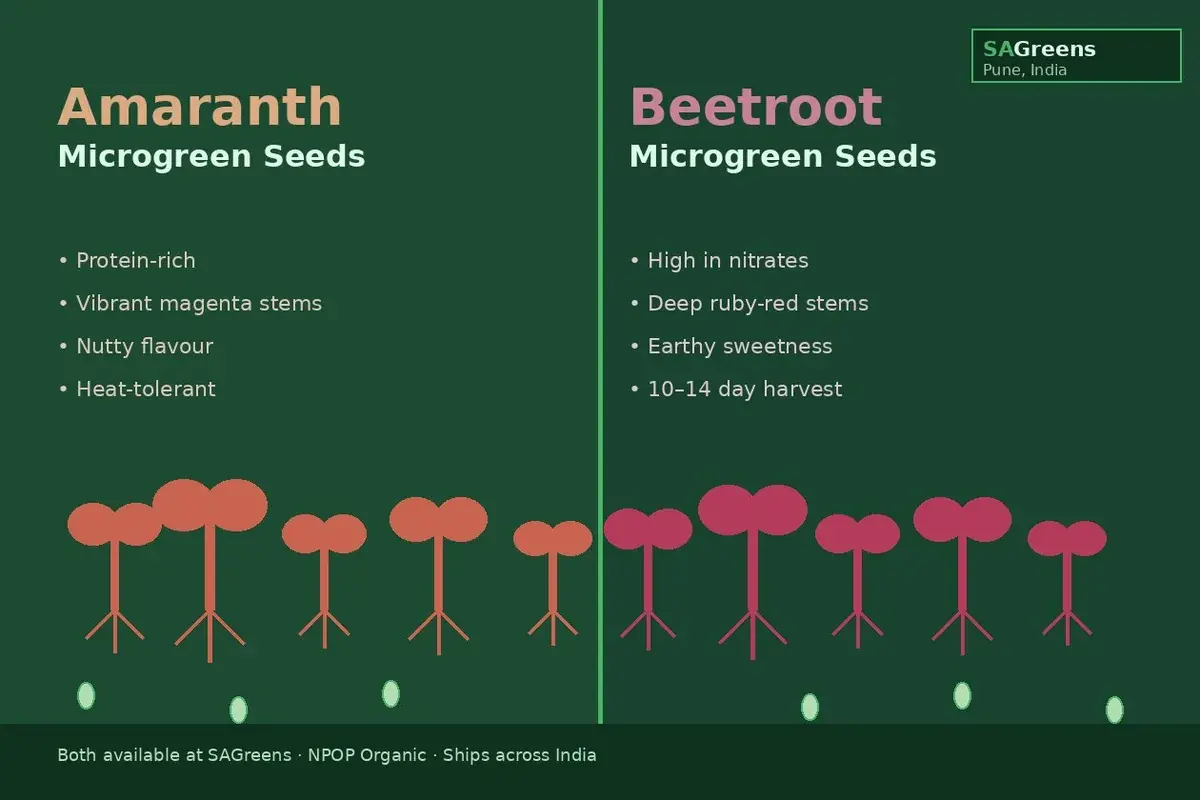
Key Takeaways: Amaranth and beetroot are two of the most visually striking and nutritionally valuable microgreen varieties available in India. Amaranth microgreens — known as lal saag (red vegetable) in Hindi — are protein-rich with vivid magenta stems. Beetroot microgreens deliver high nitrate content and stunning ruby-red colour. Both are grown from seeds available at SAGreens: see our seeds page for current availability. Both varieties take 10–14 days from seed to harvest and are suitable for home growing across all Indian climates.
India has a long culinary relationship with both amaranth and beetroot in their mature forms. Lal saag (amaranth leaves) is a beloved leafy green in Maharashtra, Gujarat, and across south India. Beetroot (chukander) features in everything from raitas to halwas to Punjabi salads. What many Indian home cooks and health enthusiasts are discovering is that the microgreen form of both vegetables offers extraordinary nutritional concentration in a fraction of the growing time — and with visual impact that makes them as appealing on a plate as they are in a nutrition chart.
This guide covers everything you need to know about growing amaranth microgreen seeds and beetroot microgreen seeds at home in India: what makes each variety special, step-by-step growing instructions from seed to harvest, the nutritional profile of each, how they work in Indian cooking, where to buy quality seeds in India, and how to grow them together in mixed trays.
For readers in Pune and Maharashtra looking to buy these seeds locally with fast delivery, SAGreens supplies both amaranth and beetroot microgreen seeds online. For growing guidance on other varieties, our complete microgreen seed types guide covers over 15 varieties.
Part 1: Amaranth Microgreen Seeds
What Are Amaranth Microgreen Seeds?
Amaranth microgreens are grown from the same seeds as the mature amaranth plant — varieties including red amaranth (Amaranthus tricolor), which produces the most vivid magenta-pink stems that make this microgreen so visually distinctive, and green amaranth (Amaranthus viridis), which produces lighter green stems.
For microgreen growing in India, red amaranth seeds are the most popular choice because of their visual impact and flavour. The microgreens have bright magenta stems, small green leaves with reddish tones, and a mild, slightly earthy flavour that works well in both sweet and savoury applications. Red amaranth microgreens are sometimes called rajgira microgreens (rajgira is the Hindi name for amaranth seed).
Amaranth seeds used for microgreens are tiny — considerably smaller than sunflower or pea shoot seeds. This means seeding density is measured differently, and the seeds do not require pre-soaking before planting (unlike large seeds such as sunflower or pea shoots).
Nutritional Benefits of Amaranth Microgreens
Amaranth microgreens are nutritionally exceptional. Research on amaranth microgreens has shown:
Protein: Amaranth microgreens contain approximately 3–4g of protein per 100g fresh weight — unusual for a leafy green. Amaranth is one of very few plant sources with a complete amino acid profile, containing all essential amino acids including lysine, which is deficient in most grain-based diets.
Iron and calcium: Amaranth microgreens are rich in iron (critical for India, which has among the world's highest rates of iron deficiency anaemia) and calcium. The iron in amaranth is non-haem iron, so pairing with vitamin C-rich foods enhances absorption.
Vitamin C and vitamin K: Both are present in significant quantities in amaranth microgreens. Vitamin C content is highest immediately after harvest.
Antioxidants (betalains): The vivid magenta colour of red amaranth microgreens comes from betalain pigments — the same antioxidants found in beetroot. These have anti-inflammatory and antioxidant properties documented in nutritional research.
For Indian vegetarian and vegan diets, amaranth microgreens offer a rare combination of complete protein and iron in a single ingredient — making them particularly valuable as a daily nutritional addition.
How to Grow Amaranth Microgreens: Step-by-Step
What you need: Amaranth microgreen seeds, a growing tray (30x20cm or larger), growing medium (cocopeat recommended — see our cocopeat growing guide), a spray bottle, and a location with indirect bright light.
Step 1: Prepare your growing medium
Fill your tray with damp cocopeat to a depth of 2.5–3cm. Press gently to create a level surface. The medium should be moist but not waterlogged — if you squeeze a handful and water drips freely, it is too wet.
Step 2: Sow the seeds
Scatter amaranth seeds evenly across the surface. Because the seeds are tiny, aim for even coverage without thick clumping. A useful technique is to mix the seeds with a small amount of dry sand to help spread them evenly. Seeding density for amaranth: approximately 5–8g of seeds per 30x20cm tray.
Step 3: No pre-soaking needed
Unlike sunflower or pea shoots, amaranth seeds do not require pre-soaking. Sow them dry directly onto the moist growing medium.
Step 4: Mist and cover
Lightly mist the seeds with clean water from a spray bottle. Cover the tray with another tray or a sheet of cardboard to create darkness and maintain moisture.
Step 5: Germination phase (Days 1–4)
Check daily. Mist if the surface appears dry. Amaranth typically shows root emergence within 24–36 hours at Indian room temperature (22–32 degrees Celsius). Full germination across the tray occurs by Day 2–3. The seeds produce a mucilaginous coating when wet — this is normal and not mold.
Step 6: Uncover and introduce light (Days 4–5)
Once most seedlings have germinated and reached 1–2cm height, remove the cover and move to a location with bright indirect light. Do not place in direct harsh afternoon sun, especially in Indian summer. A north or east-facing window, or a grow light 15–20cm above the tray, works well.
Step 7: Water from below
Switch from top-misting to bottom watering: place the growing tray inside a slightly larger tray and add water to the outer tray, allowing the growing medium to absorb from below. This keeps the stems dry and dramatically reduces mold risk. Water once daily, or twice in hot Indian summer conditions.
Step 8: Harvest (Days 10–14)
Amaranth microgreens are ready to harvest when the first true leaves appear — typically at 10–14 days from sowing, when plants reach 5–8cm height. The vivid magenta stems are fully developed at this stage. Cut just above the growing medium using clean scissors. Rinse lightly and eat fresh immediately for maximum flavour and nutritional value.
Amaranth microgreen growing tip for India: In Maharashtra and south India's hotter months (March–June), amaranth actually performs better than many cool-season microgreens. It is more heat-tolerant than broccoli, pea shoots, or sunflower, making it an excellent summer variety for Indian home growers.
Amaranth Microgreens in Indian Cooking
Amaranth microgreens are versatile in the Indian kitchen:
- Dal garnish: Scatter a small handful of amaranth microgreens on hot dal just before serving. The heat wilts them gently while the magenta colour creates a beautiful visual contrast against yellow or orange dal.
- Roti and paratha filling: Mix chopped amaranth microgreens into paneer or potato filling for vibrant and nutritious stuffed parathas.
- Raita enhancement: Add to cucumber raita for colour, texture, and nutrition.
- Smoothies: The mild flavour of amaranth microgreens blends well in fruit smoothies — particularly with mango, banana, or pomegranate.
- Salad base: Use alongside other microgreens as a salad base. Their mild earthy flavour pairs well with radish microgreens' peppery bite and sunflower microgreens' nutty richness.
Part 2: Beetroot Microgreen Seeds
What Are Beetroot Microgreen Seeds?
Beetroot microgreens (also called beet microgreens or chukander microgreens) are grown from the seeds of the common beetroot plant (Beta vulgaris). The seeds are technically seed clusters — each "seed" is actually a cluster of 2–3 seeds inside a woody outer coating, similar to regular beetroot seeds you might use in vegetable gardening.
Important note for beetroot microgreens: Because each seed cluster contains multiple seeds, you may see multiple seedlings emerging from a single sowing spot. This is normal. Some growers choose to use soaked and pre-sprouted beetroot seeds to increase germination uniformity. Alternatively, buying seed clusters that have been rubbed apart (separated) before packaging makes sowing easier.
Beetroot microgreens have deep ruby-red or magenta stems (depending on variety), with small green leaves that may have red veining. They have a mild, earthy-sweet flavour strongly reminiscent of mature beetroot — making them instantly recognisable and appealing to Indian cooks already familiar with chukander in its mature form.
Nutritional Benefits of Beetroot Microgreens
Beetroot microgreens share many of the nutritional benefits that make mature beetroot so popular in health-conscious Indian diets:
Nitrates: Beetroot microgreens are high in dietary nitrates, which the body converts to nitric oxide — a compound that relaxes blood vessels and improves blood flow. Nitric oxide has been associated with improved exercise performance, blood pressure management, and cardiovascular health in research contexts.
Betalains: The ruby-red pigments in beetroot microgreens (betacyanins and betaxanthins) are potent antioxidants with anti-inflammatory properties. These are the same betalains found in mature beetroot and, as noted above, in red amaranth.
Folate (Vitamin B9): Beetroot microgreens are a good source of folate, essential for DNA synthesis and cell division — particularly important during pregnancy and for individuals with folate-deficient diets.
Iron: Like mature beetroot, beetroot microgreens contain iron, though as non-haem iron the absorption is enhanced by pairing with vitamin C sources.
Manganese: Important for enzyme function and bone health, beetroot microgreens contain meaningful amounts of manganese.
Nutritional research suggests that beetroot microgreens may contain 4–6 times higher concentrations of some nutrients compared to mature beetroot by weight — a pattern observed across many microgreen varieties where the young seedling stage concentrates nutrients the plant will need for growth.
How to Grow Beetroot Microgreens: Step-by-Step
What you need: Beetroot microgreen seeds, a growing tray, cocopeat or a coir-perlite mix, a spray bottle, and indirect light.
Step 1: Pre-soak the seeds (highly recommended)
Beetroot seed clusters have a hard woody coating that significantly slows germination. Soak the seeds in clean room-temperature water for 8–12 hours before sowing. This softens the outer coating and dramatically improves germination speed and uniformity.
Step 2: Prepare the growing tray
Fill with damp cocopeat to 2.5–3cm depth. Level and press gently.
Step 3: Sow the pre-soaked seeds
Drain the soaked seeds and spread them evenly across the moist growing medium. Beetroot seeds are larger than amaranth seeds — seeding density is approximately 15–20g of seed clusters per 30x20cm tray. Press them lightly into the surface so they maintain contact with the growing medium.
Step 4: Mist, cover, and weight
Lightly mist the seeds. Cover the tray and, optionally, place a light weight (a second tray filled with cocopeat, for example) on top. This gentle pressure helps roots anchor quickly and improves germination uniformity in beetroot, which can be inconsistent without it.
Step 5: Germination phase (Days 1–5)
Beetroot germinates more slowly than most microgreens — expect visible germination by Day 3–4, with reasonable coverage by Day 5. In cooler conditions (below 20 degrees Celsius) germination may take up to Day 6–7. If you are growing in winter months in north India (Delhi, Chandigarh), use a seedling heat mat or place the tray in a warm indoor location to maintain germination temperature.
Step 6: Uncover and light (Days 5–7)
Once most seedlings have germinated and reached 2–3cm, remove the cover and introduce light. Move to a bright window or grow light. The characteristic ruby-red stem colour intensifies with light exposure.
Step 7: Water from below
Switch to bottom watering once uncovered. Add water to an outer tray and let the growing medium absorb from below. This is especially important for beetroot microgreens, which are more susceptible to damping off (stem rot at soil level) if overwatered from above.
Step 8: Harvest (Days 12–18)
Beetroot microgreens take slightly longer than most varieties to reach harvest size — typically 12–18 days from sowing. They are ready when the first true leaves emerge and plants reach 5–8cm. Cut above the growing medium with clean scissors. The ruby-red stems are the most prized part visually.
Beetroot growing tip for Indian conditions: Beetroot microgreens perform best in the Indian cool season (October–March). In peak summer (April–June), the slower germination becomes even slower and damping off risk increases. If you must grow beetroot in Indian summer, use bottom watering exclusively, keep airflow high, and consider lowering seeding density slightly to reduce humidity within the tray.
Beetroot Microgreens in Indian Cooking
Beetroot (chukander) is already beloved in Indian cuisine. Beetroot microgreens translate naturally:
- Raita garnish: Place a small cluster of beetroot microgreens on top of beetroot raita for colour coherence and flavour doubling.
- Sandwich and wrap filling: Add to aloo tikki wraps, kathi rolls, and health-focused sandwiches for colour and earthy sweetness.
- Juice and smoothie addition: Blend into vegetable juices alongside mature beetroot, carrot, and ginger for a concentrated nutritional boost.
- Salad component: Pair with goat cheese or paneer, walnuts, and a simple lemon-mustard dressing for a fusion salad.
- Chaat topping: Scatter over papdi chaat or dahi puri just before serving for colour and visual impact at events and restaurants.
The deep ruby-red colour of beetroot microgreens bleeds slightly when wet — a natural effect of the betalain pigments. This can be a beautiful visual element or something to manage, depending on your application. In dry applications (sandwiches, wraps, garnishes), the bleeding is minimal.
Growing Amaranth and Beetroot Together: Mixed Tray Strategy
Both amaranth and beetroot produce visually striking microgreens with red/magenta tones, but their different growing speeds create a challenge for mixed-tray growing. Amaranth typically reaches harvest at 10–14 days while beetroot requires 12–18 days.
The best strategy for growing them together is to stagger the sowing: sow the beetroot seeds first, wait 2–3 days, then sow the amaranth seeds in a second tray (or a partitioned section of the same large tray). Both trays will then be ready for harvest at approximately the same time, allowing you to serve or sell them as a mixed "ruby microgreen" combination.
When combined in a bowl or as a garnish, the visual effect of amaranth's intense magenta stems alongside beetroot's deeper ruby stems is one of the most striking presentations in microgreen growing.
Where to Buy Amaranth and Beetroot Microgreen Seeds in India
Both varieties are available from specialist microgreen seed suppliers in India. When purchasing, look for:
- Food-grade seeds: Especially important for beetroot, as commercially grown beetroot seeds are often treated with fungicides. Always confirm the seeds are food-grade and untreated.
- Red amaranth variety specifically: For the vivid magenta stems, you need red amaranth (Amaranthus tricolor or A. cruentus), not the green amaranth used in outdoor vegetable gardening.
- Soaking-appropriate beetroot seeds: Some suppliers sell beetroot seed clusters pre-separated, which makes sowing easier. Confirm what you are receiving.
SAGreens supplies both amaranth and beetroot microgreen seeds online, with delivery across India. For buyers in Pune and Maharashtra, delivery is typically 2–3 days. For other Indian cities including Mumbai, Delhi, Bangalore, Hyderabad, and Chennai, standard courier applies. Browse the full range or contact us with variety-specific questions.
For a comprehensive comparison of all microgreen seed varieties available in India, see our complete seed types guide. For commercial quantities, see the bulk seeds buying guide.
Frequently Asked Questions: Amaranth and Beetroot Microgreen Seeds
Where can I buy amaranth microgreen seeds in India?
Amaranth microgreen seeds are available from specialist microgreen seed suppliers online. SAGreens carries red amaranth seeds (the variety with vivid magenta stems) suitable for food-grade microgreen growing. Visit our seeds page for availability and current pricing, or contact us for wholesale quantities.
Where can I buy beetroot microgreen seeds in India?
Beetroot microgreen seeds (food-grade, untreated seed clusters) are available from specialist microgreen suppliers. SAGreens carries beetroot seeds appropriate for microgreen growing. Confirm any seeds you buy are food-grade and not treated with fungicide coatings, which are common in field-agriculture beetroot seeds. Visit our seeds page for current availability.
How long do amaranth microgreens take to grow?
Amaranth microgreens take 10–14 days from sowing to harvest in typical Indian indoor conditions (22–32 degrees Celsius room temperature). In cooler winter conditions below 18 degrees Celsius (such as Delhi in December-January), germination and growth may take a few days longer. Amaranth is one of the most heat-tolerant microgreens and performs well through India's warm months.
How long do beetroot microgreens take to grow?
Beetroot microgreens take 12–18 days from sowing to harvest — they are one of the slower-growing popular microgreen varieties. Pre-soaking seeds for 8–12 hours before sowing significantly improves germination speed and uniformity. Harvest when plants reach 5–8cm height and first true leaves appear.
Are amaranth microgreen seeds the same as rajgira seeds?
Yes. Rajgira is the Hindi name for amaranth (Amaranthus species). The rajgira seeds used for religious fasting (upvaas) in Maharashtra and Gujarat and the seeds used for microgreens are from the same plant genus. For microgreens, the preferred variety is red amaranth (lal rajgira), which produces the vivid magenta stems. Plain green amaranth or white rajgira seeds produce less visually striking microgreens but are equally nutritious.
Why are my beetroot microgreens growing unevenly?
Uneven beetroot microgreen germination is common and has two main causes. First, beetroot seeds are hard woody clusters — without pre-soaking (8–12 hours), some seeds germinate much later than others. Always pre-soak. Second, some beetroot seed clusters contain multiple embryos — you may see 2–3 seedlings from one cluster spot, while nearby spots show only one. This is normal. Space seeds slightly more than you might expect to allow for this.
Can I grow amaranth and beetroot microgreens without a grow light?
Yes. Both varieties grow well in a south or east-facing Indian window that receives 4–6 hours of indirect bright light daily. Direct harsh afternoon sun during Indian summer should be avoided. A north-facing window with limited light will produce leggy, pale microgreens with less stem colour — if you have limited natural light, a basic LED grow light (20W, positioned 15–20cm above the tray) makes a meaningful difference for both amaranth and beetroot.
How do I store harvested amaranth and beetroot microgreens?
Store harvested microgreens unwashed in an airtight container lined with a slightly damp paper towel in the refrigerator. Consume within 4–6 days. Both varieties deteriorate faster than heartier microgreens like sunflower. For best flavour and nutritional value, harvest and eat on the same day or the day after.
Are beetroot microgreens safe during pregnancy?
Beetroot microgreens are rich in folate (vitamin B9), making them particularly beneficial during early pregnancy when folate is critical for neural tube development. They also contain iron, which supports the increased blood volume needs of pregnancy. Always consult a gynaecologist or nutritionist for specific dietary advice during pregnancy, but beetroot microgreens are generally considered safe and nutritionally beneficial.
Pricing: SAGreens seeds — ₹198/100g (MRP ₹220, 10% off). Delivery charged at checkout. NPOP-certified organic, 90–95% germination. Order online or WhatsApp for bulk rates.
What is the difference between red amaranth and green amaranth microgreens?
Red amaranth (Amaranthus tricolor or A. cruentus) produces vivid magenta-pink stems and red-toned leaves — the variety used for visually striking microgreens. Green amaranth produces lighter green stems. Both are equally nutritious but red amaranth is preferred for microgreens due to its visual impact. The betalain pigments that create the red colour are additional antioxidants not present in green varieties.
About SAGreens: Sourcing Amaranth and Beetroot Seeds
SAGreens is a Pune-based microgreens farm and seed supplier run by Ajay Toradmal of the three-generation farming family, a third-generation farming family in Maharashtra. We grow red amaranth microgreens in our own Pune facility and have tested multiple seed batches across Indian seasons to understand what works for Indian home growers — the summer heat challenge, the monsoon humidity, the cool-season optimal window.
Our seed range includes both red amaranth and beetroot seeds for microgreen growing, sourced from NPOP-certified farms and packaged for Indian storage conditions. For home growing quantities, order directly online. For commercial quantities or wholesale pricing, contact SAGreens.
Grow more than one variety at a time — a mixed tray of amaranth, beetroot, and sunflower microgreens gives you a complete nutritional and visual palette that reflects the richness of Indian produce. Read the beginner's seed guide to start your microgreen journey with the right varieties for your kitchen and growing space.
More Microgreens Tips & Recipes
Buying Microgreen Seeds Online: Safety & Quality Checks
Learn what to check before buying microgreen seeds online in India — untreated seed, germination testing, NPOP certification and pricing.
What Untreated Seed Means, and How to Spot Treated Seed
Untreated means no fungicide coating. Non-GMO is a separate claim. How to tell them apart on a label, and why dyed seed must never reach an edible tray.
Microgreen Seeds Bangalore: Buy for Home & Commercial Use
Where to buy microgreen seeds in Bangalore. SAGreens supplies Non-GMO, food-grade seeds for home growers and commercial farmers with pan-India delivery.
Fresh Tips & Exclusive Offers
Subscribe for growing tips, seasonal updates, and exclusive offers on fresh organic microgreens in Pune.