Organic Sunflower Seeds for Microgreens India: 2026 Guide
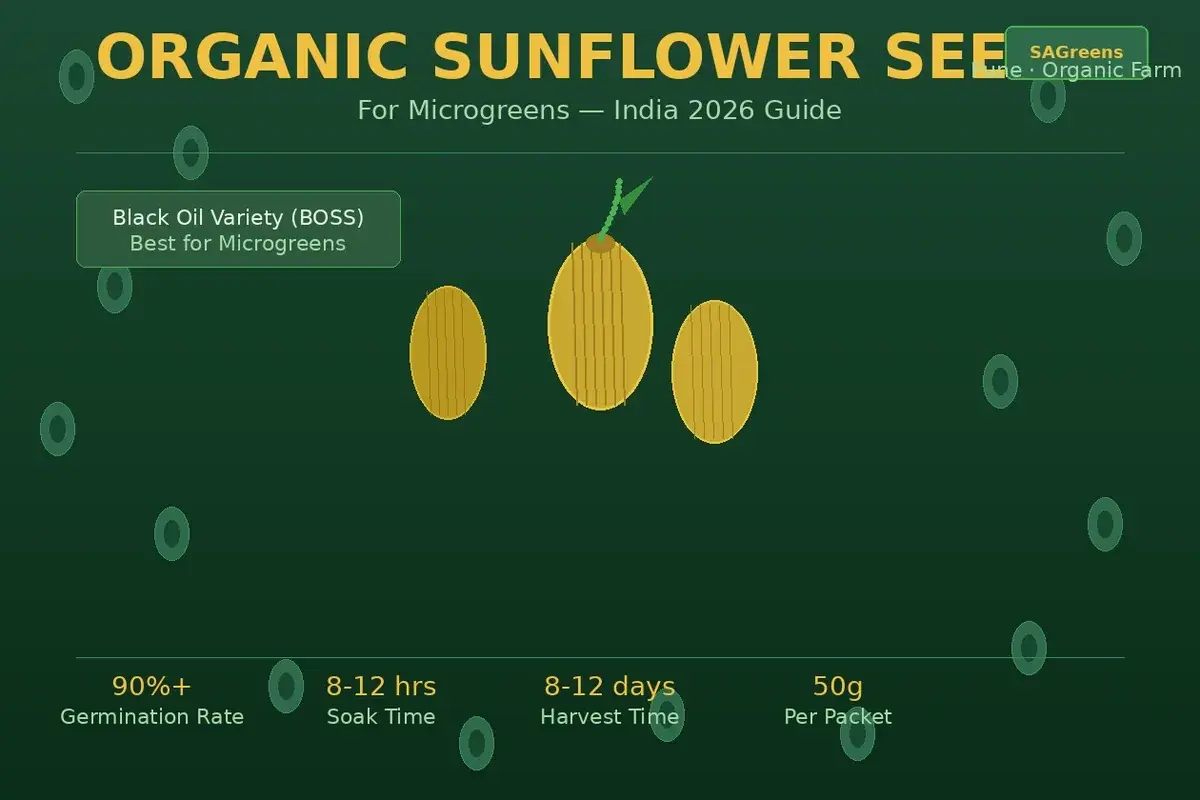
Organic Sunflower Seeds for Microgreens India: 2026 Guide
Key Takeaways: Black oil sunflower seeds (not confectionery/snack seeds) are the best choice for microgreens — 90%+ germination, thinner hull, richer flavour. Soak 8-12 hours, rinse twice, germinate under a blackout dome for 2-3 days, harvest in 8-12 days. Always buy untreated, non-GMO seeds. SAGreens Pune supplies organic sunflower seeds at ₹124 for 100g with verified germination and same-day Pune dispatch.
Sunflower microgreens are among the most popular home-grown microgreens in India. Their nutty, mildly sweet flavour suits dal garnishes, poha, roti wraps, salads, and green smoothies — and they are one of the easiest microgreens for beginners to grow successfully. But the quality of every harvest begins with one decision: the seeds you start with.
This guide covers everything Indian growers need to know about buying and using organic sunflower seeds for microgreens: seed varieties, quality markers, soaking protocol, step-by-step growing, troubleshooting, nutrition, and where to buy in India in 2026. Whether you are growing on a Pune balcony, a Mumbai terrace, or a Delhi apartment, this guide applies directly to your climate.
What Are Sunflower Seeds for Microgreens?
Sunflower microgreens are the young seedlings of Helianthus annuus, harvested at the cotyledon stage — 8 to 12 days after sowing. At this stage the seed's stored nutrients have been converted into a highly bioavailable form, making the microgreen nutritionally more concentrated than the mature seed per gram.
Two types of sunflower seeds are commonly available in India:
Black oil sunflower seeds (BOSS): Small, entirely black, thin-shelled. Originally grown for oil extraction and bird feed. Ideal for microgreen growing — high germination rate, thin hull that sheds easily, rich flavour. This is what you want.
Confectionery (striped) sunflower seeds: Larger, striped black-and-white, thick-shelled. Sold as snacks. Seeds sold for eating are heat-treated or salted, which destroys germination capacity entirely. Even untreated confectionery seeds give lower germination (60-75%) and frequent helmet head (hull stuck on the seedling leaf).
Black Oil vs Confectionery Sunflower Seeds: Full Comparison
| Feature | Black Oil (BOSS) | Confectionery (Striped) |
|---|---|---|
| Shell thickness | Thin | Thick |
| Germination rate | 88-95% | 60-75% (untreated only) |
| Hull shedding (helmet head) | Minimal | Frequent |
| Harvest time | 8-10 days | 10-14 days |
| Flavour of microgreen | Rich, nutty, slightly sweet | Milder, less distinctive |
| Availability as food-safe seeds in India | Specialty seed stores, SAGreens | Usually treated — hard to find untreated |
| Ideal for microgreens? | Yes — first choice | Acceptable only if untreated and organic |
Why Organic Certification Matters for Sunflower Seeds in India
Sunflower crops in conventional Indian agriculture are routinely treated with fungicide seed coatings — thiram, captan, and metalaxyl are the most common. These coatings are designed for seeds sown in open fields where they will grow for 90-120 days before harvest. When the same seeds are grown as microgreens and eaten within 10 days, the chemical coating is still present on the seedling. For a comprehensive explanation of all common treated seed chemicals and their health risks, see our untreated Non-GMO seeds for microgreens India guide.
Safety Standard: For any microgreen you plan to eat, buy seeds explicitly labelled as untreated, uncoated, non-GMO, and ideally certified organic. The SAGreens organic sunflower seeds are sourced without fungicide treatment, providing a clean and safe germination environment for your home growing setup.
When buying sunflower seeds for microgreens in India, look for these markers:
How Many Seeds Do You Need Per Tray?
Sunflower microgreens require a dense single layer of seeds in the tray — seeds touching each other side by side but not stacked. Here is the quantity guide for standard Indian growing trays:
| Tray Size | Seeds Required (dry weight) | SAGreens 50g Packets Needed |
|---|---|---|
| 10x10 cm (starter tray) | 25-30g | 0.5-0.6 |
| 20x20 cm (medium) | 80-90g | 1.6-1.8 |
| 30x20 cm (standard growing tray) | 120-140g | 2.4-2.8 |
| 30x30 cm (large tray) | 180-200g | 3.6-4.0 |
For first-time growers, start with a 10x10 cm or 20x20 cm tray. Overpacking causes mould due to poor airflow between seeds. Underpacking produces a patchy, thin canopy.
How to Soak Sunflower Seeds: Step-by-Step Protocol
Sunflower seeds require pre-soaking before sowing. The hull softens during soaking, which speeds germination and dramatically reduces helmet head. This step is not optional — skipping it gives 15-25% lower germination and more hull-stuck seedlings.
For the complete soaking reference covering all microgreen varieties with summer and monsoon climate adjustments, see our microgreen seeds soaking guide India.
Sunflower seed soaking protocol:
Monsoon Note for Indian Growers: During July-September when humidity is above 80%, reduce soaking to 8 hours and rinse three times after soaking rather than the standard two. High ambient humidity means seeds already absorb some moisture from the air, reducing the effective soaking benefit. More thorough rinsing also removes surface spores that increase mould risk in humid conditions.
Step-by-Step Growing Guide: Seed to Harvest
Growing sunflower microgreens at home in India requires no special equipment. A shallow tray, cocopeat, a spray bottle, and indirect light are sufficient. For a full visual walkthrough, see how to grow sunflower microgreens at home.
Equipment needed:
Days 1-2: Sowing
Fill the tray with 2-3 cm of moist cocopeat. Level it evenly with your palm. Spread the soaked, drained seeds in a dense single layer — seeds should touch each other but not stack. Mist gently with the spray bottle. Place the second tray upside down as a blackout dome. Add 1-2 kg of weight on top to press the seeds into the growing medium and encourage downward root growth.
Days 2-4: Germination (Blackout Phase)
Check once per day by briefly lifting the dome. White radicles (tiny root tips) should appear within 24-36 hours. The dome stays on during this entire phase. Mist only if the cocopeat surface looks dry to the touch — over-watering during this phase is the primary cause of mould. Remove any mushy or sour-smelling seeds immediately.
Days 4-6: Introducing Light
When seedlings are 3-4 cm tall (pale yellow from darkness), remove the blackout dome and move to a bright spot with indirect light. Avoid direct harsh afternoon sun, especially May-June. Morning light (6-9 am) is ideal for Indian growing conditions.
Days 6-8: Active Growth
Seedlings green up rapidly within 12-24 hours of light exposure — pale yellow becomes bright green as chlorophyll develops. At this stage, switch to bottom-watering: pour water into the lower collection tray and let the cocopeat wick it upward. This prevents moisture from sitting on the microgreen canopy, which causes damping off.
Days 8-12: Harvest
Harvest when the cotyledon leaves are fully open and firm and the first true leaf is just beginning to emerge at the growing tip. Use clean scissors and cut just above the cocopeat surface. Rinse in cold water, dry thoroughly in a salad spinner or between clean kitchen towels, and refrigerate in an airtight container lined with a paper towel for up to 5 days.
Common Germination Problems and Solutions
| Problem | Most Likely Cause | Fix |
|---|---|---|
| Helmet head (hull stuck on leaf) | Under-soaking; low humidity under dome | Soak 10-12 hrs; keep dome sealed; mist lightly but consistently |
| White fuzzy mould | Over-watering; poor drainage; high humidity | Reduce misting; ensure drainage holes are clear; ventilate briefly daily |
| Seeds not germinating after 72 hours | Dead, treated or fermented seeds | Test 10 seeds on wet paper towel — no germination in 48 hrs means replace seeds |
| Very uneven canopy | Uneven seed spreading; some areas too dense | Redistribute seeds at sowing; aim for single dense layer throughout |
| Pale yellow seedlings after dome removal | Normal — chlorophyll not yet active | Move to light; green-up occurs within 24 hrs |
| Sour smell during or after soaking | Fermentation from long soak or warm water | Discard batch; soak fresh seeds for 6 hrs maximum with cool water |
| Roots lifting out of cocopeat | Insufficient weight during blackout phase | Use heavier weight; press down gently after placing dome |
Nutritional Profile of Sunflower Microgreens (Per 100g)
Sunflower microgreens are among the most nutrient-dense microgreens, particularly strong in fat-soluble vitamins, minerals, and plant protein.
| Nutrient | Amount per 100g | Approximate % Daily Value |
|---|---|---|
| Protein | 3.8g | 7-8% |
| Vitamin E (tocopherols) | 7.5mg | 50% |
| Vitamin B1 (Thiamine) | 0.26mg | 22% |
| Folate (B9) | 57mcg | 14% |
| Magnesium | 42mg | 10% |
| Phosphorus | 82mg | 12% |
| Zinc | 0.9mg | 8% |
| Selenium | 5.3mcg | 10% |
| Iron | 2.1mg | 12% |
| Healthy fats (MUFA and PUFA) | 2.2g | — |
| Calories | 35-40 kcal | — |
The vitamin E content stands out: sunflower microgreens are among the richest plant-based sources of tocopherols, which protect cells from oxidative damage and support skin, hair, and eye health.
Health Benefits of Sunflower Microgreens
Heart Health Support
Sunflower microgreens contain linoleic acid, magnesium, and vitamin E — three nutrients clinically linked to reduced LDL cholesterol and lower blood pressure. For Indian diets high in saturated fats from ghee, coconut oil, and dairy, adding sunflower microgreens as a daily garnish provides a cardioprotective counterbalance without requiring any change to cooking habits.
Bone and Muscle Strength
A 50g daily serving provides approximately 21mg of magnesium, supporting over 300 enzymatic reactions including muscle contraction, protein synthesis, and calcium regulation. Vegetarian Indians who avoid meat often have suboptimal magnesium intake — sunflower microgreens are a highly efficient food-first top-up.
Mood and Nervous System Health
Sunflower microgreens contain tryptophan (a serotonin precursor) alongside B vitamins and magnesium — nutrients important for neurotransmitter production and nervous system regulation. Consistent intake as part of a balanced diet supports overall mental wellbeing.
Anti-Inflammatory Protection
Vitamin E acts as a fat-soluble antioxidant inside cell membranes, protecting them from oxidative stress — a core driver of chronic inflammation underlying cardiovascular disease, diabetes, and arthritis. Regular consumption of sunflower microgreens alongside other whole foods supports a measurably anti-inflammatory dietary pattern.
Skin and Hair Nourishment
The combination of vitamin E, zinc, and selenium supports collagen synthesis, protects against UV-induced skin damage, and promotes keratin production for healthy hair. For Indian women dealing with monsoon-related hair fall or summer skin dullness, sunflower microgreens offer a concentrated food-first approach.
For a deep dive into nutrition science, see the complete sunflower microgreens benefits guide.
How to Use Sunflower Microgreens in Indian Cooking
Sunflower microgreens have a mild, nutty flavour profile that pairs naturally with Indian cuisine — neither pungent like mustard nor bitter like fenugreek, they add texture and nutrition without dominating the dish.
Where to Buy Organic Sunflower Seeds for Microgreens in India
Finding genuinely untreated, non-GMO sunflower seeds for microgreens in India is harder than it appears. Most seeds sold in local markets and agricultural stores are field-grade and fungicide-treated. Seeds sold as snacks are heat-processed and will not germinate at all.
Trusted Source in Pune: SAGreens supplies organic black oil sunflower seeds at ₹124 for 100g — sourced without fungicide treatment, with a verified 90%+ germination rate. We dispatch across Pune same-day for orders placed before 2 pm. For growing kits, bulk orders, and personalised growing advice, contact SAGreens directly.
For a complete comparison of where to buy different microgreen seeds in India — online platforms, local stores, and quality markers to look for — read the microgreen seeds buying guide India.
You can also browse our full seed store for organic radish, broccoli, mustard, pea shoot, and coriander seeds — all in 100g packets at beginner-friendly prices.
Seasonal Growing Tips for Indian Climate
India's varied climate significantly affects sunflower microgreen growing. The main variables are temperature (germination speed) and humidity (mould risk).
| Season | Months | Temperature Range | Key Adjustments |
|---|---|---|---|
| Winter | Nov-Feb | 12-22 degrees C | Extend soak to 10-12 hrs; blackout phase may take 3-4 days; germination slower |
| Spring | Mar-Apr | 22-32 degrees C | Standard protocol; fastest germination; ideal season |
| Summer | May-Jun | 32-42 degrees C | Reduce soak to 6-8 hrs; use cool water; water twice daily; avoid south-facing sills |
| Monsoon | Jul-Sep | 24-32 degrees C | Reduce watering frequency; improve ventilation; rinse seeds 3 times after soaking |
| Post-Monsoon | Oct-Nov | 18-28 degrees C | Standard protocol; excellent growing season |
Pune growers benefit from a relatively mild year-round climate. The most challenging months are May-June when indoor temperatures can reach 38-40 degrees C even with ceiling fans. During this period, consider placing trays in an air-conditioned room or shaded balcony corner for the germination phase.
Sunflower Seeds and Weight Management
Sunflower microgreens are low in calories (35-40 kcal per 100g) while providing meaningful protein (3.8g) and healthy fats that promote satiety. Adding 30-50g of sunflower microgreens to a meal increases the meal's nutritional density without meaningfully increasing calories — a useful strategy for anyone managing their weight without compromising nutrition. For a broader look at microgreens and Indian weight management diets, see microgreens for weight loss India.
About SAGreens
How much do microgreen seeds cost per 100g packet in India?
Prices at SAGreens: sunflower seeds ₹124/100g, radish ₹120/100g, mustard ₹124/100g, broccoli ₹200/20g, fenugreek ₹69/100g, and red amaranthus ₹198/100g. Each packet yields 2–4 standard growing trays. Browse all seed varieties or WhatsApp SAGreens for bulk orders.
*This guide is written by the SAGreens team, led by Ajay Toradmal — a three-generation farming family from Keshav Nagar, Pune, Maharashtra. We grow sunflower, radish, broccoli, and pea shoot microgreens commercially and test every seed batch for germination before packing. Our sunflower seed germination tests run on 50-seed samples across three trays before any batch is approved for sale. Contact us for seeds, growing kits, or personalised advice for your Indian growing setup.*
Frequently Asked Questions
Which sunflower seeds are best for microgreens in India?
Black oil sunflower seeds (BOSS) are best. They are smaller, thin-shelled, germinate at 88-95%, and produce microgreens with richer flavour and fewer hull-stuck seedlings compared to larger confectionery (striped) varieties. Buy untreated, non-GMO black oil sunflower seeds from a verified source — not agricultural-grade seeds from local markets, which are usually fungicide-coated.
Can I use sunflower seeds bought from a shop or supermarket?
Seeds sold for eating — roasted, salted, or packaged as snacks — will not germinate because they are heat-treated. Seeds sold for field planting are usually fungicide-coated and unsafe for human consumption within 10 days. Always buy seeds labelled specifically for sprouting or microgreen use with a clear "untreated" or "organic" declaration.
How long should I soak sunflower seeds before planting for microgreens?
8-12 hours at room temperature (24-26 degrees C). In Indian summer when temperatures exceed 35 degrees C, reduce to 6-8 hours to prevent fermentation. Rinse twice after soaking before sowing. Skipping the soak results in 15-25% lower germination and more helmet head.
Why do my sunflower microgreens have the shell stuck on the leaves (helmet head)?
Helmet head is caused by insufficient soaking (hull too hard to shed), low humidity under the blackout dome (hull dries before shedding), or both. Increase soak time to 10-12 hours. Ensure the blackout dome is sealed to maintain humidity. You can gently remove stuck hulls by misting them with a spray bottle and carefully peeling them off — do not pull the seedling.
How many grams of sunflower seeds do I need for one tray?
For a standard 20x20 cm tray: 80-90g of dry seeds (approximately 1.6 packets of 50g). For a 10x10 cm starter tray: 25-30g (half a 100g packet). Seeds are sown in a dense single layer — not stacked, not spread too thin.
Do sunflower microgreens grow back after cutting?
No. Sunflower is a single-harvest microgreen. Unlike pea shoots (which regrow 2-3 times), sunflower does not regenerate after the first cut. After harvest, the roots and spent cocopeat can be composted directly.
What growing medium is best for sunflower microgreens?
Cocopeat is the most reliable growing medium for Indian conditions — pH neutral, widely available, excellent moisture retention, and more mould-resistant than pure soil. A 70% cocopeat + 30% vermicompost blend gives excellent results. Avoid using outdoor garden soil in trays — it often carries fungal spores and compacts when wet.
How do I prevent mould in sunflower microgreens?
The three main causes of mould are over-watering, blocked drainage holes, and poor air circulation. Ensure your tray has drainage holes, water only when the surface feels dry, and briefly lift the blackout dome for 10-15 minutes each day for fresh air exchange. After the blackout phase, switch to bottom-watering exclusively — this keeps the canopy dry and prevents damping off.
Can I grow sunflower microgreens without soil using a hydroponic method?
Yes, but sunflower microgreens are heavier than most and benefit from a solid growing medium to anchor their roots. If growing hydroponically, use a thick jute or coconut coir mat rather than a thin paper towel — sunflower roots need more grip. Pure water-only methods tend to produce weaker, less stable stands for sunflower.
How do I store sunflower microgreens after harvesting?
Wash in cold water, spin dry in a salad spinner or pat with clean kitchen towels until completely dry, then refrigerate in an airtight container lined with a paper towel. Properly dried and stored, sunflower microgreens last 4-5 days. Do not freeze — freezing turns the cotyledons mushy on thawing.
Are organic sunflower seeds worth the higher price?
Yes — for microgreens especially. You will eat the entire seedling within 10 days of sowing, with no cooking or peeling to reduce surface residues. Non-organic, conventionally treated seeds carry fungicide coatings that remain active during this short window. Organic seeds from ₹50 per 100g (enough for 2-4 trays) are a minimal cost difference compared to the safety and peace of mind they provide.
What is the shelf life of sunflower seeds for microgreens?
Stored in a cool, dry, dark place (an airtight container in a pantry or lower refrigerator shelf), untreated organic sunflower seeds maintain 85%+ germination for 12-18 months. Exposure to heat, humidity, or light degrades germination significantly faster. Do not store seeds in the bathroom or near a gas stove.
Can sunflower microgreens be eaten every day?
Yes — a 30-50g daily serving is nutritionally beneficial and has no known adverse effects for most people. Individuals with sunflower seed allergies should approach with caution and consult a physician. For daily dietary integration, add to one meal as a garnish or incorporate into a morning green smoothie.
How do sunflower microgreens compare to mature sunflower seeds nutritionally?
Sunflower microgreens contain higher levels of folate, vitamin E (per gram), and certain B vitamins compared to mature seeds, because the germination process converts stored nutrients into more bioavailable forms and produces new phytonutrients like chlorophyll. Calorie density drops significantly (mature seeds are calorie-dense; microgreens are mostly water). Both forms are nutritious — they complement rather than replace each other.
Where can I buy organic sunflower seeds for microgreens in Pune?
SAGreens delivers organic black oil sunflower seeds (100g, ₹124) across Pune with same-day dispatch. Visit our sunflower seed product page or contact SAGreens for bulk orders, growing kits, or a starter bundle that includes seeds, cocopeat, and a tray.
Can I use sunflower seeds from the supermarket for microgreens?
No. Seeds sold for eating — roasted, salted, or packaged as snacks — are heat-treated and will not germinate. Seeds sold for field planting are usually fungicide-coated and unsafe to eat within 10 days as microgreens. Always buy seeds specifically labelled for sprouting or microgreens with a clear untreated or organic declaration.
Can I grow sunflower microgreens hydroponically?
Yes, but sunflower microgreens benefit from a solid growing medium to anchor their heavier roots. If growing hydroponically, use a thick jute or coconut coir mat. Pure water-only flat methods tend to produce weaker, less stable stands compared to cocopeat.
Can I grow sunflower microgreens in Indian summer?
Yes, with adjustments. Reduce soak time to 6-8 hours, use slightly cool water, water twice daily, and keep trays out of direct afternoon sun. Summer (May-June) temperatures above 38°C indoors can slow germination slightly but sunflower remains viable year-round in Indian conditions.
Fresh Tips & Exclusive Offers
Subscribe for growing tips, seasonal updates, and exclusive offers on fresh organic microgreens in Pune.