How to Grow Pea Shoot Microgreens at Home
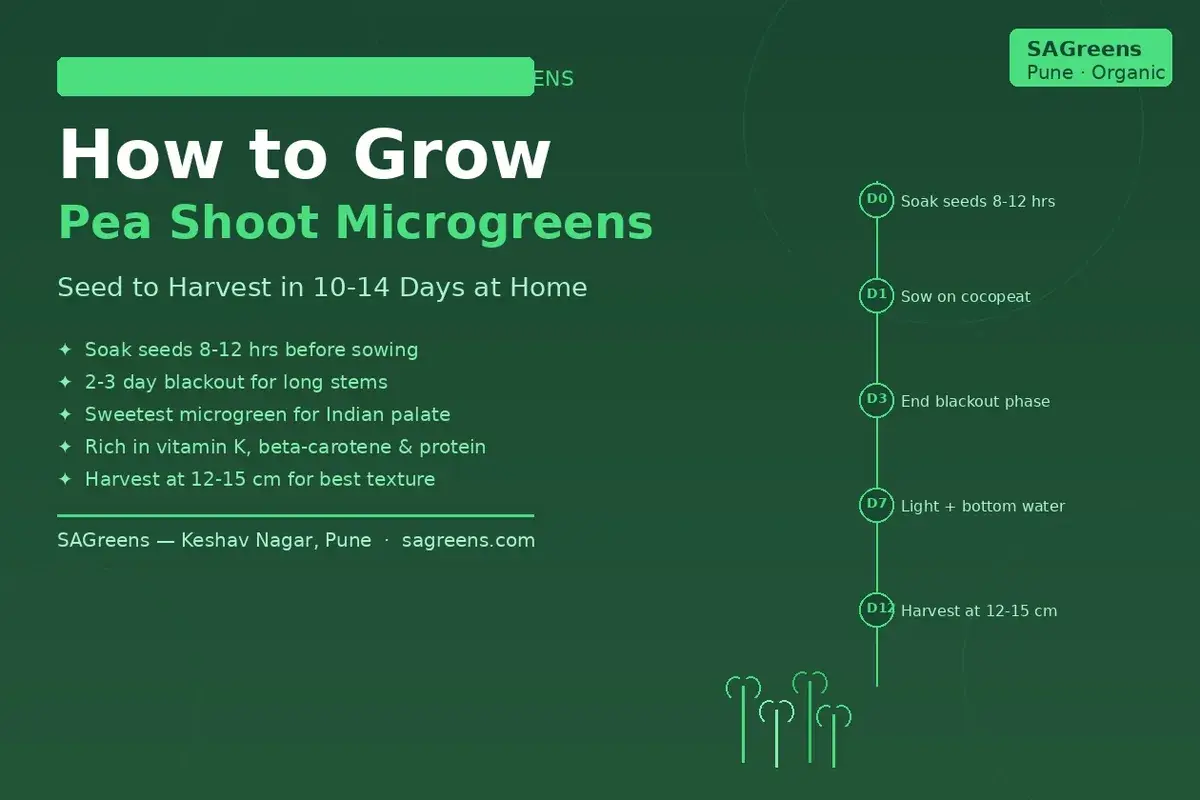
Key Takeaways: Pea shoot microgreens require 8-12 hours of seed soaking, a 2-3 day blackout phase, and harvest at 12-15 cm for the best flavour and texture. They are the sweetest and most palate-friendly microgreen variety for Indian cooking. A tray produces 150-200 g of fresh microgreens in 10-14 days and costs under ₹80 to grow. Fresh pea shoot microgreens from SAGreens are available for delivery across Pune if you want to try them before growing your own.
Pea shoot microgreens are the entry point that converts sceptics into regular microgreen growers. Unlike broccoli (slightly bitter) or mustard (pungent), pea shoots taste exactly like fresh sweet peas — mildly sweet, tender, and familiar enough to work in any Indian meal without adjustment. They grow quickly, yield generously, and are remarkably forgiving of beginner mistakes. If you have tried and failed with a fussier variety, pea shoots are the reset you need.
This guide covers the complete growing process for pea shoot microgreens at home, with specific attention to the soaking step that beginners most often skip, the blackout technique, and the India-specific adaptations for Pune's summers and monsoon season. For the complete nutritional case for pea shoots, our pea shoots microgreens benefits guide covers the vitamin K, beta-carotene, protein, and folate content in detail.
Why Pea Shoots Are the Best Starting Variety
Before getting into the how-to, it is worth understanding why pea shoots consistently outperform other varieties for home growers:
Yield: A single 25x20 cm tray of pea shoots produces 150-200 g of fresh microgreens — significantly more than broccoli (60-100 g from the same tray) or mustard (80-100 g). The large seeds store more energy, which translates into more biomass per tray.
Speed: 10-14 days from seed to harvest. Faster varieties exist (radish at 6-8 days) but pea shoots produce far more per tray.
Flavour: The sweet, fresh pea flavour is the most universally accepted in Indian households. Children eat them without complaint, adults add them raw to dal, sabzi, salads, and parathas without needing recipe modifications.
Nutrition: Pea shoots provide complete plant protein, vitamin K (important for bone health), beta-carotene (for eye health and immunity), folate (critical during pregnancy), and vitamin C. Unlike mature dried peas, the microgreen form has very low starch content and a negligible glycaemic load — safe for diabetics and weight-watchers.
Resilience: Pea shoots tolerate moderate temperature variation (18-32 degrees C), brief overwatering, and imperfect light conditions better than most other varieties. A beginner who does everything slightly wrong will still get a usable harvest.
| Factor | Pea Shoots | Broccoli | Radish | Sunflower |
|---|---|---|---|---|
| Soak before sowing | Yes (8-12 hrs) | No | No | Yes (8-12 hrs) |
| Blackout duration | 2-3 days | 4-5 days | 2-3 days | 3-4 days |
| Days to harvest | 10-14 | 8-12 | 6-8 | 10-14 |
| Tray yield (100g seeds) | 150-200 g | 60-100 g | 100-150 g | 120-180 g |
| Flavour | Sweet | Mild-bitter | Peppery | Nutty |
| Beginner difficulty | Easy | Moderate | Easy | Easy |
What You Need
Seeds: Use whole dried peas sold for microgreen use, or yellow/green peas from a reliable grocery source if you know they are untreated. Unlike broccoli or mustard, pea seeds are large enough to inspect visually — discard any that look shrivelled, mouldy, or discoloured. Germination rate should be 85%+ for a dense, even tray. The SAGreens pea shoot microgreens are grown from fresh, high-germination seeds.
Tray: A 25x20 cm tray with drainage holes. Pea shoots have vigorous root systems — the roots will grow through drainage holes and anchor into the lower tray if allowed. This is normal and does not damage the crop.
Growing medium: 3-4 cm of moist cocopeat. Pea shoots need slightly deeper medium than broccoli or radish because their roots are more substantial. Alternatively, a thick layer (2-3 cm) of damp jute cloth works for one-tray trialling.
Blackout cover and humidity tray: As with all microgreens. The blackout cover should be heavy enough to add slight weight pressure — this helps seed-to-medium contact for even germination.
Light: 4-6 hours of direct morning sun, or a 20-watt 6500K LED grow light running 12-14 hours per day.
Step 1: Seed Soaking (8-12 Hours)
Pea seeds have a firm outer coat that significantly slows water absorption if sown dry. Soaking triggers enzymatic activation inside the seed and dramatically speeds germination — reducing the time from sowing to visible shoot by 1-2 days and producing a more even germination spread across the tray.
Soaking method:
- Measure your seeds: 100-120 g for a 25x20 cm tray
- Place in a clean bowl and cover with 3x the seed volume of room-temperature water (20-25 degrees C)
- Leave in a dark, room-temperature spot for 8-12 hours (overnight is ideal)
- After soaking, drain thoroughly — seeds should be plump and visibly swollen
- Rinse once with fresh water and drain again before sowing
Do not soak for more than 14 hours. Extended soaking causes anaerobic conditions in the centre of the seed mass, producing a sour smell and reducing germination rate.
Soaking Check: After 8-12 hours, each seed should be noticeably larger and slightly wrinkled. If seeds look unchanged after 10 hours, the water may have been too cold or the seeds may be old. Use fresh seeds and water at 22-25 degrees C.
Step 2: Sowing
- Fill the tray with 3-4 cm of moist cocopeat. Level and firm the surface.
- Distribute soaked, drained seeds in a single dense layer across the tray surface. Seeds can touch but should not pile more than 1-2 deep. For a 25x20 cm tray, 100-120 g of seeds is the right density.
- Press seeds gently into the cocopeat with the back of a flat card or a second tray. Good seed-to-medium contact is important for even germination.
- Mist lightly — 10-15 sprays. The seeds should look moist but not flooded.
- Cover immediately with the blackout cover.
Step 3: Blackout Phase (2-3 Days)
Pea shoots need a shorter blackout phase than broccoli — 2-3 days is sufficient. The seeds are large and store enough energy for rapid germination without extended darkness.
During the blackout phase, lift the cover once daily to check moisture. The cocopeat should remain moist. If the surface looks dry, mist lightly and re-cover. By Day 2, you should see germination — white roots pushing into the cocopeat and the first pale shoots rising from the seed. By Day 3, most shoots will be 3-5 cm tall with hooked, pale yellow tips.
The blackout weight is important for pea shoots. As the large seeds germinate, the cotyledons (seed leaves) push upward with significant force. A heavy blackout cover keeps them from lifting off the growing medium, ensuring the roots stay anchored and stems remain straight. If cotyledons start lifting the cover, add a small weight on top.
Step 4: Light Phase (Days 3-10)
Remove the blackout cover when most shoots are 3-5 cm tall with hooked tips. Place in bright light immediately.
Within 6-8 hours, the hooked tips will straighten. Within 24 hours, the first true leaves — small, paired leaflets — begin to emerge alongside the cotyledons. Pea shoot microgreens are harvested at this early true leaf stage, not at cotyledon stage like broccoli.
Watering during the light phase: Switch entirely to bottom watering. Fill the humidity tray with 300-400 ml of water daily in the morning. Pea shoots consume significantly more water than smaller-seeded microgreens because the plant mass is greater. During hot Pune summers, you may need to bottom-water twice per day.
Bottom Watering for Pea Shoots: Unlike broccoli or radish, pea shoots have a high water demand during the light phase. An under-watered pea shoot tray wilts visibly and loses its crisp texture. Check the tray weight daily — a light tray needs water. Never let the roots dry out completely during the light phase.
Step 5: Harvest (Days 10-14)
Pea shoot microgreens are ready to harvest when:
- The first true leaves are fully emerged (small paired leaflets visible at the tip)
- Stem height is 12-15 cm
- The stems are firm and upright, not floppy or yellowing
- The tray has a fresh, sweet pea aroma
Use clean scissors to cut just above the cocopeat level. Pea shoots can sometimes regrow from the stump for a small second harvest — this works about 40% of the time and produces thinner, less sweet shoots. Most growers prefer to treat each tray as single-use.
Rinse briefly in cold water, shake dry, and use immediately for best flavour and texture. Store refrigerated in a container with a very slightly damp paper towel lining the base — pea shoots keep well for 4-6 days.
India-Specific Growing Notes
Summer (March-June)
In Pune's peak summer (35-40 degrees C), pea shoot germination accelerates and the light phase becomes faster. Reduce the blackout to 2 days and watch the light phase closely — you may be harvesting at Day 8-10 instead of 12-14. Bottom water twice daily. Avoid placing trays in direct afternoon sun.
Monsoon (June-September)
Pea shoots are relatively mould-resistant compared to coriander or broccoli, but the high ambient humidity in Pune monsoon still requires airflow management. Run a ceiling fan at low speed in the growing space, reduce initial misting after sowing to a single pass, and harvest promptly when ready — do not let a mature tray sit more than 1-2 days past harvest readiness during monsoon.
Winter (November-February)
Ideal conditions for pea shoots in Pune. The cooler temperatures produce slower growth but sweeter, more tender shoots. Harvest at Day 12-14 for the best flavour. Bottom water once daily is usually sufficient.
How to Use Pea Shoot Microgreens in Indian Cooking
Pea shoots integrate more naturally into Indian cooking than almost any other microgreen:
- Dal garnish: Add 30-40 g raw over masoor, moong, or toor dal just before serving. The sweet flavour balances dal's earthiness perfectly.
- Poha and upma: Scatter raw over the hot dish after plating — they wilt slightly from residual heat, intensifying the sweet flavour.
- Paratha filling: Mix with paneer and spices for a fresh, unusual filling.
- Chaat: Add to papdi chaat or bhel puri as a fresh element — the sweetness contrasts beautifully with the tangy imli chutney.
- Sabzi: Brief wilting in the last 30 seconds of cooking a light sabzi adds colour and nutrition.
- Salad: Raw in a kachumber with tomato, cucumber, and lemon dressing.
Nutrition: What You Are Eating
Pea shoot microgreens per 100 g provide approximately:
| Nutrient | Amount | Daily Value (approx.) |
|---|---|---|
| Protein | 3.5-4.0 g | 7% |
| Vitamin K | 85-110 mcg | 100%+ |
| Vitamin C | 35-50 mg | 40-55% |
| Beta-carotene | 1,500-2,200 mcg | significant |
| Folate | 65-90 mcg | 16-22% |
| Iron | 1.5-2.0 mg | 8-11% |
| Calories | 35-42 kcal | low |
Troubleshooting
| Problem | Cause | Fix |
|---|---|---|
| Uneven germination | Seeds not soaked, or soaked too long | Soak 8-12 hours at 22-25 degrees C |
| Floppy stems in light phase | Insufficient light or overwatering | Move to brighter spot; check drainage |
| Yellowing leaves | Nitrogen stress or insufficient light | Increase light duration or intensity |
| Mould at base | Overwatering + poor airflow | Bottom water only; run fan 2+ hours/day |
| Roots lifting seeds off medium | Insufficient cover weight | Add weight on blackout cover from Day 1 |
| Bitter taste | Overripe — harvested after first true leaves fully opened | Harvest earlier next tray |
For a comprehensive germination troubleshooting guide, see our microgreens germination guide.
Comparing Pea Shoots to Other Growing Guides
If you want to build a multi-variety home growing routine, pea shoots pair beautifully with faster varieties. Combine with broccoli microgreens (harvest at Day 8-10) for a staggered schedule, or with radish (harvest at Day 6-8) for a continuous supply. Our sunflower microgreens growing guide covers another large-seed variety with a similar soaking requirement and comparable harvest timeline.
Seed Quality & Pricing: All SAGreens microgreen seeds are NPOP-certified organic — untreated, non-GMO, germination tested before dispatch. Seeds start at ₹50/100g (wheatgrass), ₹124/100g (sunflower, mustard) and ₹120/100g (radish). Delivery charged at checkout, by city and weight. Browse microgreen seeds or contact us for bulk pricing.
Frequently Asked Questions
Do pea shoot microgreens need soaking before sowing?
Yes. Unlike broccoli or radish, pea seeds have a firm outer coat that requires 8-12 hours of soaking to hydrate properly. Unsoaked pea seeds germinate erratically and produce patchy trays. Soak overnight in room-temperature water, drain thoroughly, and sow immediately.
Are pea shoots the same as pea sprouts?
No, and the soaking step above is where the two get confused. Pea sprouts are germinated in a jar without soil or light and eaten whole within 2 to 3 days, root and all. Pea shoots are sown into a medium after soaking, given light for 7 to 10 days, and cut above the medium at day 10 to 14. The light phase is what makes shoots taste sweeter than a jar sprout ever does, and because they are cut rather than eaten whole they do not carry the same food-safety profile. Our pea shoots benefits guide covers the nutrition side, and the microgreens vs sprouts comparison sets out the distinction in full.
How long does the blackout phase last for pea shoots?
Two to three days at room temperature (22-28 degrees C). In Pune's hot summers, reduce to 2 days. The blackout phase ends when most shoots are 3-5 cm tall with hooked pale tips just beginning to straighten.
Can pea shoot microgreens regrow after harvest?
Sometimes — roughly 40% of trays produce a small second flush from the stump within 7-10 days of the first harvest. The second flush is thinner and less sweet. Most home growers prefer to start a fresh tray.
What is the best variety of pea to use for microgreens?
Yellow field peas and green garden peas both work well. Speckled peas and black-eyed peas can also be used. The main requirement is that seeds are untreated (no fungicide coating) and recent enough to have a high germination rate. Dried grocery-store green peas work if they are fresh-season stock and untreated.
Why are my pea shoots floppy and not standing upright?
Most commonly caused by either insufficient light intensity (move closer to light source or increase daily light hours) or overwatering during the light phase (roots sitting in water). Ensure the bottom tray drains fully 2-3 hours after watering.
How many grams of seeds do I need per tray?
For a 25x20 cm tray, use 100-120 g of dry seeds. This produces a dense, even canopy and a yield of 150-200 g of fresh microgreens at harvest.
Are pea shoot microgreens safe for diabetics?
Yes. Unlike mature dried peas (which are starchy and moderate-GI), pea shoot microgreens are harvested before starch accumulates in the cotyledons. They have very low carbohydrate content, high fibre, and are safe for diabetic diets at typical serving sizes of 40-80 g per day.
Do pea shoot microgreens have any side effects?
Pea shoot microgreens are safe for healthy adults. People with oxalate sensitivity should note that pea shoots contain moderate oxalates — far less than spinach, but relevant for people with a history of kidney stones advised to limit oxalate intake. Pea shoots also contain purines, relevant for gout patients; consistent large quantities (200 g+ daily) would warrant a conversation with a doctor for active gout sufferers.
How do I know when pea shoots are ready to harvest?
Pea shoots are ready when the shoots are 10-15 cm tall and the first tendrils begin curling. The leaves should be fully open, bright green, and firm. Taste one — it should be sweet, crisp, and taste like fresh garden peas. If you see the first true leaves starting to develop beyond the initial cotyledons, harvest immediately — flavour and tenderness peak before the true leaf stage.
Can pea shoot microgreens be juiced?
Yes. Pea shoot microgreens juice has a mild, sweet green flavour and is one of the most palatable microgreen juices. Combine with cucumber, mint, and a squeeze of lemon for a refreshing drink. Most vitamins C, K, and beta-carotene survive cold juicing. For maximum nutrition, eating raw is preferred over juicing since you retain the full fibre content.
What temperature is ideal for growing pea shoots in Indian homes?
Pea shoots grow best at 18-26°C. They tolerate Pune's cooler October-February season very well — this is actually ideal pea weather. In summer (March-May), germination can be fast but growth leggy; use a cooler room or grow in an air-conditioned space during the hottest weeks. Monsoon humidity is manageable with good airflow and careful moisture management during the blackout phase.
How do I store fresh pea shoot microgreens?
Harvest pea shoots dry (do not wet before storage), wrap loosely in a paper towel to absorb excess moisture, and store in an airtight container in the refrigerator. Consume within 5-7 days. If storing for more than 3 days, replace the paper towel on Day 3 as it absorbs excess moisture and can cause rot. Do not freeze — freezing destroys the texture and deactivates enzymes.
How long does it take to grow pea shoot microgreens at home?
Pea shoot microgreens are typically ready to harvest in 10-14 days from sowing at 20-25 degrees C. Cooler conditions slow growth slightly; warmer conditions above 30 degrees C can cause leggy, weak growth. The blackout phase lasts 2-3 days, followed by 7-10 days of light before harvest.
Can I regrow pea shoots after the first harvest?
Yes — pea shoots are one of the few microgreen varieties that reliably regrow after the first cut. Leave 2-3 cm of stem above the cocopeat and continue bottom watering. You can usually get one or two more harvests, though subsequent yields will be smaller and the leaves slightly tougher.
What is the sowing density for pea shoot microgreens?
Use 100-120 g of soaked pea seeds per 25x20 cm tray — a single dense layer covering the cocopeat surface without large gaps. Pea seeds are large; even coverage is more important than exact weight. Overcrowding (seeds piled on top of each other) leads to damping off in humid Indian conditions.
Why are my pea shoots turning yellow?
Yellow pea shoots are almost always caused by insufficient light after the blackout phase. Pea shoots need at least 4-6 hours of direct morning sun or 12-14 hours of broad-spectrum LED light to produce chlorophyll. Move the tray closer to a window or increase LED exposure time.
Buying vs Growing: Cost Comparison for Pune
| Option | Cost | Freshness | Effort |
|---|---|---|---|
| SAGreens fresh delivery (100g) | ₹150 | Same-morning harvest | Zero — order online |
| Home growing (100g yield) | ₹15-25 seeds + medium | Harvest same day | 20 min setup + daily check |
| Grocery store microgreens | ₹80-120 | 3-7 days old | Zero |
For Pune households, the practical approach is to start with a fresh SAGreens delivery to understand what peak-quality pea shoots look and taste like, then set up your own tray alongside. Pea seeds from your kirana store (green split peas) cost ₹50-80 per kg; a 25x20 cm tray uses 100-120 g of dry seeds. Cocopeat adds another ₹10-15. Your first tray costs ₹80-120 to set up including equipment; subsequent trays cost ₹15-20 in consumables only.
At scale, home-grown pea shoots are 6-8x cheaper than purchased microgreens and deliver fresher greens. The time investment is minimal: 10 minutes for soaking and sowing, 30 seconds per day for moisture checks, and 5 minutes for harvest. For the 150-200 g yield per tray and the nutritional content you receive, pea shoot microgreens deliver the highest food value per rupee and per minute of any home-grown food practical for a Pune apartment.
Order fresh pea shoot microgreens from SAGreens to establish your quality benchmark. For seeds to grow your own, see our guide to buying microgreen seeds online in India. For side-by-side variety comparisons, read our guide to which microgreens are best.
Conclusion
Pea shoot microgreens are the most rewarding beginner variety: generous yields, sweet familiar flavour, and enough resilience to forgive the small mistakes every new grower makes. The process is straightforward — soak overnight, sow dense, blackout for 2-3 days, water from below during the light phase, harvest at 12-15 cm.
Start with our fresh pea shoot microgreens to understand what the harvest should look and taste like, then set up your own tray. For variety comparison and which varieties to grow alongside pea shoots, read our guide on which microgreens are best. For growing advice specific to your setup and Pune's seasons, reach out to the SAGreens team — we grow pea shoots year-round and are happy to troubleshoot.
Why Pea Shoots Win: The combination of a 150-200 g tray yield, a 10-14 day harvest cycle, a sweet flavour that works in every Indian meal, and genuine vitamin K and protein content makes pea shoot microgreens the highest-value single variety a home grower can produce. Start here. Expand from here.
What do microgreen seeds cost to buy in India?
Fresh microgreens from SAGreens come in 50g punnets: sunflower ₹100, mustard ₹100, fenugreek ₹120, radish ₹150, broccoli ₹200. Seed is sold separately, and each 100g seed packet grows 2–4 standard trays at home. Browse all seed varieties or WhatsApp SAGreens for bulk pricing and growing advice.
*This guide is written by the SAGreens team, led by Ajay Toradmal — a three-generation farming family based in Keshav Nagar, Mundhwa, Pune. We grow pea shoot microgreens year-round and supply fresh trays to households and restaurants across Pune. For seeds, growing supplies, or fresh pea shoots delivered to your door, contact SAGreens.*
More Microgreens Tips & Recipes
How to Grow Sunflower Microgreens: Soak, Sow, Harvest
Step-by-step sunflower microgreens at home in India. How long to soak, the blackout phase, harvesting at 8 to 10 cm, and what changes by season.
How to Grow Radish Microgreens at Home in 5-7 Days
Grow radish microgreens at home in 5 to 7 days. Step-by-step India guide covering seed, cocopeat, the blackout phase, monsoon tips and harvest.
Microgreens Kerala Growing Guide | Tropical Climate Tips
Complete guide to growing microgreens in Kerala's tropical climate. Best varieties for humidity, monsoon tips, seed sourcing. Kochi delivery.
Fresh Tips & Exclusive Offers
Subscribe for growing tips, seasonal updates, and exclusive offers on fresh organic microgreens in Pune.