How to Grow Broccoli Microgreens at Home | India Guide
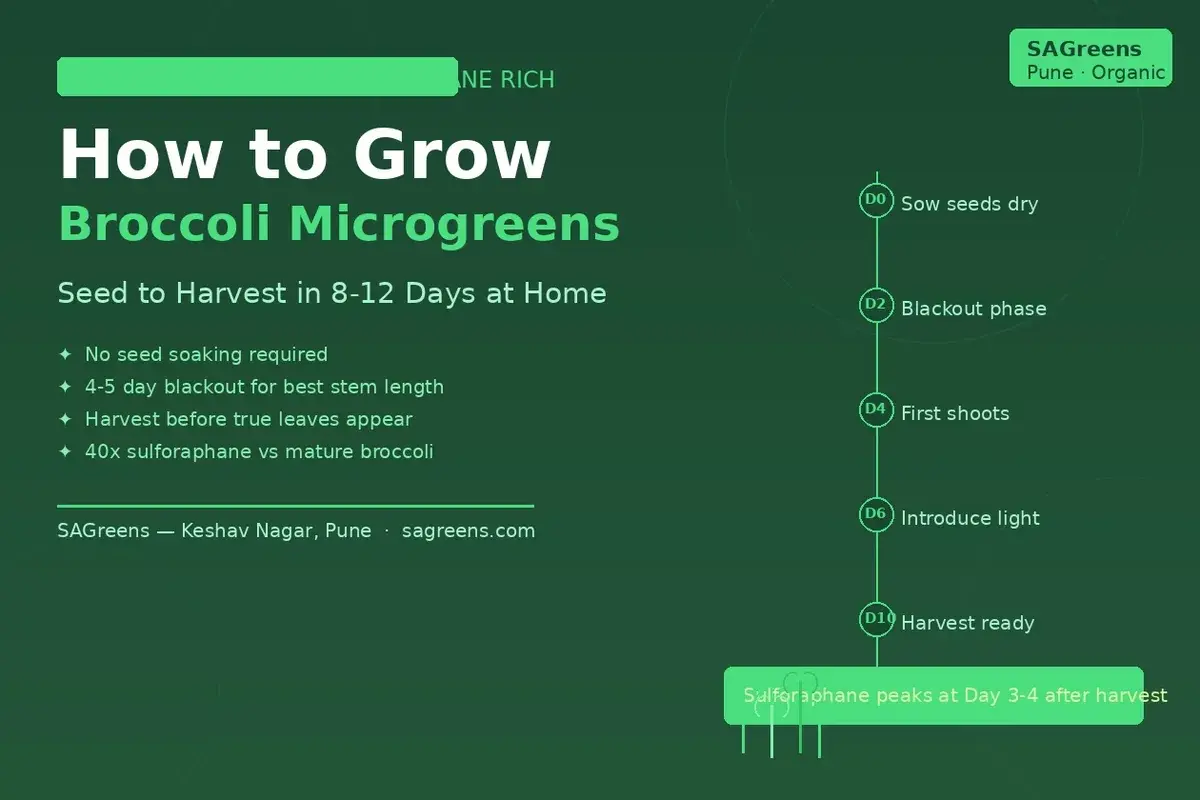
Broccoli microgreens are the single best starting point for anyone learning to grow microgreens at home in India. They need no pre-soaking, germinate within 24-48 hours, tolerate the temperature swings of an Indian apartment, and reach harvest in 8-12 days. They also carry a genuinely remarkable nutritional payload for their size.
Key Takeaways: Broccoli microgreens grow in 8-12 days with no seed soaking required. Sow 8-12g of seed per tray, keep in blackout for 3-4 days, then move to bright indirect light. Ideal temperature is 20-30 degrees Celsius, which most Indian homes hold naturally for much of the year. Expect 96% germination from fresh, untreated seed. The harvest is mild and fresh-tasting, not bitter.
This guide covers the full process as we run it at SAGreens in Pune, including the adjustments that matter for Indian conditions — summer heat, monsoon humidity, and the hard water common across Maharashtra.
What Are Broccoli Microgreens?
Broccoli microgreens are broccoli plants harvested at the cotyledon stage, roughly 8-12 days after sowing, when the seedling has opened its first pair of seed leaves but has not yet developed true leaves. You eat the entire stem and leaf.
They are not sprouts. Sprouts are germinated in a jar without soil or light and eaten root-and-all within 3-5 days. Microgreens are grown in a medium, receive light, and are cut above the growing medium at harvest. The distinction matters for both food safety and flavour — if you want the full comparison, our microgreens vs sprouts guide covers it in detail.
The flavour of broccoli microgreens surprises most first-time growers. Mature broccoli is assertive and sulphurous. Broccoli microgreens are mild, fresh and faintly sweet, with only a whisper of cabbage character. Children who refuse cooked broccoli will usually eat them without complaint.
Why Broccoli Microgreens Are Worth Growing
The nutritional case rests on glucoraphanin, the compound that converts to sulforaphane when the plant tissue is chewed or chopped. Research on young brassica seedlings has repeatedly found dramatically higher glucoraphanin concentrations per gram than in the mature vegetable — with some studies reporting differences of up to a hundredfold.
The practical implication is that a small quantity of broccoli microgreens delivers what would otherwise require a large serving of cooked broccoli. And because they are eaten raw, no sulforaphane is lost to boiling.
For the complete nutritional breakdown, including vitamin and mineral figures, see our broccoli microgreens benefits and nutrition guide.
| Attribute | Broccoli microgreens |
|---|---|
| Days to harvest | 8-12 |
| Pre-soak required | No |
| Germination time | 24-48 hours |
| Blackout phase | 3-4 days |
| Seed per tray | 8-12g |
| Ideal temperature | 20-30 degrees Celsius |
| Difficulty | Beginner |
| Flavour | Mild, fresh, lightly cabbage-like |
What You Need Before You Start
The equipment list is short and most of it you already own.
- A shallow tray with drainage holes, plus a second solid tray underneath to catch water
- Growing medium — cocopeat is the standard choice across India, widely available and inexpensive
- Broccoli seeds sold for microgreen growing, untreated and food grade
- A spray bottle
- Something opaque to cover the tray during blackout — an inverted tray or a sheet of cardboard
A note on seed, because this is where most failures originate. Broccoli seed sold for field planting is frequently treated with fungicide, which is dangerous on a crop you eat raw and whole. Always confirm the seed is untreated and food grade. Our guide to untreated non-GMO seeds explains what to check and what the labelling means.
Seed Quality: All SAGreens microgreen seeds are NPOP-certified organic — no fungicide, no chemical treatment, germination tested before dispatch. Our organic broccoli seeds are ₹200 for 20g (MRP ₹249, 20% off), enough for roughly two trays. Delivery charged at checkout.
Step-by-Step: How to Grow Broccoli Microgreens
Step 1: Prepare the Medium
Moisten your cocopeat until it holds together when squeezed but releases no dripping water. Over-wet medium is the leading cause of mould, particularly during the Indian monsoon.
Fill the tray with 3-4cm of medium and level the surface with your hand or a flat piece of card. An uneven surface produces uneven germination, because seeds sitting in hollows stay wetter than seeds on ridges.
Step 2: Sow the Seed — Do Not Soak
Broccoli seed is small and requires no pre-soaking. This is one of the reasons it suits beginners. Soaking small brassica seed makes it clump and sow unevenly, and offers no germination benefit. If you are growing several varieties and want to know which do need soaking, our seed soaking guide covers each one.
Scatter 8-12g of seed evenly across the tray surface. The seeds should sit close together but not stacked on top of one another. Over-seeding is the second most common beginner error — a dense mat restricts airflow between stems and invites mould.
Do not bury the seed. Press it gently into contact with the surface with a flat palm, then mist lightly.
Step 3: Blackout — Days 1 to 4
Cover the tray so no light reaches the seed and keep it at room temperature. In darkness the seedlings put their energy into root establishment and stem extension rather than leaf development, which produces the long, uniform stems you want.
Mist once or twice daily. The surface should stay damp, never waterlogged. Lift the cover briefly each day to let air move across the tray — thirty seconds is enough, and it markedly reduces mould risk in humid conditions.
Germination begins within 24-48 hours. By day three you should see a dense pale mat of stems pushing against the cover.
Step 4: Light Phase — Days 5 to 7
Remove the cover. The seedlings will be pale yellow and will look alarming. Within a few hours of light exposure they begin greening, and within a day they are properly green.
Move the tray to bright indirect light. An east-facing window giving morning sun is close to ideal in most Indian homes. Avoid harsh direct afternoon sun, which scorches the delicate cotyledons and dries the tray faster than you can keep up with.
Switch from misting to bottom watering now. Pour water into the lower solid tray and let the medium draw it up. Keeping the leaves dry from this point onward is the single most effective mould prevention measure there is.
Step 5: Harvest — Days 8 to 12
Harvest when the cotyledons are fully open and deep green, and before true leaves emerge. True leaves signal that flavour is turning sharper and texture is toughening.
Cut with clean scissors just above the medium line. Cutting low picks up cocopeat, which is unpleasant to eat and difficult to rinse out.
Broccoli microgreens do not regrow after cutting. Compost the spent medium and root mat, or reuse it in your balcony pots.
Growing Broccoli Microgreens Through the Indian Seasons
Indian conditions vary enormously across the year and across the country. The plant is the same; the management changes.
| Season | Main challenge | What to change |
|---|---|---|
| Summer (Mar-Jun) | Heat, rapid drying | Grow indoors away from windows; water twice daily; harvest at day 8-9 |
| Monsoon (Jun-Sep) | Humidity, mould | Reduce seed density; increase airflow; strict bottom watering |
| Winter (Oct-Feb) | Slower growth | Expect 12-14 days; warmest room in the house; no other change needed |
Monsoon is where most growers lose trays. Humidity above 80% combined with a dense seed mat is precisely the environment mould wants. Sowing at the lower end of the range — 8g rather than 12g — makes a substantial difference. A small fan running on low in the room helps more than most people expect. Our monsoon growing guide covers this in depth across varieties.
Water hardness is worth mentioning for growers in Pune, Mumbai and much of Maharashtra. Hard water leaves mineral deposits on the medium surface over successive grows. It does not harm the crop, but if you are reusing trays, rinse them properly between cycles.
Troubleshooting
White fuzz on the medium. Almost always root hair, not mould. Root hair is fine, halo-like, appears symmetrically around the stem base, and disappears when misted. Mould is web-like, spreads in irregular patches across the surface, and often smells musty. If it is genuinely mould, increase airflow, reduce watering, and sow more thinly next time.
Pale, leggy, falling-over stems. Insufficient light after blackout. Move closer to a window. Stems that stretch and collapse have gone too long searching for light.
Patchy germination. Uneven sowing, uneven surface, or old seed. Broccoli seed should germinate at 90%+ if fresh; ours tests at 96%. Seed more than two years old loses vigour noticeably.
Seed hulls stuck on the leaves. Normal, and mostly cosmetic. Misting during the light phase softens them and many drop off. Slightly firmer initial contact between seed and medium reduces it.
Sour or off smell. Overwatering with poor drainage. The root zone has gone anaerobic. Discard the tray — do not eat it — and reduce water next cycle.
Using Broccoli Microgreens in Indian Cooking
Because the flavour is mild, broccoli microgreens work in far more Indian dishes than people assume.
- Scattered over dal or khichdi at the table, after the heat is off
- Folded into raita with cucumber and roasted jeera
- Layered into sandwiches and rolls in place of lettuce
- Blended into chutney with coriander, green chilli and lemon
- Finished over poha or upma just before serving
The rule is consistent: add them off the heat. Sulforaphane formation depends on an enzyme that heat destroys, so anything beyond residual warmth loses the nutritional advantage that made you grow them.
For more ideas across varieties, see our microgreens in Indian cuisine guide.
Storing the Harvest
Harvest dry. Wet microgreens deteriorate within a day.
Line an airtight container with dry kitchen paper, add the cut greens loosely without packing, and refrigerate. Stored this way, broccoli microgreens hold for 5-7 days. Wash only immediately before eating.
If they wilt slightly, a two-minute soak in cold water usually revives them. Dry thoroughly before returning them to the fridge.
Buying Broccoli Seeds and Microgreens in India
If you want to grow, you need untreated food-grade seed. If you would rather skip growing and simply eat them, we deliver fresh.
| What you want | Product | Price |
|---|---|---|
| Grow your own | Organic Broccoli Seeds | ₹200 / 20g |
| Eat without growing | Fresh Broccoli Microgreens | ₹200 / 50g |
| Try several varieties | Full seed range | From ₹50 |
We ship seed pan-India and deliver fresh microgreens across Pune the same day. For bulk seed pricing or restaurant supply, contact us on WhatsApp.
If broccoli is your first microgreen, our best microgreen seeds for beginners guide suggests what to grow alongside it, and our home growing guide for Pune covers general setup in more detail.
Frequently Asked Questions
Do broccoli microgreens need soaking before sowing?
No. Broccoli seed is small and germinates readily without pre-soaking. Soaking causes small brassica seed to clump, which produces uneven sowing and increases mould risk. Sow dry seed directly onto pre-moistened cocopeat.
How long is the blackout phase for broccoli microgreens?
Three to four days. During blackout the seedlings direct energy into root establishment and stem extension rather than leaf development, which produces the long uniform stems you want. Lift the cover briefly each day to allow airflow.
When should I harvest broccoli microgreens?
Between days 8 and 12, when the cotyledons are fully open and deep green but before true leaves emerge. True leaves signal that flavour is turning sharper and texture is toughening. Cut with clean scissors just above the medium line.
How much sulforaphane is in homegrown broccoli microgreens?
Broccoli microgreens are rich in glucoraphanin, the precursor that converts to sulforaphane when the tissue is chewed or chopped. Research on young brassica seedlings has reported substantially higher glucoraphanin per gram than in mature broccoli heads. Exact levels vary with seed batch, light and harvest day, so treat published figures as indicative rather than precise.
Can I grow broccoli microgreens without a balcony?
Yes. Broccoli microgreens need no outdoor space at all. A kitchen counter near a window, or any indoor spot with bright indirect light, is sufficient. Many growers in Mumbai and Pune apartments grow entirely indoors year-round, which also avoids monsoon rain and summer heat.
My broccoli microgreens taste bitter. What went wrong?
Almost always harvesting too late. Once true leaves develop, glucosinolate levels rise and flavour turns sharp. Harvest at the cotyledon stage instead. Heat stress above 32 degrees Celsius and prolonged harsh direct sun can also push flavour towards bitterness.
How do I store harvested broccoli microgreens?
Harvest dry and do not wash before storing. Line an airtight container with dry kitchen paper, add the cut greens loosely without packing, and refrigerate. Stored this way they hold for 5-7 days. Wash only immediately before eating.
How much seed do I need per tray?
8-12g per standard tray. Use the lower end during monsoon, when reduced density improves airflow and lowers mould risk. A 20g pack covers roughly two trays.
Why are my broccoli microgreens leggy and pale?
Not enough light after the blackout phase ended. Broccoli microgreens need bright indirect light for 4-6 hours daily once uncovered. Move the tray closer to a window, avoiding harsh direct afternoon sun.
Do broccoli microgreens regrow after cutting?
No. Broccoli is cut once. Unlike pea shoots, which regrow for a second harvest, brassicas do not produce a second flush. Compost the medium and start a fresh tray.
Are broccoli microgreens safe for children?
Yes, and their mild flavour makes them one of the easier vegetables to introduce. Because they are eaten raw, use untreated food-grade seed and wash before serving. Our microgreens for kids guide has age-appropriate serving ideas.
Broccoli Compared With Other Brassica Microgreens
Broccoli belongs to the brassica family, alongside mustard, radish, kale, cabbage and kohlrabi. They share small seed size, fast germination and no soaking requirement, which is why they are grouped together in most growing guides. They differ considerably in flavour and speed.
| Variety | Days | Flavour | Difficulty | Notes |
|---|---|---|---|---|
| Broccoli | 8-12 | Mild, fresh | Beginner | Highest glucoraphanin of the group |
| Radish | 6-8 | Sharp, peppery | Beginner | Fastest brassica; very forgiving |
| Mustard | 6-8 | Hot, pungent | Beginner | Strongest flavour; use sparingly |
| Kale | 8-10 | Mild, sweet | Beginner | Similar handling to broccoli |
| Cabbage | 8-10 | Very mild | Beginner | Mildest of the group |
| Kohlrabi | 8-12 | Sweet, crisp | Intermediate | Slower and slightly more demanding |
If you are running multiple trays, staggering broccoli against radish works well — radish is ready as broccoli enters its light phase, giving you a continuous supply from two trays. Our complete guide to microgreen seed types compares all fifteen varieties we grow.
What One Tray Actually Yields
Growers frequently ask whether growing at home is worth it against simply buying fresh. The arithmetic is straightforward.
A tray sown with 8-12g of broccoli seed yields roughly 150-250g of cut microgreens, depending on seeding density, light quality and how close to day twelve you harvest. From a 20g seed pack at ₹200, that is two trays and approximately 300-500g of harvest.
| Item | Figure |
|---|---|
| Seed per tray | 8-12g |
| Yield per tray | 150-250g |
| Trays per 20g pack | About 2 |
| Total yield per pack | 300-500g |
| Grow cycle | 8-12 days |
Cocopeat and tray costs are minor and the trays are reusable across many cycles. The genuine cost is attention — twelve days of daily checking. Growers who enjoy the process find it worthwhile; those who want the nutrition without the routine are usually better served buying fresh, which is why we sell both.
Scaling Up: Notes for Small Commercial Growers
Several SAGreens seed customers grow for local sale rather than household use. A few observations from running trays continuously in Pune.
Consistency matters more than peak yield. Restaurants and subscription customers care that the product arrives the same every week. That argues for controlled indoor conditions and a fixed schedule rather than chasing maximum growth.
Stagger sowing rather than batching. Sowing every second day gives a steady harvest instead of a glut followed by a gap.
Track germination by batch. Seed vigour declines with age, and knowing that a particular batch runs at 92% rather than 96% lets you adjust seeding density instead of discovering a thin tray on harvest day.
Buy seed in quantity once you are past the trial stage. Our bulk microgreen seeds guide covers wholesale pricing and storage, and we quote bulk rates directly on request.
Detailed Nutritional Notes
Broccoli microgreens concentrate several nutrients relative to their weight. The most discussed is glucoraphanin, the precursor to sulforaphane, but the wider profile matters too.
| Nutrient | Contribution |
|---|---|
| Glucoraphanin | Precursor to sulforaphane; substantially higher per gram than mature broccoli |
| Vitamin C | Supports immune function and iron absorption |
| Vitamin K | Contributes to bone metabolism and normal clotting |
| Folate | Relevant during pregnancy and for red blood cell formation |
| Sulphur compounds | Support the body's own antioxidant pathways |
Two practical points. First, sulforaphane forms only when plant tissue is damaged, so chewing thoroughly or chopping before serving matters. Second, the enzyme responsible is heat sensitive, which is the reason every serving suggestion in this guide places the greens on the dish after cooking rather than during.
Anyone on blood-thinning medication should note the vitamin K content and keep intake consistent rather than variable, as they would with any leafy green.
About SAGreens
SAGreens is a microgreens farm in Keshav Nagar, Mundhwa, Pune, run by Ajay Toradmal, who comes from a three-generation farming family in Maharashtra. We grow microgreens for homes and restaurants across Pune and supply NPOP-certified organic microgreen seeds across India.
Every seed batch is germination-tested before dispatch, because a seed that does not germinate wastes a grower's twelve days, not just their money.
Related Reading
Fresh Tips & Exclusive Offers
Subscribe for growing tips, seasonal updates, and exclusive offers on fresh organic microgreens in Pune.