Are Mustard Microgreens Too Spicy? Try Yellow Instead
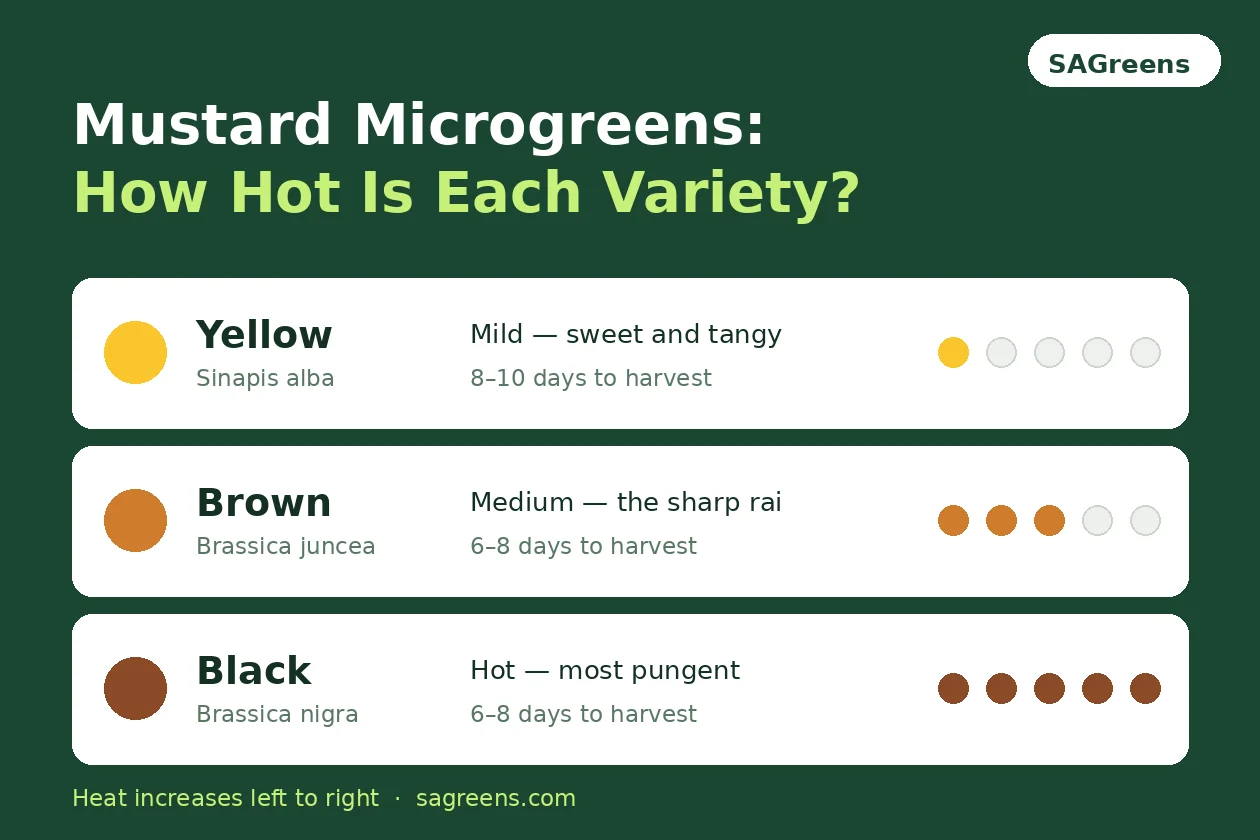
Mustard microgreens are spicy, and the amount of heat depends almost entirely on which of the three varieties you grew. That one fact resolves most of the disappointment people have with them.
Key Takeaways: Mustard microgreens range from mild to fiercely hot depending on variety. Yellow mustard (Sinapis alba) is the mildest — sweet and tangy, closer to a salad leaf than a pickle. Brown mustard, the rai most Indian kitchens already use, is sharper. Black mustard is hottest. Heat also rises with tray age, with heat stress, and with under-watering, so the same seed can taste different from two trays. If a mustard tray in your house went uneaten, the variety is the first thing to change, not the method.
Yes, mustard microgreens are spicy — but not all to the same degree
The pungency in mustard is not incidental. It is the plant defending itself. When you bite a mustard seedling you rupture its cells, and an enzyme called myrosinase meets compounds called glucosinolates that were sitting harmlessly in a separate compartment. The reaction produces isothiocyanates, and those are what hit the back of your nose.
This is the same chemistry that makes wasabi and horseradish sharp, and it is why mustard heat behaves differently from chilli heat. Chilli capsaicin is oil-soluble and lingers on the tongue. Mustard isothiocyanates are volatile — they travel up rather than across, which is why a strong mustard microgreen catches you in the sinuses and then fades quickly.
How much of it a plant makes depends on the species. That is the whole reason the three mustards taste so different.
The three varieties, side by side
| Variety | Latin name | Heat | Days to harvest | Tastes like |
|---|---|---|---|---|
| Yellow | Sinapis alba | Mild | 8-10 days | Sweet, faintly tangy |
| Brown | Brassica juncea | Medium | 6-8 days | The sharp rai of a tempering |
| Black | Brassica nigra | Hot | 6-8 days | Most pungent of the three |
The gap between yellow and black is not subtle. People who describe mustard microgreens as inedible have almost always been given black or brown; people who describe them as mild have usually eaten yellow without knowing that is what it was.
If a mustard tray went uneaten, change the variety before you change anything else. Growers tend to assume they harvested late or watered wrong. Nine times out of ten they simply grew a hotter variety than the household wanted.
Our guide to growing mustard microgreens at home covers the method for all three, which is nearly identical. This page is about which one to pick.
Yellow mustard: the one to grow if heat is the problem
Yellow mustard microgreen seeds produce the gentlest tray of the three. The flavour is sweet and slightly tangy, with the mustard character clearly present but soft enough that it sits underneath a dish rather than on top of it.
Two other things distinguish it. It takes 8 to 10 days rather than 6 to 8, so it is the slower variety, and it fills the tray more densely in return. And it looks different: pale green-yellow stems with bright lime cotyledons, where brown mustard runs darker and sometimes faintly purple at the stem.
That visual difference is useful on a plate. A yellow mustard garnish reads as fresh and light; a brown mustard garnish reads as assertive before anyone has tasted it.
Yellow mustard is the variety that gets finished. If you are growing for children, for guests who have never eaten microgreens, or for food you do not want overpowered, it is the correct choice rather than a compromise.
A 100g pack of organic yellow mustard seeds is ₹150 and fills roughly seven to nine trays.
Fresh from SAGreens
Organic Microgreen Seeds — Delivered Across India
Quality-tested sunflower, radish, broccoli, mustard & more. Shipped to your door in Pune, Bangalore, Delhi, Mumbai and all major cities.
Brown and black: when the heat is the point
There is nothing wrong with hot mustard microgreens. They are excellent on food that can take them.
Rich, fatty and heavily spiced dishes swallow a mild garnish whole. A sharp mustard microgreen cuts through in a way yellow simply cannot. Scattered over a kebab, folded into a chaat at the last second, or laid across a rich dal, brown mustard does a job no mild green will do.
Our organic mustard seeds at ₹124 per 100g are the sharper option, and the mustard microgreen seeds page covers that side in detail.
The mistake is not growing hot mustard. The mistake is growing hot mustard and then using it where a mild green belonged.
What makes the same variety taste hotter than last time
Variety sets the range. Growing conditions decide where inside that range a particular tray lands, which is why two trays of the same seed can taste noticeably different.
| What you did | Effect on heat | Why |
|---|---|---|
| Harvested later than usual | Hotter | Glucosinolate content rises as the seedling matures |
| Let the tray dry out | Hotter | Mild water stress pushes the plant to defend itself |
| Grew through a hot spell | Hotter | Heat stress works the same way |
| Harvested a day early | Milder | Less time to accumulate |
| Kept the tray evenly moist | Milder | An unstressed plant makes less |
| Grew in cooler months | Milder | Slower, gentler growth |
A tray tastes hotter when the plant has had a harder life. Consistent watering and cutting on schedule will take the edge off any mustard variety by a noticeable margin. Neglect does the opposite.
This is genuinely useful control. If your brown mustard is close to right but slightly too much, harvesting on day six rather than day eight and keeping the tray properly watered will soften it without changing seed.
Five ways to tame mustard heat without changing variety
Which variety for which dish
| Dish | Best variety | Why |
|---|---|---|
| Raita and curd-based sides | Yellow | Tang without fighting the curd |
| Fresh chutneys | Yellow | Adds mustard note, keeps it balanced |
| Sandwiches and salads for children | Yellow | Mild enough to be eaten rather than picked out |
| Kebabs and rich grills | Brown or black | Cuts fat; a mild green disappears |
| Chaat | Brown | Belongs in a dish already built on sharp contrasts |
| Dal, added at serving | Brown | Echoes the tempering |
| Plain poha or upma | Yellow | Nothing there to hide behind |
Our guide to using microgreens in Indian cuisine goes further into pairing across regional cooking.
Growing the mild one
The method is the same as any mustard, with one timing change.
Sow dry. Do not pre-soak mustard seed of any variety — it is small enough to take moisture from damp cocopeat on its own, and soaking makes it clump so it spreads unevenly. Use roughly 15 to 20g for a 25cm by 25cm tray.
Cover for blackout for two to three days. This is what makes the stems push upward rather than sprawl sideways.
Then uncover into bright indirect light and bottom water once or twice a day. Misting flattens seedlings this small.
Harvest at day 8 to 10 rather than the 6 to 8 you would use for brown or black. This is the part growers get wrong: they treat all mustard as a one-week crop, uncover yellow on day six, find it short, and conclude the seed was poor. Judge it on day eight.
Yellow mustard wants sowing two days earlier than brown to land on the same cutting day. If you run trays on a weekly rhythm, build that into the schedule rather than discovering it tray by tray.
Mistakes that make mustard hotter than you wanted
How mustard compares with the other peppery microgreens
Mustard is not the only microgreen with bite, and growers choosing on flavour alone often find that a different crop was what they actually wanted.
| Microgreen | Type of heat | Intensity | Days | Notes |
|---|---|---|---|---|
| Yellow mustard | Mustard, volatile | Mild | 8-10 | Sweet and tangy; the gentle option |
| Brown mustard | Mustard, volatile | Medium | 6-8 | The familiar rai sharpness |
| Black mustard | Mustard, volatile | Hot | 6-8 | Most pungent of the three |
| Radish | Peppery, lingering | Medium | 6-8 | Crisper stem, heat sits on the tongue |
| Rocket | Peppery, bitter edge | Medium | 8-12 | Bitterness alongside the heat |
The distinction that matters is where the heat goes. Mustard is volatile and travels up into the sinuses, then clears. Radish microgreens are peppery in a flatter way that stays on the tongue longer and comes with far more crunch, because the stem is thicker.
If what you liked about mustard was the sharpness but not the nose-hit, radish is probably the crop you wanted. If what you liked was specifically the mustard character, yellow gives you that at low intensity in a way radish cannot, because it is a different flavour entirely rather than a milder version of the same one.
Does storage change how hot they taste?
Somewhat, and in the direction most people do not expect: cut mustard microgreens lose heat over time rather than gaining it.
The isothiocyanates responsible for the pungency are volatile, which is what makes them reach your sinuses in the first place. That same volatility means they escape. A tray cut on Monday and eaten Monday is noticeably sharper than the same greens eaten on Thursday from the fridge.
This is worth knowing in both directions. If a variety is slightly too hot for your household, cutting a day ahead and refrigerating will take some edge off. If you grew mustard specifically for the heat, eat it the day you cut it and stop storing it.
Cut mustard loses pungency in the fridge, it does not gain it. Eat it the day you harvest if heat is the point; cut a day ahead if you want it softer.
Store in an airtight container with a dry paper towel at refrigerator temperature and use within four to five days. The paper towel matters more than the container: surface moisture is what turns a mustard tray slimy, and mustard goes over faster than sturdier greens like sunflower.
What the seed pack cannot tell you
There is one honest limitation worth stating. Heat in mustard is not a fixed number the way germination rate is. Two farms growing the same species in different soil, season and water regime will produce seed whose crops sit at different points on the scale, and the same is true of two trays in your own kitchen a month apart.
What the variety tells you is the range. Yellow will always be milder than brown grown the same way; brown will always be milder than black. What it cannot tell you is exactly where inside that range your tray will land, because that depends on how the plant was treated over eight days.
This is why we would rather tell you the mechanism than quote a number. Once you know that stress raises heat and even watering lowers it, you can steer the crop yourself, which is more useful than a figure on a packet.
Frequently Asked Questions
Are mustard microgreens spicy?
Yes, but the amount varies enormously by variety. Yellow mustard (Sinapis alba) is mild, sweet and slightly tangy. Brown mustard is sharp, similar to the rai used in Indian tempering. Black mustard is the most pungent of the three. The heat comes from isothiocyanates, the same family of compounds that make wasabi and horseradish sharp, and it fades faster than chilli heat.
Which mustard microgreen is the mildest?
Yellow mustard, Sinapis alba, is clearly the mildest of the three. It tastes sweet and faintly tangy rather than hot, and it is the variety to choose for children, for guests unfamiliar with microgreens, or for delicate dishes. It also takes 8 to 10 days to harvest rather than the 6 to 8 of brown and black.
Why do my mustard microgreens taste hotter than last time?
Growing conditions move the heat within the range the variety sets. A tray that dried out between waterings, grew through a hot spell, or was harvested later than usual will taste sharper. Glucosinolate content rises as the seedling matures and when the plant is stressed. Even watering and cutting on schedule reliably produces a milder crop from the same seed.
Can I make mustard microgreens less spicy?
Yes, several ways. Harvest a day or two earlier, keep the tray evenly moist rather than letting it swing dry, and serve it with fat — curd, ghee or coconut blunt the pungency quickly. Mixing mustard half and half with sunflower or pea shoot gives the flavour at half the intensity. Cooking removes the heat but also removes the point.
Are mustard microgreens hotter than mature mustard leaves?
Generally yes. Microgreens concentrate glucosinolates in a small amount of tissue, so gram for gram the seedling is sharper than the mature leaf, which has spread the same compounds across much more leaf mass and developed a bitter, earthy character instead.
Which mustard microgreen should I grow for children?
Yellow mustard. It is the mildest by a wide margin, sweet rather than hot, and it is the variety most likely to be eaten rather than picked off the plate. Serving it with curd softens it further. Our guide to microgreens for children covers introducing them more generally.
How long do yellow mustard microgreens take to grow?
Eight to ten days from sowing to harvest, two days longer than brown or black mustard. The variety grows more slowly and fills the tray more densely in exchange. Judge the tray on day eight rather than day six, or you will uncover it early and get a short, uneven crop.
Do mustard microgreen seeds need soaking?
No, and this applies to all three varieties. Sow dry directly onto pre-moistened cocopeat. The seed is small enough to take up moisture from the medium on its own, and soaking makes it sticky so it clumps and spreads unevenly.
How much do yellow mustard microgreen seeds cost?
₹150 for a 100g pack from SAGreens, which fills roughly seven to nine trays at 15 to 20g per tray. Brown mustard seed is ₹124 per 100g. Delivery is charged at checkout by weight and pin code. The full range is on the seed catalogue.
Can I use mustard seeds from my kitchen to grow microgreens?
It is not a good idea. Culinary spice seed is not sold for germination, carries no tested germination figure, and may have been treated or stored in ways that make it unsuitable. It is also frequently unclear whether a jar of rai is brown or black, so you will not know what heat level you are growing. Seed sold for microgreens is untreated and tested.
Are mustard microgreens good for you?
They are a brassica, so like broccoli and radish microgreens they contain glucosinolates, along with vitamins C and K. The compounds responsible for the flavour are the same ones the research on brassicas is interested in. They are a useful addition to a diet rather than a treatment for anything.
Which is better, yellow or brown mustard microgreens?
Neither is better; they serve different purposes. Choose yellow when you want mustard flavour without heat — for children, mild dishes, curd-based sides. Choose brown or black when you want the sharp bite that cuts through rich food. Deciding by heat is essentially the whole decision, because the growing method is nearly identical.
Which one should you order
If a mustard tray has ever gone uneaten in your house, order yellow mustard seed next. If you have been happy with the heat and want more of it, stay with brown mustard. Both ship from our Pune farm across India, and both grow by the same method with the harvest date two days apart.
If you are unsure which variety you grew last time, send us a photo of the tray through our contact page and we will tell you what we see. Stem colour usually settles it.
About the author. SAGreens is run by Ajay Toradmal in Keshav Nagar, Mundhwa, Pune, from a three-generation farming family. We grow all three mustard varieties on the farm and eat them before we sell the seed.
Fresh Tips & Exclusive Offers
Subscribe for growing tips, seasonal updates, and exclusive offers on fresh organic microgreens in Pune.