Microgreens Business in Bangalore: Complete Guide to Cost, Profit & Starting
A microgreens business in Bangalore is easier to run than in almost any other Indian city, and harder to sell in than most. The climate does the growing for you — no cooling in summer, no heating in winter, and the best trays of the Indian year from October to February. The selling is where the work is, because Bengaluru already has more microgreen suppliers than any other city in the country.
The demand is real enough to support that competition. Bengaluru has an unusually high concentration of independent restaurants, cloud kitchens and health-focused cafes, an established organic retail scene, and gated communities where several thousand high-income households sit inside one delivery stop. Chefs here already know what microgreens are, which removes the explaining that growers in smaller cities spend their first year doing.
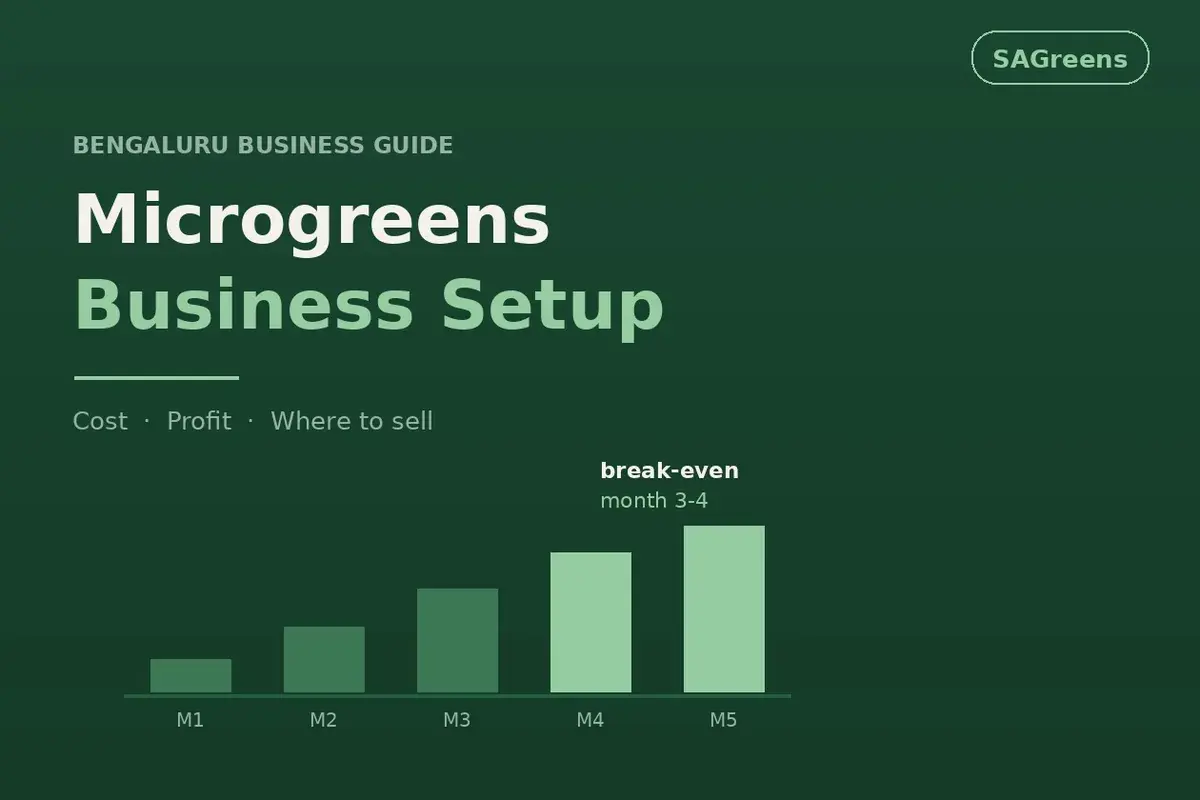
Key Takeaways: A small Bangalore microgreens operation starts at ₹15,000-25,000 for 20-25 trays. Bangalore's moderate climate removes the cooling costs that Delhi and Chennai growers carry, which is the single biggest structural advantage. Expect break-even at month 3-4 running 20-30 trays weekly. Restaurants in Indiranagar and Koramangala pay ₹150-250 per 100g; apartment subscriptions pay less per gram but churn less. Seed is the main recurring cost at ₹50-200 per 100g pack.
This guide covers the nine steps to starting, what the setup actually costs, what it realistically earns once operating expenses come out, where to sell across Indiranagar, Koramangala, HSR Layout, Whitefield and Electronic City, and the seed decisions that quietly determine your margin. The figures come from growers we supply seed to, not from a spreadsheet. For the growing side rather than the business side, read our complete microgreens growing guide for Bangalore.
Why Bangalore Suits Microgreen Growing
The climate advantage is real and worth quantifying. Bengaluru sits between roughly 18 and 33 degrees Celsius for most of the year, which is close to the ideal 20-28 range for microgreens.
Growers in Delhi lose weeks to 45-degree summers and need cooling. Chennai and Kochi fight humidity year-round. Pune manages, but May is difficult. Bengaluru needs neither air conditioning nor a heater for most of the year, and that removes the largest variable cost other cities carry.
The cool season from October to February produces the best trays of the Indian year. Pigmented varieties like purple sango radish develop noticeably deeper colour here, because anthocyanin production increases at lower temperatures. That matters commercially, since colour is what restaurants pay a premium for.
The trade-off is competition. Bengaluru has more established microgreen suppliers than any other Indian city, and restaurants there have usually been approached before. You are not introducing a novel product; you are displacing someone.
How to Start a Microgreens Business in Bangalore
Nine steps, in the order that costs you the least to get wrong.
1. Choose a growing space. A spare room, an enclosed balcony or a terrace with shade. You need 40 to 60 square feet for 25 trays on a four-tier rack, plus somewhere clean to harvest. Bengaluru rent is high enough that taking commercial space before you have customers is the commonest way these ventures die. Check the light your space actually gets across a week before committing to it.
2. Buy trays and basic equipment. Twenty-five growing trays with drainage plus twenty-five solid trays beneath them, a steel rack, scissors, a spray bottle and a kitchen scale. The scale matters more than it sounds: sowing by eye is the reason two trays of the same variety come out different.
3. Choose your seed. Untreated, food grade, with a stated germination rate. This decision sets your margin for the life of the business, and it is covered in detail further down.
4. Run a small trial first. Three or four trays of two varieties, sown a week apart, before you spend on twenty-five. You are testing your specific space, not the crop — light, airflow and how fast your medium dries are all local. Germination test each new seed lot the same way: twenty seeds on damp tissue, counted at day five.
5. Learn to harvest and pack. Cut on the morning of delivery, above the medium, with clean scissors into a sanitised container. Do not wash unless a buyer requires it, because surface water halves shelf life. Punnets with a label carrying your name, the variety, the cut date and your FSSAI number are what a chef expects to see.
6. Register the business. FSSAI first — see the Karnataka section below. A GST registration is only required above the turnover threshold, but restaurants and quick commerce platforms will ask for a proper invoice, so keep clean records from the first sale.
7. Find customers before you scale. Approach ten to fifteen buyers with samples while your trial trays are still running. Three recurring accounts are worth more than thirty one-off sales, and the selling takes longer than the growing ever will.
8. Price and calculate real profit. Work out cost per usable tray including the seed you wasted on poor germination, then price on reliability rather than by undercutting. The cost and profit sections below set out the arithmetic.
9. Scale on confirmed orders. Add trays when an account asks for more, not in anticipation. Microgreens are unsaleable within a week of cutting, so capacity built ahead of demand becomes compost.
Looking for quality microgreen seeds for your business? Explore the SAGreens microgreen seed range — untreated, germination tested, and shipped to every Bengaluru pin code.
Microgreens Business Cost in Bangalore
These are realistic Bengaluru figures for a small operation running 20-25 trays a week.
| Item | Cost | Notes |
|---|---|---|
| Trays (25 growing + 25 solid) | ₹3,000-4,500 | Reusable for years |
| Rack or shelving | ₹3,500-6,000 | 4-5 tiers, steel |
| Cocopeat (5kg blocks x 4) | ₹800-1,200 | About 3 months supply |
| Seed (initial range) | ₹2,000-3,500 | 5-6 varieties |
| Grow lights (optional) | ₹3,000-6,000 | Only if light is poor |
| Spray bottles, scissors, misc | ₹800-1,200 | |
| Packaging (initial 500 units) | ₹2,500-4,000 | Punnets and labels |
| FSSAI registration | ₹100-2,000 | Basic vs State licence |
| Total | ₹15,000-25,000 | Without lights: ₹12,000-19,000 |
Three costs are missing from that table on purpose, because they are not setup costs and are where new growers underestimate. Labour is yours at this scale — 25 trays is six to eight hours a week — and only becomes a line item above roughly 100 trays. Delivery is fuel and time, and Bengaluru traffic makes it the largest hidden cost in the business. Marketing for a microgreens business is samples and travel rather than advertising: budget ₹1,000-2,000 a month for punnets you give away, which is the cheapest customer acquisition available to you.
Prices may vary based on quantity, variety and market conditions.
Bengaluru rents make a dedicated space expensive, so nearly every operation at this scale runs from a spare room, balcony or terrace. That is not a compromise — at 20-30 trays you do not need more, and paying rent before you have customers is the commonest way these ventures fail.
Monthly Running Costs
| Item | Monthly cost |
|---|---|
| Seed | ₹2,000-4,000 |
| Cocopeat | ₹300-500 |
| Packaging | ₹1,500-3,000 |
| Electricity (BESCOM, lights only) | ₹200-600 |
| Water | Negligible |
| Delivery or fuel | ₹1,500-3,000 |
| Total | ₹5,500-11,000 |
Seed is the largest recurring input, and germination rate moves your margin more than pack price does — the arithmetic is set out in the seed section below. Our bulk microgreen seeds guide covers volume pricing at commercial quantities.
Seed Quality: All SAGreens microgreen seeds are NPOP-certified organic, untreated and germination tested before dispatch. Radish ₹120/100g, sunflower ₹124/100g, mustard ₹124/100g, pea shoot ₹88/100g. We ship to every Bengaluru pin code in 2-4 days, delivery charged at checkout. Contact us for commercial rates.
What You Can Earn
A standard tray yields 150-250g depending on variety. At 25 trays weekly that is roughly 4-6kg a month of saleable product.
| Channel | Price per 100g | Notes |
|---|---|---|
| Restaurants, premium | ₹180-250 | Indiranagar, MG Road, UB City |
| Restaurants, mid-tier | ₹120-180 | Koramangala, HSR, Whitefield |
| Apartment subscription | ₹100-150 | Lower price, far lower churn |
| Farmers markets | ₹150-200 | Weekend only, high effort |
| Quick commerce | ₹80-120 | Volume, thin margin |
At 5kg monthly across mixed channels averaging ₹140 per 100g, revenue is roughly ₹7,000. Against running costs of ₹5,500-11,000, month one usually loses money.
That is normal and worth stating plainly. The business works at 40-60 trays weekly, not 25. Most Bangalore operations reach break-even in month 3-4, once they have three or four recurring customers rather than sporadic orders.
| Scale | Trays/week | Monthly revenue | Monthly profit |
|---|---|---|---|
| Starting | 20-25 | ₹6,000-8,000 | Negative to break-even |
| Established | 40-50 | ₹14,000-18,000 | ₹6,000-9,000 |
| Full-time | 80-100 | ₹28,000-36,000 | ₹15,000-22,000 |
These assume you are doing the labour yourself. Paying someone changes the arithmetic considerably, and at Bengaluru wages it usually does not work below 100 trays.
It is worth separating four numbers that get conflated in most guides, because a business that looks profitable on gross margin can still lose money every month:
| Established operation, 45 trays/week | |
|---|---|
| Potential revenue | ₹16,000 |
| Direct cost of goods (seed, cocopeat, packaging) | ₹6,000 |
| Gross margin | ₹10,000, about 62% |
| Operating expenses (delivery, electricity, samples, misc) | ₹3,000 |
| Net profit before your own labour | ₹7,000 |
| Your hours | 12-15 a week |
Nothing here is guaranteed. It assumes you sell what you grow, which is the assumption that fails most often. A month with one lost restaurant account and no replacement turns that ₹7,000 into a loss, which is why three or four recurring customers matter more than any efficiency you can find in the growing.
Where to Sell Microgreens in Bangalore
This is the part that decides whether the business works, and where most people underestimate the effort. Our guide to where to sell microgreens in India compares every channel on price, effort and churn. No area has guaranteed demand — the ones below simply have the highest density of the buyers who already understand the product.
Restaurants and cafes
The highest price per gram and the hardest to win. Concentrate on areas with dense independent dining: Indiranagar and Koramangala first, then MG Road, Church Street, Domlur and Richmond Town. UB City and Whitefield hotels pay the most but have the longest procurement cycles.
Chefs buy on three things: consistency, appearance, and reliability of delivery. They will forgive a slightly higher price and will not forgive a missed delivery. Bring samples in the packaging you intend to use, not in a bag.
Apartment communities
Bengaluru's advantage over most Indian cities. Large gated communities in Whitefield, Sarjapur Road, Electronic City, HSR Layout and Hebbal contain thousands of high-income households in a single delivery stop.
A WhatsApp group and a weekly delivery slot is the whole operation. The price is lower than restaurants but churn is far lower, and one community can absorb 15-20 trays weekly on its own.
Organic stores and health cafes
Jayanagar, Malleshwaram, Basavanagudi and Indiranagar have established organic retail. Margins are thinner because the store takes a cut, but it is steady and requires no delivery effort per customer.
Farmers markets
Weekend markets in Koramangala, Whitefield and Sadashivanagar. Good for building a customer list and testing varieties. Poor as a primary channel — high effort per rupee, and weather dependent.
Cloud kitchens and juice bars
Bengaluru's cloud kitchen density is the highest in India, and salad and bowl brands use microgreens as a standard garnish rather than a novelty. They order smaller quantities than restaurants but far more predictably, because their menus do not change. Juice and smoothie bars around Indiranagar, Koramangala and HSR Layout buy wheatgrass and pea shoots in particular — see our wheatgrass seed guide for what growing to that demand involves.
Gyms and nutrition-led customers
Gyms and CrossFit boxes across Indiranagar, HSR Layout and Whitefield rarely buy directly, but their noticeboards and WhatsApp groups reach exactly the customer who will subscribe. The same is true of nutritionists and diet consultants, who recommend rather than resell. This is a referral channel rather than a sales one, and it costs nothing but a conversation.
Direct to consumer
Jayanagar, Basavanagudi and Malleshwaram households buy differently from Whitefield ones — smaller quantities, more often, and more likely to want familiar varieties than pigmented ones. A simple WhatsApp order list serves this better than any website, and the customers stay for years if the delivery day never moves.
Quick commerce
Swiggy Instamart, Zepto and BigBasket reach volume but at thin margins and demanding delivery windows. Worth considering only once you can reliably produce 60+ trays weekly.
What to Grow for the Bangalore Market
Match the crop to the channel rather than growing what you like.
| Channel | Grow | Why |
|---|---|---|
| Restaurants | Purple sango, chinese pink, affila peas | Colour and form command a premium |
| Subscriptions | Radish, sunflower, pea shoots | Volume, familiar, eaten regularly |
| Organic stores | Broccoli, kale, wheatgrass | Health positioning sells the shelf |
| Farmers markets | Mixed boxes | Variety drives impulse purchase |
Radish and sunflower should be your volume crops in every case — fast, reliable and cheap per gram produced. If you are still learning the crop itself, our microgreens growing guide covers method from sowing to cut. Our fastest growing microgreens guide covers the rotation that keeps supply continuous, which matters more than variety when a restaurant expects delivery twice a week.
FSSAI Registration in Karnataka
Selling food commercially in India requires FSSAI registration. For a business turning over under ₹12 lakh annually, a Basic Registration is sufficient and costs ₹100 per year. Above that, a State Licence is required, typically ₹2,000-5,000 annually.
Apply through the FoSCoS portal. Karnataka processing usually takes two to four weeks. Restaurants and organic stores will ask for your registration number before their first order, and quick commerce platforms will not onboard you without it.
Register before you approach buyers rather than after. Being asked for a number you do not have costs you the account.
The Realistic Timeline
Month 1. Set up, run trial trays, work out which varieties grow well in your specific space. Sell to friends and neighbours. Expect to lose money.
Month 2. Approach 10-15 restaurants with samples. Expect two or three to trial you. Start one apartment WhatsApp group.
Month 3-4. Break-even, if you have secured three or four recurring customers. Most people who quit do so here, having underestimated how long selling takes.
Month 6. Steady 40-60 trays weekly, ₹6,000-9,000 monthly profit, working part-time hours.
Month 12. Either scaled to full-time volume or settled as a supplementary income. Both are legitimate outcomes.
The Honest Risks
Competition is real. Bengaluru has more microgreen suppliers than any Indian city. Restaurants have been approached before, often by someone who then failed to deliver consistently. That history works against you initially and for you once you prove reliable.
Selling is the job, not growing. Growing microgreens is straightforward and becomes routine within a month. Finding and keeping buyers is continuous work that most people underestimate entirely.
Perishability is unforgiving. A tray you cannot sell is a total loss within a week. Grow to confirmed orders rather than to hope, particularly early.
Cashflow before break-even. Budget three to four months of running costs beyond your setup cost. Running out of working capital in month two is the commonest failure, not crop failure.
Pricing Your Product in Bangalore
Most new growers price too low, assuming they need to undercut to win accounts. In practice restaurants rarely switch on price alone, and a low opening price is difficult to raise later.
| Pack | Typical Bangalore price | Best channel |
|---|---|---|
| 50g punnet | ₹90-130 | Retail, farmers markets |
| 100g punnet | ₹140-220 | Restaurants, subscriptions |
| 250g bulk bag | ₹300-450 | Restaurant weekly supply |
| Mixed box, 4 x 50g | ₹350-500 | Apartment subscriptions |
Price on consistency rather than on cost-plus. A chef who can rely on Tuesday and Friday deliveries will pay ₹200 per 100g without argument. One who has been let down twice will not pay ₹120, because the risk of an unusable garnish on a plated dish costs them more than the difference.
Subscriptions deserve a specific note. A ₹400 weekly mixed box to fifteen apartment households is ₹24,000 a month of predictable revenue, collected in advance, with no procurement cycle and no invoicing. That is usually a better business than chasing restaurants, and almost nobody starts there because it feels less impressive.
Delivery Logistics Across Bengaluru
Bengaluru traffic makes delivery the hidden cost of this business, and route design matters more than most people expect.
Cluster your customers geographically rather than accepting every order. Twenty deliveries within Whitefield and Sarjapur Road is a two-hour round trip. The same twenty spread from Yelahanka to Electronic City is a full day, and the fuel cost alone can erase the margin on the smaller orders.
Fix delivery days. Two days a week, same days each week, is easier to sell than daily availability and dramatically cheaper to run. It also lets you sow to a known schedule rather than to guesswork, which reduces waste from unsold trays.
Harvest on the morning of delivery. Microgreens lose visible quality within a day, and chefs judge on appearance first. Our storage guide covers holding quality between cut and delivery.
For apartment communities, a single security-gate handover with a WhatsApp group message beats individual doorstep delivery. Residents collect within the hour and you have made one stop rather than fifteen.
Scaling Beyond the Spare Room
The natural ceiling for a home operation in Bengaluru is around 80-100 trays weekly. Past that, three things change.
Space. A hundred trays on five-tier racking needs roughly 60-80 square feet of dedicated floor area plus working space. That is a small room, not a corner of one.
Labour. Sowing, watering, harvesting and packing 100 trays is 20-25 hours weekly. That is a full-time job, and the point at which paying someone becomes worth considering.
Rent. Commercial space in Bengaluru is expensive enough that it should only be taken on against contracted volume, not in anticipation of it. Several growers who took space early did not survive the fixed cost.
The growers who scale successfully generally do so on the back of two or three anchor accounts that cover the fixed costs, with retail and subscriptions providing the margin on top. Building the anchor accounts first and the capacity second is the order that works.
Our bulk seed guide covers wholesale pricing at the volumes this requires, and we quote commercial rates for growers running continuous production.
Bangalore Versus Other Indian Cities
Worth understanding what is specific to Bengaluru and what is general.
| Factor | Bengaluru | Comparison |
|---|---|---|
| Climate | Best in India, no cooling needed | Delhi and Chennai carry cooling costs |
| Competition | Highest in India | Pune and Ahmedabad markets less crowded |
| Restaurant density | Very high, independent-heavy | Advantage over most Tier-2 cities |
| Apartment communities | Large, high income, concentrated | Strongest subscription market in India |
| Rent | High | Argues for home-based operation longer |
| Customer awareness | High, product needs less explaining | Reduces sales effort per account |
The net position is favourable. High awareness and dense demand outweigh the competition, provided you can differentiate on reliability rather than on price. In a city where several suppliers have already disappointed a given restaurant, simply delivering consistently for three months is a real competitive advantage.
Approaching Your First Bangalore Restaurant
The first three accounts are the hardest, and there is a method that works better than walking in cold.
Go mid-afternoon, between roughly 3pm and 5pm. Lunch service is finished and dinner prep has not started, which is the only window when a chef has two minutes.
Ask for the chef, not the manager. Managers refer you to procurement and procurement takes weeks. Chefs decide what goes on a plate and can trial you the same week.
Bring the product in the packaging you intend to supply, cut that morning. A punnet that looks good on their counter is a stronger argument than any price list.
Lead with one variety, not a catalogue. Offering eight options invites deliberation; offering a punnet of purple sango and a specific price invites a yes or a no.
Propose a trial rather than a contract. Two deliveries at no charge, then a decision. The cost of two punnets is trivial against the value of an account that reorders weekly for a year.
Follow up once, by WhatsApp, three days later. Chefs are busy rather than uninterested, and a single polite reminder converts more accounts than persistence ever does.
Where to Buy Microgreen Seeds in Bulk for a Bangalore Business
Seed is your largest recurring cost and the input that decides your margin, so where you buy it matters more than any other purchasing decision you make.
What commercial growers should look for in seed
Untreated and food grade. Seed sold for field planting is frequently fungicide-coated, which is unacceptable on a crop harvested in seven days and eaten raw. Ask explicitly; nursery seed is often treated without obvious labelling.
A stated germination rate. This is the number that decides your real cost, not the pack price. Seed at ₹124 testing at 93 per cent is cheaper per usable tray than seed at ₹90 testing at 70, because the cheap seed wastes medium, tray space and twelve days of your rotation as well as the seed itself. Our range tests at 90-95 per cent depending on variety. Test each new lot yourself anyway: twenty seeds on damp tissue, counted at day five, tells you what you actually bought.
NPOP certification if you intend to market the product as organic. Restaurants and organic retailers in Jayanagar and Indiranagar increasingly ask, and being unable to answer costs the account.
Consistent supply. Switching seed suppliers mid-contract changes your yield and your delivery reliability. Chefs notice.
Hygiene you can demonstrate. An FSSAI-registered operation should be able to say where its seed came from and when. Keep the packing slips. A buyer who asks and gets a straight answer rarely asks twice.
Bulk microgreen seed prices for Bangalore growers
| Seed | Pack price | Monthly need at 25 trays/week |
|---|---|---|
| Radish seeds | ₹120 / 100g | 400-500g |
| Sunflower seeds | ₹124 / 100g | 500-700g |
| Mustard seeds | ₹124 / 100g | 300-400g |
| Pea shoot seeds | ₹88 / 100g | 400-500g |
| Coriander seeds | ₹124 / 100g | 200-300g |
| Broccoli seeds | ₹200 / 20g | 100-150g |
Prices may vary based on quantity, variety and market conditions. Wholesale rates start at 500g per variety and improve again from 1kg, which is where a 40-tray-a-week operation lands. SAGreens ships to every Bengaluru pin code in 2-4 business days, delivery charged at checkout. To order directly, see our Bangalore seed ordering page, or ask us for wholesale microgreen seed pricing against your weekly tray count rather than a weight.
Starting a microgreens business in Bangalore? Explore SAGreens microgreen seeds for home growers and commercial growers — sunflower, radish, broccoli, pea shoot and wheatgrass seed, all untreated and germination tested.
Buying seed locally versus online in Bangalore
Nurseries around Lalbagh, Jayanagar and Hebbal stock general vegetable seed, but very little of it is sold for microgreen use and almost none carries a germination figure. It is usually field seed, frequently treated, and sold without the traceability a commercial food operation needs.
Buying microgreen seeds online gives you tested, untreated stock in known quantities with a documented source, which is what an FSSAI-registered business needs to be able to demonstrate. Our guide to buying microgreen seeds in Bangalore compares the options in detail, and the bulk seed guide covers volume pricing.
How much seed to hold at once
Buy what you will use within three to four months. Seed viability declines gradually, and a bulk purchase that sits through Bengaluru's June-to-September monsoon can lose enough germination to cost you more than the discount saved. Store airtight with a silica sachet; our seed storage guide covers shelf life by variety.
Frequently Asked Questions
How much does it cost to start a microgreens business in Bangalore?
Between ₹15,000 and ₹25,000 for a 20-25 tray operation, or ₹12,000-19,000 if you skip grow lights and use natural light. That covers trays, racking, cocopeat, an initial seed range, packaging and FSSAI registration. Bengaluru rents mean nearly everyone starts from a spare room or terrace rather than renting space.
Is a microgreens business profitable in Bangalore?
At sufficient scale, yes. A 40-50 tray weekly operation typically produces ₹14,000-18,000 monthly revenue and ₹6,000-9,000 profit, assuming you do the labour. At 20-25 trays most operations sit around break-even. The business becomes meaningfully profitable at 60+ trays weekly with recurring customers.
Where can I sell microgreens in Bangalore?
Restaurants in Indiranagar, Koramangala, MG Road and Whitefield pay the most at ₹150-250 per 100g. Apartment communities in Whitefield, Sarjapur Road, HSR and Electronic City offer lower prices but far lower churn. Organic stores in Jayanagar and Malleshwaram provide steady volume. Farmers markets suit customer acquisition rather than primary sales.
How long does it take to break even?
Three to four months for most Bengaluru operations, provided you secure three or four recurring customers. The constraint is almost never growing ability — it is how long finding reliable buyers takes. Budget three to four months of running costs beyond your setup spend.
Do I need FSSAI registration to sell microgreens in Bangalore?
Yes. A Basic Registration costs ₹100 annually and covers turnover under ₹12 lakh. Above that you need a State Licence at ₹2,000-5,000. Apply through the FoSCoS portal; Karnataka processing takes two to four weeks. Register before approaching buyers, because restaurants and quick commerce platforms ask for the number before their first order.
Which microgreens sell best in Bangalore?
Radish and sunflower for volume across every channel. Purple sango radish, chinese pink radish and affila peas for restaurants, where colour and form justify a premium. Broccoli and wheatgrass sell well through organic stores on health positioning. Match the crop to the channel rather than growing what you personally prefer.
How many trays do I need for a full-time income?
Roughly 80-100 trays weekly, producing ₹28,000-36,000 monthly revenue and ₹15,000-22,000 profit while doing the labour yourself. Below 60 trays it works better as supplementary income. Paying staff rarely makes sense at Bengaluru wages below 100 trays.
Is Bangalore's climate good for growing microgreens commercially?
It is the best of any major Indian city. Bengaluru stays roughly between 18 and 33 degrees Celsius year-round, close to the ideal 20-28 range, so you avoid the cooling costs Delhi and Chennai growers carry. The October to February cool season produces the best quality, particularly for pigmented varieties.
How much seed will I need each month?
For 25 trays weekly at 8-12g per tray, roughly 1-1.2kg monthly across varieties, costing ₹2,000-4,000. Germination rate affects this more than pack price — seed at 96% germination costs less per usable tray than cheaper seed at 70%. Our seed storage guide covers keeping bulk seed viable.
What is the biggest reason microgreen businesses fail in Bangalore?
Underestimating how long selling takes, then running out of working capital during month two or three. Growing becomes routine quickly; finding and retaining buyers does not. The second commonest cause is growing to hope rather than to confirmed orders, since unsold trays are a total loss within a week.
Can I run a microgreens business from a Bangalore apartment?
Yes, and most Bengaluru operations start that way. Twenty to thirty trays fit on a five-tier rack in roughly 15 square feet, with a balcony or bright window supplying light. The practical ceiling for an apartment is around 80-100 trays, past which you need dedicated floor space. Starting at home rather than renting is what keeps early cashflow survivable.
Do I need a licence to sell microgreens from home in Bangalore?
Yes. FSSAI Basic Registration is required regardless of where you grow, and covers turnover under ₹12 lakh at ₹100 per year. Home-based food businesses are explicitly permitted under it. Some apartment associations have separate rules about commercial activity, so check your society bylaws before scaling.
How do I find restaurants that buy microgreens in Bangalore?
Walk the independent dining clusters rather than searching online. Indiranagar 100 Feet Road, Koramangala 5th and 7th Block, Church Street and Domlur have the highest density of chef-led kitchens. Hotel groups in UB City and Whitefield buy more volume but take months to onboard. Ask existing customers for referrals once you have two or three accounts.
What profit margin should I expect on microgreens in Bangalore?
Roughly 45-60 percent at established scale, once seed, cocopeat, packaging and delivery are deducted. Restaurants give the highest gross margin, quick commerce the lowest at 20-30 percent after platform fees. Margin improves substantially with scale because packaging and delivery costs are largely fixed per trip rather than per unit.
How much space is required for a microgreens business?
About 40 to 60 square feet for 25 trays on a four-tier rack, plus clean bench space to harvest and pack. A hundred trays needs 60 to 80 square feet of dedicated floor area and is roughly the ceiling for a home operation in Bengaluru. Height matters more than floor area, because racking goes upwards.
Which seeds are best for growing microgreens commercially?
Radish and sunflower carry most commercial operations: fast, reliable, cheap per gram produced and familiar to buyers. Pea shoots and mustard add volume, broccoli and wheatgrass sell the health positioning in organic retail, and pigmented varieties like purple sango earn the restaurant premium. Whatever you choose, buy untreated food-grade seed with a stated germination rate — field seed dressed with fungicide has no place on a crop eaten raw in seven days.
How long does it take to harvest microgreens?
Six to fourteen days from sowing, depending on variety. Radish is six to eight days, mustard seven to nine, broccoli eight to ten, sunflower ten to twelve, pea shoots ten to fourteen. Bengaluru's temperatures sit close to the ideal range, so trays here usually run at the faster end without any intervention.
Is microgreens farming suitable for beginners?
The growing is, and becomes routine within a month. The business is harder, because it is a sales job with a plant attached — perishable stock, buyers who have been let down before, and no shelf life to hide behind. Start with three or four trays and two varieties, learn what your space does, and find your first customer before you buy twenty-five trays.
How much time does a microgreens business take each week?
About 8-10 hours weekly at 25 trays, and 20-25 hours at 100 trays, covering sowing, watering, harvesting, packing and delivery. Growing itself is a small part of that. Selling and delivery consume most of the time, particularly in Bengaluru traffic, which is why clustering customers geographically matters.
Can I sell microgreens on Swiggy Instamart or Zepto in Bangalore?
Yes, but not as a starting channel. Quick commerce platforms require FSSAI registration, consistent daily volume and tight delivery windows, while paying ₹80-120 per 100g against ₹150-250 from restaurants. They suit growers already producing 60+ trays weekly who want to absorb surplus, rather than anyone building their first accounts.
What happens to microgreens I do not sell?
They are a total loss within about a week, which is why growing to confirmed orders matters more in this business than in most. Surplus can go to farmers markets, discounted subscription boxes, or to staff and family, but none of that recovers the cost. Experienced growers deliberately under-produce and turn away occasional orders rather than carry regular waste.
Is winter or summer better for microgreens business in Bangalore?
Winter, from October to February. Cooler nights produce thicker stems, better colour in pigmented varieties, and visibly better quality overall. Bengaluru summers are mild by Indian standards so production continues year-round, but if you are planning to scale or approach new restaurant accounts, doing it with winter-quality product is a meaningfully better first impression.
How much seed does a commercial microgreens operation in Bangalore need?
Roughly 1-1.2kg monthly at 25 trays weekly, rising to 4-5kg at 100 trays. At SAGreens prices that is ₹2,000-4,000 monthly at the small end and ₹8,000-15,000 at full-time volume. Buying in bulk lowers the per-gram cost, though seed should still be bought in quantities usable within a few months. Our seed storage guide covers holding bulk seed through Bengaluru's monsoon.
Should I specialise in one microgreen or grow many varieties?
Grow two or three reliably before adding more. Radish and sunflower cover most volume requirements and are the most forgiving. Restaurants value a supplier who delivers the same quality every week over one offering ten varieties inconsistently. Add specialty varieties like purple sango once your base rotation is dependable.
About SAGreens
SAGreens is a microgreens farm in Keshav Nagar, Mundhwa, Pune, run by Ajay Toradmal, who comes from a three-generation farming family in Maharashtra. We grow microgreens for homes and restaurants across Pune and supply NPOP-certified organic microgreen seeds throughout India, including every Bengaluru pin code.
We supply seed to several Bengaluru growers running exactly the operations described here. The figures above come from what they tell us about their costs and pricing, not from a spreadsheet.
Related Reading
More Microgreens Tips & Recipes
Microgreen Seeds Bangalore: Buy for Home & Commercial Use
Where to buy microgreen seeds in Bangalore. SAGreens supplies Non-GMO, food-grade seeds for home growers and commercial farmers with pan-India delivery.
How to Choose a Microgreen Seed Supplier in India
What to ask a microgreen seed supplier before you order — germination evidence, treated versus untreated, pack sizes, and what changes when you buy in volume.
Organic Microgreen Seeds India: NPOP-Certified & Untreated
What makes microgreen seeds truly organic in India? NPOP certification, no fungicide, tested germination. SAGreens supplies certified organic seeds nationwide.
Fresh Tips & Exclusive Offers
Subscribe for growing tips, seasonal updates, and exclusive offers on fresh organic microgreens in Pune.