Organic Microgreen Seeds India: NPOP-Certified & Untreated
Organic Microgreen Seeds India: NPOP-Certified & Untreated
The word "organic" is widely used in Indian seed marketing. It appears on packaging, in marketplace listings, and in supplier promotional material — often without any enforceable definition behind it. For microgreen growers producing edible food, the distinction between seeds that are genuinely certified organic and seeds carrying an unverifiable organic claim is significant: it determines both food safety for the people eating your microgreens and the commercial integrity of your "organic" label.
Key Takeaways: Genuine organic microgreen seeds in India carry NPOP (National Programme for Organic Production) certification — the only third-party audited organic standard in India backed by regulatory authority. NPOP-certified seeds are untreated (no fungicide or insecticide coating) and sourced from certified farms. SAGreens supplies NPOP-certified organic microgreen seeds to home growers and commercial operations across India, with a minimum 85% germination guarantee on all varieties.
This guide explains what organic certification actually means in the Indian seed context, how to verify a seed's organic status before purchasing, and which seed varieties SAGreens supplies with full NPOP documentation.
SAGreens is run by the Toradmal family — a three-generation farming family from Pune, Maharashtra. Our perspective on organic seeds combines agronomic practice from decades of crop cultivation with direct experience growing and supplying microgreens commercially. We do not merely resell certified seeds; we grow with them and stake our farm reputation on their performance.
What "Organic" Means for Microgreen Seeds in India
India regulates organic production through NPOP — the National Programme for Organic Production, administered by APEDA (Agricultural and Processed Food Products Export Development Authority). NPOP is India's official organic standard and the only organic certification framework backed by regulatory authority in the Indian market.
For microgreen seeds, NPOP certification means:
No synthetic chemical seed treatments. NPOP prohibits synthetic fungicide and insecticide treatments on seeds used in certified organic production. This is the most critical characteristic for microgreen growing — treated seeds are unsafe for edible sprout and microgreen production where the entire plant, including the seed coat, is consumed.
Certified farm of origin. Seeds certified under NPOP must be sourced from farms holding valid NPOP certification for the specific crop. The seed's organic status is traceable back to a certified farm — not just claimed at the retail packaging stage.
Third-party audit. NPOP certification requires annual third-party inspection and audit by an accredited certifying body. The certification is not self-declared — it is externally verified. NPOP certificate numbers are registered in the APEDA database and can be cross-checked.
Certificate renewal. NPOP certificates are renewed annually. A certificate expired more than 12 months ago is not current and should not be treated as evidence of current organic status.
Understanding this definition separates genuinely certified organic seeds from the far larger category of seeds marketed with organic language but without verifiable certification.
Why Organic Certification Matters for Microgreen Growing
The agronomic and food safety reasons for using NPOP-certified, untreated seeds in microgreen production are distinct from the reasons for choosing organic produce in general:
Seed treatment is ingested with the microgreen. In most vegetable growing, the seed is the starting point — the plant that grows is separated from the seed coat and any treatment residues by root growth, washing, and cooking. In microgreen growing, the seed coat remains attached to the stem base and is typically consumed with the microgreen. Chemical treatments applied to the seed coat — thiram, captan, carbendazim, and similar systemic fungicides used in Indian agricultural seed treatment — are therefore directly ingested.
Microgreens are typically eaten raw. Unlike treated vegetables that may be cooked (which degrades some fungicide residues), microgreens are typically consumed raw — on salads, as garnish, in smoothies. There is no heat degradation step between the treated seed coat and the consumer.
Density of seed in tray-based growing. Microgreen trays are seeded at very high density — 90–120g per 10x20 inch tray for sunflower, 40–50g for radish. A single tray concentrates a significant quantity of seed treatment residue in a small area that then germinates into edible produce. Field sowing rates are a fraction of microgreen sowing density.
FSSAI compliance for commercial producers. The Food Safety and Standards Authority of India (FSSAI) applies food safety standards to fresh edible produce sold commercially. Commercial microgreen operations using certified, untreated seeds are in a much stronger compliance position than those using agricultural field seeds. NPOP batch documentation provides demonstrable due diligence for any FSSAI inspection.
Important: Seeds labelled "chemical-free" or "natural" without an NPOP certificate number are making unverifiable claims. In the Indian market, only NPOP certification provides externally audited, legally grounded evidence of organic status.
How to Verify Organic Certification Before Buying Seeds in India
Follow this verification process before purchasing seeds from any Indian supplier:
Step 1: Request the NPOP certificate number. Ask the supplier for their specific NPOP certificate registration number. Legitimate NPOP certification includes a unique certificate number issued by an accredited certifying body.
Step 2: Confirm the certificate covers your variety. NPOP certificates specify which crops and varieties are covered. Confirm that the certificate covers the specific variety you are purchasing — a broccoli seed certificate does not cover sunflower seeds from the same supplier.
Step 3: Check currency of the certificate. Ask for the certificate issue date and expiry date. An expired certificate or a certificate about to expire is not evidence of current organic status.
Step 4: Request written untreated confirmation. Ask explicitly: "Are these seeds untreated — no fungicide, insecticide, or pelleting agent of any kind?" Request this confirmation in writing. Email and WhatsApp message both constitute written confirmation.
Step 5: Inspect seeds on arrival. Open any new order and visually inspect a handful of seeds before storage. Pink, red, blue, or grey powder coating indicates fungicide treatment. Return any batch showing coloured coating immediately.
Step 6: Run your own germination check. Soak 20–30 seeds on damp kitchen paper in a covered container. Count germinating seeds at 48–72 hours and compare to the stated rate. This verifies both seed viability and that germination performance matches the supplier's claim.
For more detail on the buying process, see our microgreen seeds buying guide and our guide on the difference between microgreen seeds and regular seeds.
SAGreens Organic Microgreen Seed Range
SAGreens supplies NPOP-certified organic seeds across all major microgreen varieties. The following are available in retail (100g) and commercial (500g–5kg) quantities:
High-Demand Varieties
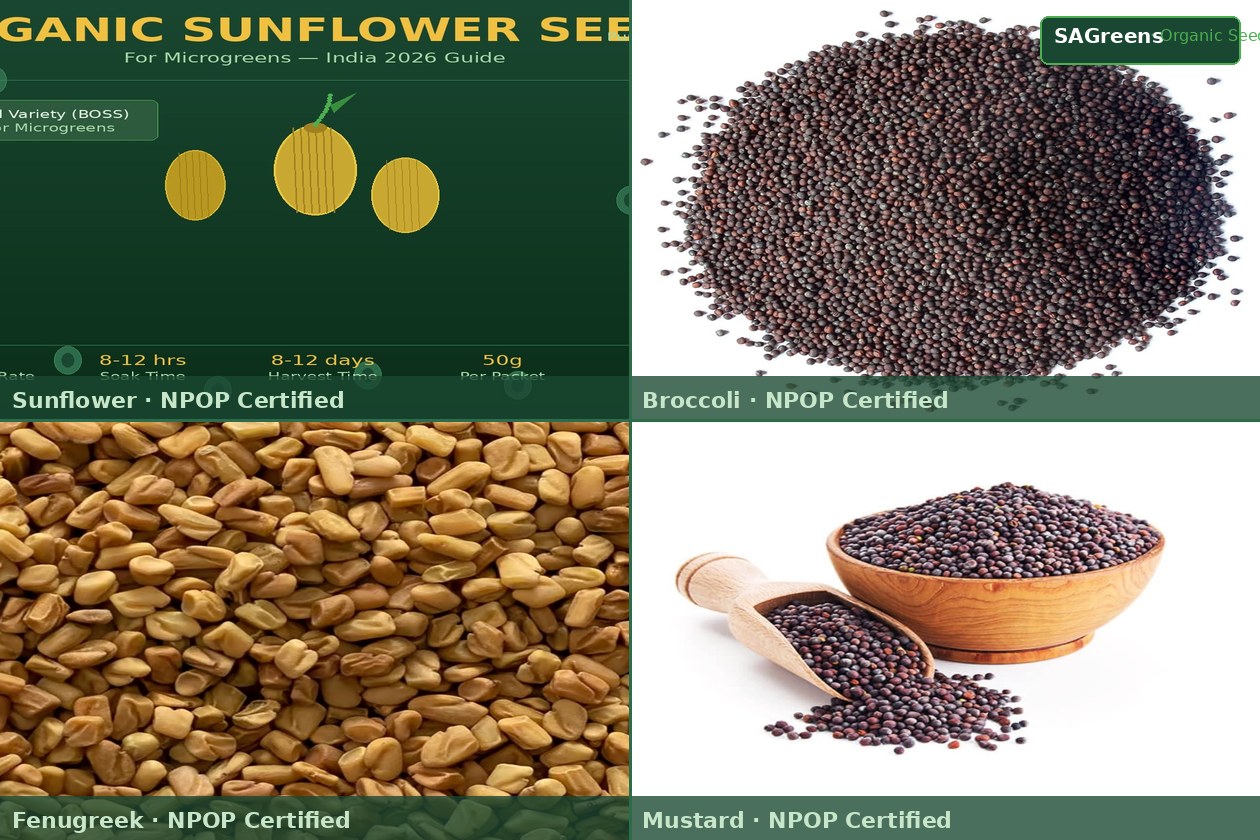
Organic Sunflower Seeds. The market-leading microgreen variety in India. SAGreens organic sunflower seeds are black oil type — selected for microgreen production density and flavour, not field oil production. 85%+ germination guaranteed. Available retail and commercial.
Organic Radish Seeds. The fastest-cycling, most reliable variety for year-round Indian growing. Organic radish seeds produce in 6–8 days and are heat-tolerant across Indian summer conditions. White daikon, purple sango, and Chinese pink varieties all available from SAGreens with NPOP certification.
Organic Broccoli Seeds. The premium health-positioning variety. Organic broccoli microgreen seeds produce sulforaphane-rich microgreens at concentrations that justify premium pricing in the wellness and restaurant segments. 85%+ germination guaranteed.
Organic Pea Shoot Seeds. High visual appeal, sweet flavour, slow cycle (10–12 days). Organic pea shoot seeds produce the long-tendrilled microgreens preferred by hotel and fine-dining accounts in Pune and Bangalore.
Organic Fenugreek Seeds. Deep roots in Indian wellness culture — methi microgreens are familiar to Indian consumers and carry strong Ayurvedic association. Organic fenugreek seeds from SAGreens are NPOP-certified and produce in 8–10 days.
Organic Mustard Seeds. The most cost-effective option for high-volume commercial growing. Organic mustard seeds cycle in 5–7 days and tolerate Indian heat well, making them suitable for year-round production without season adjustment.
Specialty and Premium Varieties
Organic Coriander Seeds. An Indian market-specific variety with strong home and restaurant demand. Organic coriander seeds take slightly longer to establish (12–14 days) but produce distinctive flavour that commands premium positioning.
Organic Wheatgrass Seeds. The foundation of the Indian wellness juice bar market. Organic wheatgrass seeds are certified and tested for the high-volume throughput that juice bar and detox centre accounts require.
Organic Kohlrabi Seeds. A premium European-origin variety gaining traction in high-end Indian restaurants. Organic kohlrabi seeds produce blue-purple stemmed microgreens with distinctive visual appeal and mild flavour.
Organic Spinach Seeds. Slower-cycling but high-value. See our spinach microgreens growing guide for growing protocol specific to Indian conditions.
Organic Seed Variety Comparison
| Variety | Cycle (days) | Germination | Flavour | Best Season India |
|---|---|---|---|---|
| Sunflower | 8–10 | 88–92% | Nutty, mild | Year-round |
| Radish (daikon) | 6–8 | 88–93% | Peppery | Year-round |
| Broccoli | 7–9 | 85–90% | Mild, earthy | Oct–Feb |
| Pea Shoot | 10–12 | 85–90% | Sweet, tender | Oct–Mar |
| Fenugreek | 8–10 | 85–90% | Earthy, bitter | Year-round |
| Mustard | 5–7 | 87–92% | Spicy, sharp | Year-round |
| Coriander | 12–14 | 78–85% | Herbal, citrus | Oct–Feb |
| Wheatgrass | 8–10 | 85–90% | Earthy, green | Year-round |
All SAGreens varieties are NPOP-certified and untreated. Germination figures are batch-tested and represent the minimum guaranteed range.
View the complete range at our products page.
Organic Certification for Different Grower Types
The importance and application of organic certification differs by grower context:
Home growers. For personal consumption, NPOP certification is primarily a food safety assurance — you are confirming the seeds you grow and eat are untreated. Price sensitivity is higher for home growers; SAGreens 100g retail packs at certified organic pricing are designed for this segment.
Commercial farms selling as "organic microgreens." If you sell microgreens under an organic label or premium positioning, your upstream seed certification is directly relevant to your commercial claims. Selling microgreens grown from uncertified seeds as "organic" is a compliance risk. NPOP-certified seed supply from SAGreens provides the documentation foundation for your organic product claims.
Restaurant and hotel supply. Hotel procurement teams and fine-dining chefs increasingly request certification documentation for fresh produce they serve. SAGreens batch documentation — NPOP certificate, germination test, harvest year — satisfies this documentation requirement and supports premium pricing conversations with professional buyers.
Juice bars and wellness centres. The Indian wellness segment is uniquely sensitive to organic claims — customers are often specifically choosing organic produce. For wheatgrass, broccoli, and fenugreek microgreens supplied to this segment, certified seed origin documentation is a commercial asset.
Organic vs Non-Organic Seeds: Germination and Yield Comparison
A common question from growers evaluating organic seed pricing: does organic certification mean lower yield or germination versus conventional (agricultural) seed?
The answer is nuanced. Organic certification affects treatment status, not seed genetics. A well-produced, fresh-batch, NPOP-certified sunflower seed should germinate at the same rate as a well-produced, fresh-batch conventional seed of the same variety — the certification confirms what was NOT done (treatment), not what was done to improve performance.
What NPOP certification does affect:
Consistency. NPOP-certified farms operate under documented agronomic standards. Seed quality variance across batches from certified farms tends to be lower than from uncertified sources with variable practices.
Reliability of germination claims. Certified suppliers are more likely to actually test germination rates because the certification audit process requires documentation. The 85% germination guarantee from SAGreens is a tested and documented claim, not an estimate.
Storage assumptions. Certified organic seeds cannot use synthetic preservative treatments, so correct storage is more important — not less. SAGreens recommends airtight container storage with food-grade desiccant for all certified seeds, particularly in coastal Indian cities during the monsoon season.
For seeds purchased from uncertified sources at lower price points, the risk is not just treatment — it is also that germination claims are often unverified and that seed age (older stock with reduced viability) may not be disclosed.
Grower tip: When comparing prices between certified organic and uncertified seeds, calculate the effective per-tray seed cost at each germination rate, not the per-gram price. A certified seed at ₹2 per gram with 88% germination costs less per tray than an uncertified seed at ₹1.4 per gram at 72% germination when tray coverage is accounted for.
Seasonal Considerations for Organic Seed Purchasing in India
India's climate creates specific seasonal considerations for organic seed buying and storage:
Pre-summer purchase (February–March). Stock heat-tolerant varieties before the April–June heat peak. Organic sunflower, radish, and mustard seeds purchased in February store safely through summer in properly sealed containers. Avoid overstocking organic pea shoot and broccoli at this time.
Monsoon storage (June–September). Certified organic seeds cannot use synthetic anti-moisture treatments. Store all seeds with food-grade silica gel desiccant in sealed containers. In coastal cities — Mumbai, Kochi, Chennai — ambient monsoon humidity of 80–90% can significantly reduce seed viability within weeks if storage is inadequate.
Peak season preparation (September–October). Order before the October demand peak for certified stock. The post-monsoon cooling period triggers strong microgreen demand from restaurants and health-food buyers — certified seed stock from reputable suppliers sells through quickly in September. Place advance orders in August or early September.
See our beginner seeds guide for variety selection recommendations, our complete seed types guide for a full variety comparison, and our microgreen seed supplier guide for how to vet any Indian seed supplier before purchasing.
Placing an Organic Microgreen Seed Order with SAGreens
SAGreens supplies organic microgreen seeds to growers across India. Here is how to order:
Online via our products page. Browse and order individual varieties in retail pack sizes at our products page.
Direct contact for commercial accounts. Commercial operations with standing order requirements, bulk quantity needs, or documentation requirements for food safety compliance should contact us directly. We confirm commercial account terms and pricing individually.
WhatsApp ordering. Many SAGreens customers order via WhatsApp for convenience. Contact us through our contact page to receive our ordering WhatsApp number.
All orders include NPOP certificate documentation, germination percentage with test date, and untreated confirmation. Commercial orders include full batch documentation for FSSAI compliance support.
Frequently Asked Questions
What are organic microgreen seeds?
Organic microgreen seeds are seeds certified under India's National Programme for Organic Production (NPOP) — confirmed untreated (no fungicide, insecticide, or synthetic coating) and sourced from a certified organic farm. NPOP certification is the only externally audited organic standard in India.
How is organic microgreen seed different from regular seed in India?
NPOP-certified organic seeds carry no synthetic chemical treatments, are sourced from certified farms, and are backed by third-party audit documentation. Regular agricultural seeds in India are typically treated with fungicides as standard practice and are not certified under NPOP.
Are SAGreens microgreen seeds organic?
Yes. All SAGreens microgreen seeds are NPOP-certified and untreated — no fungicide, insecticide, or pelleting agent. NPOP certificate documentation is provided on request for all varieties.
Can I get organic certification documentation for seeds I buy from SAGreens?
Yes. SAGreens provides NPOP certificate number, germination test result with date, harvest year, and untreated confirmation for all seed varieties. Commercial accounts receive full batch documentation for FSSAI compliance support.
Is organic microgreen seed more expensive than regular seed?
NPOP-certified organic seeds carry a premium over agricultural field-grade seed, typically 30–50% higher per gram. However, the effective tray cost is often comparable or better, because certified seeds have guaranteed germination rates (85%+) versus unknown-rate field seed that may germinate at 60–70%.
Which organic microgreen seeds are best for beginners?
Organic sunflower seeds and organic radish seeds are the best starting varieties — both have reliable germination, clear visual progress, and deliver in under 10 days. See our beginner seeds guide for detailed recommendations, and our seed soaking guide for first-tray prep.
Where can I buy organic microgreen seeds online in India?
SAGreens supplies certified organic microgreen seeds online across India. Visit our products page to browse varieties. We ship to all major cities and serviceable pin codes nationwide.
Does SAGreens ship organic seeds to Bangalore?
Yes. SAGreens ships to Bangalore and all Karnataka cities. Standard delivery to Bangalore is 2–3 days from order confirmation.
What is NPOP certification and why does it matter for microgreen seeds?
NPOP (National Programme for Organic Production) is India's official, APEDA-regulated organic certification standard. It prohibits synthetic chemical treatments on certified seeds, requires sourcing from certified farms, and mandates annual third-party audit. For microgreen growing, NPOP certification is the most reliable verification that seeds are safe for edible produce.
Are organic microgreen seeds available in bulk from SAGreens?
Yes. SAGreens supplies bulk organic seeds from 500g per variety for commercial operations. High-volume varieties (sunflower, radish, pea shoot) are available in 1kg, 2kg, and 5kg packs. See our bulk seeds guide for commercial purchasing information.
How do I store organic microgreen seeds to maintain their viability?
Store in airtight containers with food-grade desiccant (silica gel) away from heat and direct sunlight. Most varieties remain viable for 12–18 months from harvest at room temperature in sealed storage. Basil and coriander have shorter viability at 6–9 months. In coastal cities during monsoon, sealed airtight storage with desiccant is essential.
Can I use organic microgreen seeds grown from my own previous harvest?
Yes, for most varieties. However, F1 hybrid varieties do not breed true from saved seed — they revert to parent characteristics. SAGreens supplies open-pollinated varieties where seed saving is viable. Confirm variety type before saving for replanting.
What is the difference between organic and non-GMO microgreen seeds?
Non-GMO means the seeds are not genetically modified. Organic (NPOP-certified) means seeds are untreated, from certified farms, and without synthetic chemical inputs — but not necessarily tested for GMO status separately. SAGreens supplies seeds that are both NPOP-certified organic and sourced from varieties with no known GMO history.
How quickly does SAGreens ship organic seeds after ordering?
Orders placed before 12pm on working days are typically shipped the same day. Pune delivery is 1–2 days. Most major cities receive delivery in 2–4 days. Contact us for specific delivery estimates to your location.
What if my organic seeds from SAGreens germinate below the guaranteed rate?
SAGreens guarantees 85%+ germination on all seed varieties. If seeds underperform this guarantee, we provide replacement seeds at no cost. Contact us with your germination test results and batch information for replacement processing.
Are organic microgreens nutritionally superior to conventionally grown microgreens?
Research on this question is limited and results are mixed. The primary advantage of organic microgreen seeds is not a significant nutritional uplift but rather the absence of fungicide residues that would otherwise be directly consumed with the microgreen. For daily consumption, absence of synthetic chemical inputs matters more than any measured nutritional difference.
How do I check if seeds I already have are treated?
Pour a small quantity of seeds onto white paper in good light. Look for any uniform colour coating — pink, red, blue, or grey powder indicates fungicide treatment. Treated seeds also sometimes have a faint chemical odour. Untreated seeds are typically the natural colour of the seed (black for sunflower, tan for pea, brown for fenugreek). If there is any doubt, contact your supplier for written untreated confirmation before using seeds for edible production.
Can I grow certified organic microgreens on an apartment balcony in India?
Yes. Certified organic microgreen growing on a balcony requires only NPOP-certified, untreated seeds, an organic-compliant growing medium (cocopeat is acceptable; verify the brand does not use synthetic wetting agents), and clean water. The NPOP framework does not require farm registration for home growers — organic certification for home use is effectively established through your choice of certified inputs. For commercial selling as organic, certification of the growing operation itself is required.
What does FSSAI say about organic microgreens sold commercially?
FSSAI regulates fresh produce sold commercially in India under the Food Safety and Standards Act 2006. FSSAI food safety standards apply to fresh sprouts and microgreens sold commercially — including requirements for safe growing conditions and, for organic labelling, compliance with the Food Safety and Standards (Organic Foods) Regulations 2017, which reference NPOP certification as the accepted organic standard. Commercial growers selling microgreens as organic should maintain seed certification documentation and growing records.
Where can I learn more about growing organic microgreens successfully in India?
SAGreens publishes growing guides across specific varieties and Indian conditions. Useful starting points: our beginner seeds guide, our seed soaking guide, our monsoon growing guide, and our seeds buying guide. All guides are written from direct growing experience in Indian conditions.
More Microgreens Tips & Recipes
Buy Microgreen Seeds Online India: Complete Guide
How to buy the best organic microgreen seeds online in India. What to look for, which varieties to start with, germination rates, pricing, and where to...
Untreated Non-GMO Seeds for Microgreens India Guide
Why untreated, Non-GMO seeds are essential for safe microgreens at home. What treated seeds contain, health risks, and where to buy in Pune and across India.
Microgreen Seeds Bangalore: Buy for Home & Commercial Use
Where to buy microgreen seeds in Bangalore. SAGreens supplies Non-GMO, food-grade seeds for home growers and commercial farmers with pan-India delivery.
Fresh Tips & Exclusive Offers
Subscribe for growing tips, seasonal updates, and exclusive offers on fresh organic microgreens in Pune.