Microgreen Seed Supplier India: Certified, Untreated Seeds
Microgreen Seed Supplier India: Certified, Untreated Seeds
Finding a reliable microgreen seed supplier in India is one of the highest-stakes sourcing decisions a microgreen grower makes. The wrong supplier — one selling treated agricultural seeds or uncertified stock — can ruin batches, compromise food safety for edible produce, and make commercial microgreen farming economically unviable. The right supplier delivers consistent germination, NPOP certification, and a logistics chain that reaches you fresh, wherever you are in India.
Key Takeaways: A qualified microgreen seed supplier in India provides NPOP-certified, untreated seeds with a printed germination guarantee of 85% or higher. SAGreens supplies certified seeds to home growers and commercial operations across Pune, Bangalore, Mumbai, Delhi, and all major Indian cities. Seed quality is the single largest variable in microgreen growing success — verified certification matters more than price.
SAGreens has been a trusted microgreen seed supplier across India since the Toradmal family launched their certified seed division alongside their Pune microgreen farm. As a third-generation farming family, we understand both sides of the seed supply relationship — growing microgreens commercially, and sourcing the seeds that make consistent commercial production possible.
What Makes a Microgreen Seed Supplier Reliable in India
Not all seed suppliers are equal. India's agricultural input market is large and varied — the same marketplace that supplies certified organic seed also hosts agricultural field seed, treated seed, and uncertified stock under attractive packaging. Distinguishing a reliable supplier from an unreliable one requires checking specific signals.
NPOP certification is the baseline requirement. India's National Programme for Organic Production (NPOP) prohibits synthetic chemical seed treatments for certified organic production. A supplier with a current, valid NPOP certificate cannot legally provide treated seeds under that certification. This makes NPOP certification the most enforceable quality signal available in the Indian market — it is a legal obligation backed by third-party auditing, not a voluntary marketing claim.
Germination percentage with test date. A supplier who tests their seeds prints the results. Any listing without a germination percentage is selling untested stock. SAGreens prints a minimum 85% germination guarantee on every seed pack with the test date included. For commercial growers, germination rate directly affects your cost-per-tray — a 75% germination rate versus an 85% rate on sunflower seeds represents a 13% increase in seed cost per tray.
Untreated confirmation in writing. Fungicide-treated seeds — common in Indian agricultural supply — are coated with thiram, captan, or similar synthetic treatments. These are standard practice for field crops but dangerous for edible sprout and microgreen production. A reliable supplier confirms untreated status explicitly and in writing, not just through packaging claims.
Nationwide logistics with cold-chain awareness. A supplier who ships across India must understand how heat and humidity affect seed viability in transit. Seeds shipped through Indian summers without temperature management lose germination rate. SAGreens uses packaging with food-grade desiccant for all shipments and adjusts logistics routing during peak summer months.
SAGreens as Your Microgreen Seed Supplier: What We Supply
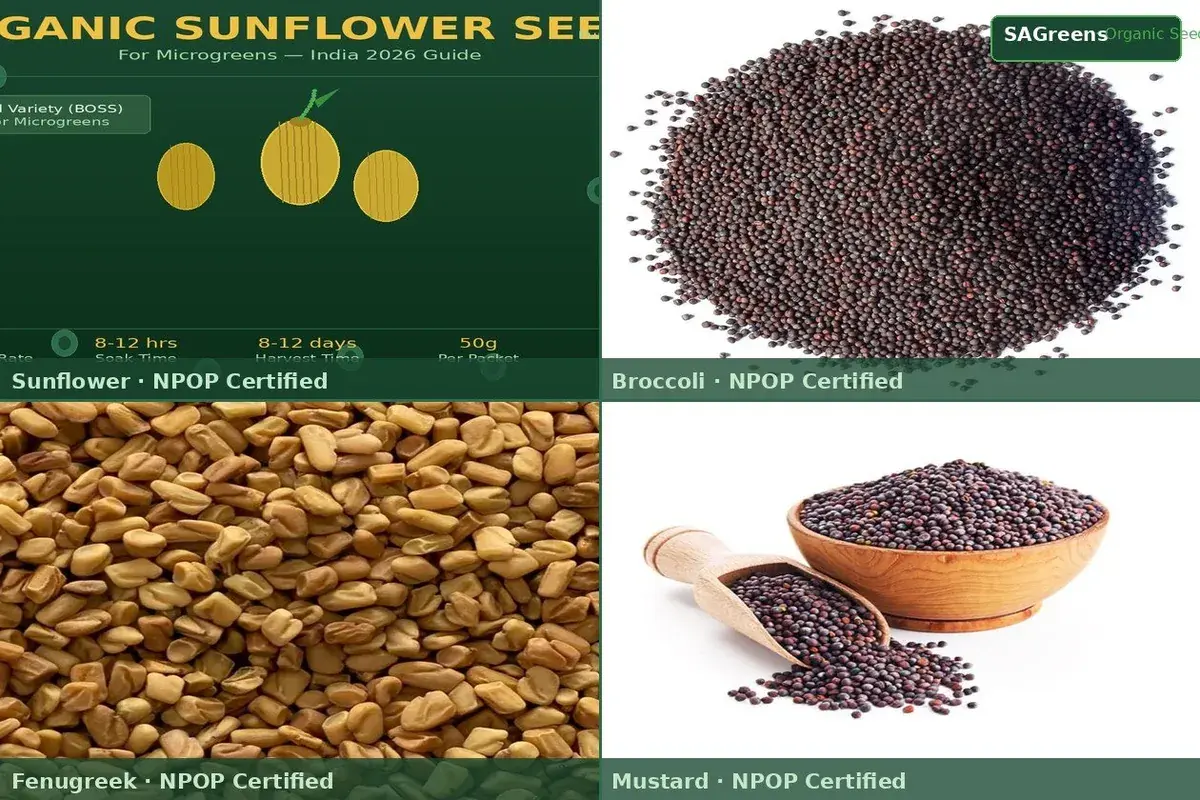
SAGreens supplies a complete range of certified microgreen seeds to growers and commercial operations across India. Our seed catalogue covers the highest-demand varieties for Indian growing conditions:
Sunflower microgreen seeds. The most popular microgreen in India by volume. SAGreens sunflower seeds are black oil type — the highest-germination, densest-canopy variety for microgreen production. Available in 100g retail packs and 1kg–5kg commercial quantities. Minimum 85% germination guaranteed.
Radish microgreen seeds. Fast-cycling (6–8 days), high-yield, and reliable in Indian conditions year-round. Organic radish seeds from SAGreens are NPOP-certified and available in daikon, purple sango, and white radish varieties.
Broccoli microgreen seeds. The premium variety for health-conscious consumers and restaurant accounts. Broccoli microgreens contain sulforaphane at concentrations 10–100x higher than mature broccoli heads. Organic broccoli seeds from SAGreens are tested at 85%+ germination and supply the Indian wellness market segment effectively.
Pea shoot seeds. The highest-value variety for restaurant visual appeal. Organic pea shoot seeds produce long-tendrilled microgreens with a sweet flavour profile that hotels and fine dining establishments in Pune, Mumbai, and Bangalore prioritize.
Fenugreek seeds. The strongest Indian cultural connection in the microgreen category — methi microgreens have deep roots in Ayurvedic practice and Indian home cooking. Organic fenugreek seeds from SAGreens support both edible and wellness market positioning.
Mustard seeds. Fast cycling, heat-tolerant, and cost-effective. Organic mustard seeds are a commercial grower staple, producing in 5–7 days with minimal growing media requirement.
For a complete overview of our seed range, visit our products page.
How SAGreens Serves Commercial Microgreen Growers
Commercial microgreen operations — farms supplying restaurants, hotels, cloud kitchens, and corporate catering — have requirements that retail seed purchasing cannot meet: consistent batch quality across deliveries, advance availability assurance during demand peaks, and documentation for food safety compliance.
Standing order arrangements. SAGreens offers monthly and quarterly standing order schedules for commercial buyers. A confirmed standing order ensures stock priority, eliminates repeated price negotiation, and provides invoice documentation for GST compliance. Commercial operations purchasing ₹5,000 per month or above qualify for our commercial account pricing.
Advance ordering for demand peaks. Indian demand peaks for microgreens — Diwali and wedding season (October–November), summer health season (April–May), and the New Year health push — create supply pressure on certified seed stock. SAGreens commercial accounts can confirm advance orders 6–8 weeks ahead to guarantee availability during these peaks.
Batch documentation for food safety compliance. The FSSAI (Food Safety and Standards Authority of India) increasingly applies food safety standards to fresh produce sold commercially. SAGreens provides batch-level documentation — NPOP certificate number, germination test date and result, harvest year, untreated confirmation — for every commercial delivery. This documentation supports FSSAI compliance and provides due diligence evidence for any food safety inspection.
Germination issue replacement policy. If seeds from SAGreens do not perform to the stated germination guarantee, we provide replacement seed at no cost. Our replacement policy is documented in writing on every order confirmation. This is a commercial commitment — not a marketing statement.
For commercial account enquiries, contact us directly with your monthly seed requirement and the varieties you grow.
Nationwide Delivery: How SAGreens Ships Seeds Across India
SAGreens ships microgreen seeds to all major Indian cities and states. Our logistics network has been calibrated through years of commercial seed supply experience:
Pune and Maharashtra. Our home base. Orders placed before 12pm are typically shipped same-day. Standard delivery within Pune is 1–2 days. Maharashtra state delivery is 2–3 days. Commercial accounts in Pune can arrange weekly pickup if preferred.
Bangalore and Karnataka. Our second-largest customer base outside Maharashtra. Bangalore's rapidly growing health-food and restaurant scene has created strong commercial demand for certified microgreen seeds. Delivery to Bangalore is typically 2–3 days from order confirmation.
Mumbai and Western India. Mumbai's hotel and restaurant supply chain is a significant segment of SAGreens commercial seed supply. Mumbai delivery is 2–3 days. Gujarat and Rajasthan typically 3–4 days.
Delhi and Northern India. Delhi and NCR delivery is typically 3–4 days. We ship to all northern states with standard India Post or courier logistics. Summer orders (April–June) for northern India are packaged with additional desiccant due to the heat spike in transit.
Southern India. Chennai, Hyderabad, and Kerala receive orders in 3–4 days. For Kerala specifically, see our Kerala microgreen seeds guide for monsoon storage recommendations specific to that climate.
Northeast and remote areas. We ship to all serviceable pin codes across India. Remote area delivery times vary; we confirm expected delivery before dispatch for all remote orders.
Seed Varieties by Growing Season: Supplier Recommendations
Indian seasons affect microgreen seed performance significantly. As a supplier, SAGreens recommends adjusting your variety mix by season to maintain consistent quality and yield:
April–June (summer peak). Heat-tolerant, fast-cycling varieties perform best: radish (6–8 days), mustard (5–7 days), sunflower (8–10 days with summer adjustment). Avoid overstocking pea shoot and broccoli seeds during this period — they perform best in cooler months and seeds stored through an Indian summer outside refrigeration may lose viability.
July–September (monsoon). Ambient humidity creates mould pressure in growing environments. Reduce water in your growing protocol, ensure excellent airflow, and prioritize varieties with natural resistance: radish, mustard, fenugreek. All SAGreens seed shipments during this period include extra desiccant packaging. Store received seeds immediately in airtight containers with food-grade silica gel.
October–February (peak quality season). The cooler period delivers the best microgreen quality across all varieties. Pea shoot, broccoli, sunflower, and fenugreek all perform at their best in this window. This is also the peak demand season — confirm seed availability with your supplier in September for October delivery.
Comparing Microgreen Seed Suppliers in India: What to Ask
Before committing to any microgreen seed supplier in India, ask these questions in writing:
| Question | What a good answer looks like |
|---|---|
| Are these seeds NPOP-certified? | NPOP certificate number provided |
| Are seeds untreated — no fungicide, insecticide, or pelleting? | Explicit written confirmation |
| What is the germination percentage for this batch? | Stated percentage with test date |
| What is the harvest year for this stock? | Specific year stated (ideally current) |
| Do you offer replacement if germination underperforms? | Documented replacement policy |
| Can you provide a batch certificate? | Full certificate provided on request |
A supplier who answers all six questions clearly and in writing is operating at a professional level. A supplier who deflects, provides vague answers, or delays is not. The cost of a supplier switch is low; the cost of a failed batch in a commercial operation — seed cost, media cost, growing time, missed delivery revenue — is high. Choose your supplier based on documentation quality, not price alone.
SAGreens Supplier Promise: Every seed pack we supply comes with NPOP certificate number, germination percentage with test date, explicit untreated confirmation, and a harvest year statement. Commercial accounts receive full batch documentation for food safety compliance.
For commercial growers: Monthly seed cost on 30 sunflower trays at 85% germination (SAGreens) versus 70% germination (untested supplier): SAGreens requires 3.18kg seed at ₹1.5/g = ₹4,770. Untested supplier requires 3.86kg at ₹1.0/g = ₹3,860. SAGreens costs ₹910 more per month but produces 30 complete trays. The untested supplier produces 26 complete trays — 4 trays of lost revenue, typically ₹1,600–₹2,400 at retail. Total net advantage of certified supplier: ₹690–₹1,490 per month on this single variety alone.
Seed Variety Performance by Indian Region: A Supplier Perspective
India's geography creates meaningfully different growing conditions across the country. A supplier serving growers across Pune, Bangalore, Chennai, Mumbai, Delhi, and Kerala is not shipping to uniform conditions — it is serving six distinct microclimates with different humidity ranges, temperature profiles, and seasonal patterns. Understanding regional performance differences helps you stock the right varieties for your location.
Pune (Maharashtra Plateau — moderate climate). Pune's climate is the most consistently favourable for microgreen growing in India. At 560m altitude, temperatures rarely exceed 38°C and the relatively dry monsoon compared to coastal Maharashtra means mould pressure is lower than in Mumbai or Kochi. Sunflower, pea shoot, broccoli, and fenugreek all perform at their best in Pune's October–February window. SAGreens is Pune-based; our seed stock is calibrated to Pune growing conditions by direct observation.
Bangalore (Karnataka Plateau — mild year-round). Bangalore's altitude (920m) produces one of the most stable year-round microgreen growing climates in India. Heat peaks are limited; monsoon humidity is present but not extreme. Radish, sunflower, and broccoli perform reliably across all seasons. Pea shoot performs exceptionally well October–March. Bangalore's rapidly expanding health-food restaurant scene has made it SAGreens' second-largest seed supply market.
Mumbai (Coastal Maharashtra — high humidity). Mumbai's coastal humidity — reaching 90–95% during the monsoon — creates the highest mould pressure of any major Indian city. Growers in Mumbai should prioritise fast-cycling varieties (radish: 6–8 days, mustard: 5–7 days) that exit before mould can establish. SAGreens seed shipments to Mumbai include extra desiccant during June–September. Longer-cycle varieties like pea shoot and broccoli require rigorous airflow management in Mumbai apartments.
Delhi and NCR (Continental climate — extreme summer). Delhi's summer heat peak (May–June) regularly exceeds 42°C with low humidity. Radish, mustard, and sunflower tolerate this best. Delhi's dry winter (November–February) is ideal for all varieties — the region's best microgreen growing window. Air quality concerns during winter drive strong demand for indoor-grown, air-purifying microgreens in Delhi NCR.
Chennai and Southern Coast (Hot, humid, year-round). Chennai's heat and humidity profile is the most demanding for microgreen growing in India's major cities. Fast-cycling, mould-resistant varieties — radish, mustard — are recommended year-round. Broccoli and pea shoot are viable only in Chennai's brief cooler period (December–January). SAGreens ships seeds to Chennai with extended desiccant packaging.
Kerala (Tropical — extreme monsoon humidity). Kerala receives the heaviest monsoon rainfall in India, with coastal humidity reaching 90%+ for five months of the year. Radish, fenugreek, and mustard are the most reliable choices for Kerala growers. See our dedicated Kerala microgreen seeds guide for variety-specific monsoon advice.
Comparing Microgreen Seed Prices by Supplier Type in India
Understanding Indian seed market pricing helps you interpret supplier quotes correctly:
| Supplier Type | Certification | Germination Test | Typical Price per gram |
|---|---|---|---|
| NPOP-certified specialist (SAGreens) | NPOP certified | Batch-tested, guaranteed | ₹1.2–3.5 |
| Online marketplace (mixed) | Unverified | Often unstated | ₹0.8–2.0 |
| Agricultural input shop | None | None | ₹0.4–0.9 |
| Farm-direct uncertified | None | None | ₹0.3–0.7 |
Price per gram is only one variable. Effective price per productive tray — accounting for germination rate — is the correct comparison metric for any commercial microgreen operation.
Red Flags: Microgreen Seed Suppliers to Avoid
Several supplier patterns consistently deliver poor outcomes for microgreen growers in India:
Unlisted germination rates. If a supplier lists seeds without a germination percentage, assume 60–70% — the typical performance of untested agricultural field seed.
Price dramatically below market. NPOP-certified, germination-tested sunflower seeds retail at ₹1.2–1.8 per gram in India. A listing at ₹0.5–0.7 per gram is almost certainly selling field-grade agricultural seed. The cost difference is real but the implied losses in failed germination, rejected batches, and food safety risk far exceed any per-gram saving.
No return policy on germination failures. Suppliers who test their seeds stand behind them. No return policy means no testing.
Ambiguous certification claims. "Organic" without an NPOP certificate number is unverifiable. Require the certificate number and cross-check it against the APEDA certification database.
Anonymous or undated stock. Professional seed suppliers can identify the harvest year and batch number for any pack they sell. Anonymous, undated stock is a significant risk indicator.
For more detail on evaluating seed quality before purchase, see our microgreen seeds buying guide, our guide on microgreen seeds vs regular seeds, and our companion guide on organic microgreen seeds in India.
Frequently Asked Questions
What is a microgreen seed supplier?
A microgreen seed supplier is a business that sells seeds specifically prepared and certified for microgreen production — untreated, germination-tested, and typically NPOP-certified for organic growing. This is distinct from agricultural seed suppliers, who sell field-grade seeds that may be treated with fungicides.
How do I find a reliable microgreen seed supplier in India?
Look for NPOP certification, a stated germination percentage with test date, explicit untreated confirmation in writing, and a documented replacement policy for germination failures. SAGreens meets all four criteria and supplies seeds nationwide.
Does SAGreens supply seeds to cities other than Pune?
Yes. SAGreens ships microgreen seeds to all major Indian cities including Bangalore, Mumbai, Delhi, Chennai, Hyderabad, and all serviceable pin codes across India.
What is the minimum order for microgreen seeds from SAGreens?
SAGreens supplies seeds in 100g retail packs with no minimum order requirement. Commercial accounts purchasing regularly can arrange standing orders and bulk pricing starting from 500g per variety.
Are SAGreens seeds NPOP-certified?
Yes. All seeds supplied by SAGreens are NPOP-certified and untreated — no fungicide, insecticide, or pelleting agent. NPOP certificate documentation is available on request for commercial accounts.
What germination rate does SAGreens guarantee?
SAGreens guarantees a minimum 85% germination rate on all seed varieties. If a batch underperforms this guarantee, we provide replacement seed at no cost.
Can I buy microgreen seeds in bulk from SAGreens?
Yes. SAGreens supplies bulk quantities starting from 500g for most varieties, with 1kg, 2kg, and 5kg packs available for high-volume varieties (sunflower, radish, pea shoot). For detailed bulk information, see our bulk microgreen seeds guide.
What varieties does SAGreens supply?
SAGreens supplies sunflower, radish (daikon, purple sango, white, Chinese pink), broccoli, pea shoot, mustard, fenugreek, basil, coriander, wheatgrass, kohlrabi, spinach, Swiss chard, beetroot, amaranth, corn, kale, cabbage, cauliflower, alfalfa, and more. Full range at our products page.
How does SAGreens handle seed quality in Indian summer?
Seeds shipped during Indian summer (April–June) are packed with food-grade desiccant and we use heat-aware logistics routing. Storage recommendations for received seeds include airtight containers with silica gel desiccant, away from direct heat and sunlight.
Is SAGreens a good supplier for commercial microgreen farms?
Yes. SAGreens supplies commercial microgreen operations with standing order arrangements, advance booking for demand peaks, full batch documentation for FSSAI compliance, and a documented germination replacement guarantee. Contact us to discuss commercial account terms.
What documentation does SAGreens provide for commercial orders?
Commercial orders receive NPOP certificate number, germination test percentage with date, harvest year statement, explicit untreated confirmation, and a batch reference number for traceability.
Can I order microgreen seeds from SAGreens via WhatsApp?
Yes. Many SAGreens customers order via WhatsApp for convenience. Contact us through our contact page for our ordering WhatsApp number.
What is the difference between a microgreen seed supplier and a regular seed supplier?
A microgreen seed supplier provides seeds specifically selected for edible sprout density, speed, and flavour in a tray-based growing environment — plus certification confirming they are untreated and safe for edible production. A regular seed supplier focuses on field agriculture performance, often supplying treated seeds that are unsafe for edible microgreen use.
How long do microgreen seeds stay viable if stored correctly?
Most varieties (sunflower, radish, broccoli, mustard) remain viable for 12–18 months from harvest when stored in airtight containers with desiccant at room temperature. Basil and coriander have shorter viability: 6–9 months. See our buying guide for complete storage information.
How do I place an order with SAGreens?
Visit our products page to browse available varieties, or contact us directly for commercial account enquiries, bulk orders, or standing order arrangements.
How do I switch from my current seed supplier to SAGreens?
Start with a single variety trial order — 100–200g of your highest-volume variety. Run it alongside your current stock to compare germination rate, seed condition on arrival, and documentation quality. Most commercial growers who run a side-by-side comparison find the switch straightforward after one successful trial batch.
What is the difference between a 100g retail pack and a 1kg bulk pack from SAGreens?
Both retail and bulk packs carry the same NPOP certification, germination guarantee, and untreated status — the difference is price per gram and packaging format. Retail 100g packs are in resealable pouches for home grower convenience. Bulk packs from 500g upward use sealed, desiccant-included commercial packaging and carry a lower per-gram cost.
Can I get a seed sample before placing a large order?
Contact SAGreens directly through our contact page to discuss sample availability for commercial accounts. We evaluate sample requests on a case-by-case basis for operations considering standing orders of significant volume.
How do I verify an NPOP certificate is genuine?
NPOP certificates are registered through accredited certifying bodies under APEDA (Agricultural and Processed Food Products Export Development Authority). Ask the supplier for the certificate number and issuing body. Cross-check the certificate number and scope against the APEDA certification directory. A genuine certificate includes the certificate holder's name, the issuing body, coverage scope (crops and varieties), issue date, and expiry date.
Do you supply seeds for all microgreen varieties or only select ones?
SAGreens supplies over 20 microgreen varieties — from the most common (sunflower, radish, mustard) to specialty varieties (kohlrabi, Swiss chard, Chinese pink radish, red amaranth). Check our products page for the current full catalogue. If a specific variety you need is not listed, contact us — we can discuss sourcing options for commercial accounts.
About SAGreens: Founded by Ajay Toradmal from a three-generation farming family in Maharashtra, SAGreens supplies NPOP-certified organic microgreen seeds to home growers, restaurants, and commercial farms across India. Every seed batch is germination-tested and backed by a replacement guarantee.
More Microgreens Tips & Recipes
Buying Microgreen Seeds Online: Safety & Quality Checks
Learn what to check before buying microgreen seeds online in India — untreated seed, germination testing, NPOP certification and pricing.
Microgreen Seeds Bangalore: Buy for Home & Commercial Use
Where to buy microgreen seeds in Bangalore. SAGreens supplies Non-GMO, food-grade seeds for home growers and commercial farmers with pan-India delivery.
Microgreen Seed Prices India 2026: ₹50 to ₹360 per 100g
What microgreen seed actually costs in India — ₹50 to ₹360 per 100g by variety, where wholesale tiers begin, and why the cheapest seed usually costs more.
Fresh Tips & Exclusive Offers
Subscribe for growing tips, seasonal updates, and exclusive offers on fresh organic microgreens in Pune.