Microgreens and Thyroid Health: What to Eat, What to Limit
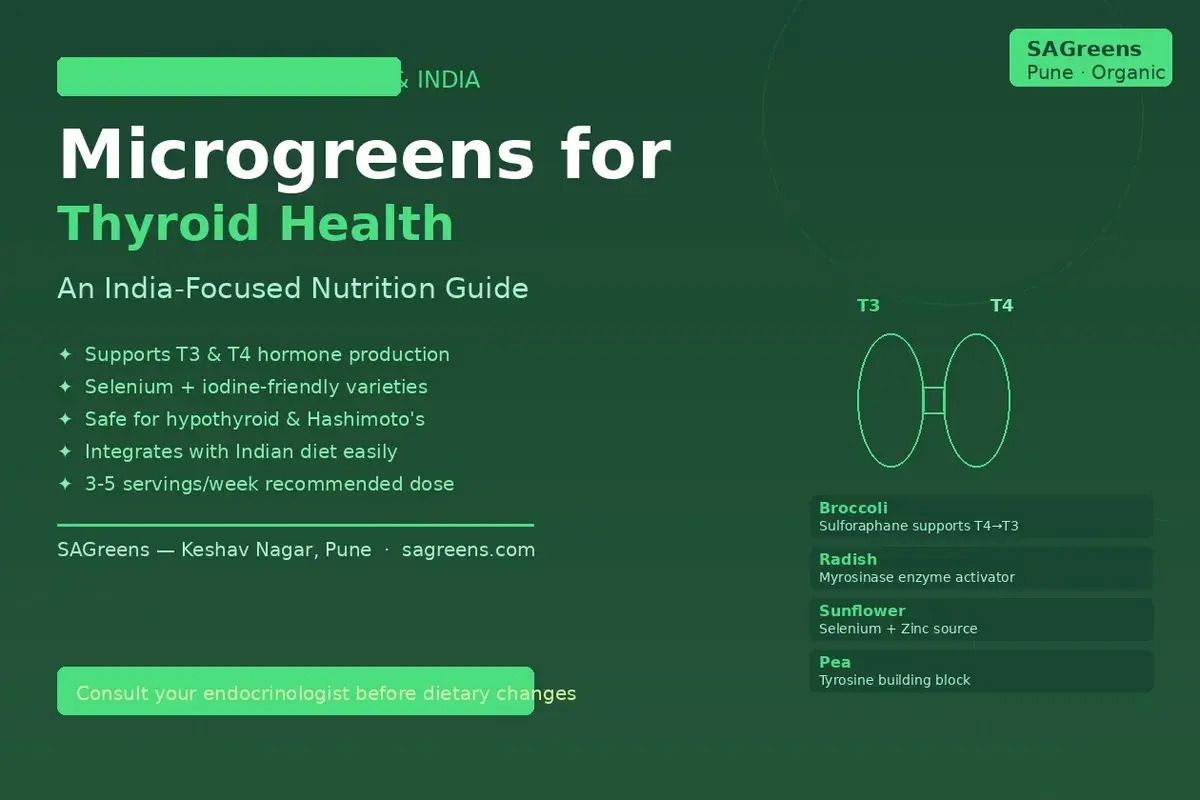
Microgreens for Thyroid Health: A Practical India Guide
Key Takeaways: Radish, sunflower, and pea shoot microgreens provide nutrients — selenium, zinc, tyrosine — that directly support thyroid hormone production. Broccoli microgreens are safe in moderate quantities (30-50 g per day) but require specific consideration for people with hypothyroidism. India has one of the highest rates of iodine deficiency-linked thyroid disorders globally, and dietary strategies including microgreens offer a food-first path to nutritional support. Always consult an endocrinologist before making dietary changes if you have a diagnosed thyroid condition.
India carries roughly 42 million thyroid patients — the second-highest thyroid disorder burden in the world after China. Hypothyroidism (underactive thyroid) accounts for the majority, with women in the 25-55 age group most affected. Iodine deficiency, environmental toxins, autoimmune conditions (Hashimoto's thyroiditis), and genetic factors all contribute to this burden. The Indian diet, rich in cruciferous vegetables like cauliflower, cabbage, and mustard leaves, also contains goitrogenic compounds that can interfere with thyroid function in people who are already iodine-deficient — making dietary guidance particularly nuanced.
Microgreens sit at an interesting intersection in this picture. Some varieties — radish, sunflower, pea shoots — provide nutrients that support thyroid function with minimal risk. Others — broccoli, mustard — require more careful consideration. This guide maps the evidence carefully and gives you a practical framework for integrating microgreens into a thyroid-supportive diet in the Indian context. For a broader picture of microgreens and chronic health conditions, see our guide on microgreens for diabetes in India.
How the Thyroid Works: The Basics You Need
The thyroid gland, positioned in the front of your neck, produces two main hormones: T4 (thyroxine) and T3 (triiodothyronine). T4 is the storage form, produced in larger quantities. T3 is the active form — it enters cells and regulates metabolism, heart rate, body temperature, cognitive function, and mood. Most T4 is converted to T3 in the liver and peripheral tissues.
This conversion pathway is the central issue in many thyroid conditions. Even when the thyroid gland itself is functioning, poor conversion of T4 to T3 — driven by nutritional deficiencies, inflammation, or liver stress — can produce hypothyroid symptoms (fatigue, weight gain, brain fog, cold sensitivity, hair loss) while standard blood tests show "normal" TSH levels.
Three nutrients are particularly critical for this system:
| Nutrient | Role in Thyroid Function | Common Deficiency in India |
|---|---|---|
| Iodine | Required to build T4 and T3 molecules | Widespread in inland and highland regions |
| Selenium | Required for the enzyme that converts T4 to T3 | Moderate deficiency in Indian soils |
| Zinc | Required for TSH production and T3 receptor function | Deficiency common in vegetarians |
Microgreens cannot replace iodine (the primary intervention for iodine-deficiency hypothyroidism) but they can address selenium and zinc deficiencies, reduce inflammatory load on the thyroid, and provide supportive phytonutrients. Read our overview of microgreens as nutritional powerhouses for the broader context of what these plants contain.
Microgreens That Support Thyroid Health
Radish Microgreens: The Safest High-Impact Choice
Radish microgreens are the single best choice for people with thyroid conditions because they are a meaningful source of selenium (approximately 1.2-2.0 mcg per 100 g) and zinc, rich in sulforaphane and isothiocyanates that reduce inflammation, and not raw-food goitrogenic in the same way as cruciferous brassicas like broccoli or cabbage.
The sulforaphane in radish microgreens activates Nrf2 pathways that reduce systemic inflammation — inflammation being a key driver of autoimmune thyroid conditions including Hashimoto's. A 2019 study in the International Journal of Molecular Sciences noted that Nrf2 activation reduced inflammatory markers associated with thyroiditis in animal models.
Radish microgreens can be eaten raw, which is important because cooking destroys myrosinase, the enzyme required to activate sulforaphane from its inactive glucosinolate form. A 30-50 gram serving of raw radish microgreens on a salad, chaat, or as a topping for dal provides meaningful sulforaphane with low goitrogenic risk.
Sunflower Microgreens: Selenium and Mood Support
Sunflower microgreens are among the richest microgreen sources of selenium, with approximately 2.4-3.5 mcg per 100 g depending on the selenium content of the soil or growing medium. They are also high in:
- Vitamin E: a fat-soluble antioxidant that protects thyroid tissue from oxidative stress
- Magnesium: involved in over 300 enzymatic reactions, including T4-to-T3 conversion
- Tryptophan: precursor to serotonin, addressing the mood dysregulation common in hypothyroidism
Crucially, sunflower microgreens contain no glucosinolates and are not goitrogenic by any mechanism. They are the safest choice for someone with diagnosed hypothyroidism or Hashimoto's who wants to add microgreens to their diet without navigating the cruciferous goitrogen question. Their mild, nutty flavour works equally well raw in Indian salads, as a garnish on sabzi, or blended into a green smoothie.
Pea Shoot Microgreens: Tyrosine for Hormone Building
Thyroid hormones are built from iodine and an amino acid called tyrosine. Without adequate dietary tyrosine, even sufficient iodine cannot be converted into T4 and T3 efficiently. Pea shoot microgreens are a notable plant source of tyrosine, alongside protein, folate, and vitamin C.
Pea shoots also contain phytoestrogens (isoflavones) in low amounts — relevant context for people with Hashimoto's thyroiditis who are navigating the broader hormone picture. The quantities in food-level portions are considered safe by mainstream nutritional research. In Indian cooking, pea shoots work beautifully as a sabzi ingredient when briefly stir-fried, as a soup green, or raw on chaat.
Broccoli Microgreens: Powerful but Nuanced for Thyroid
Broccoli microgreens contain the highest sulforaphane content of any microgreen variety and offer genuine anti-inflammatory and detoxification support relevant to autoimmune thyroid conditions. However, broccoli is a cruciferous vegetable and contains glucosinolates that, when raw and eaten in large quantities, can interfere with thyroid iodine uptake.
The evidence on cruciferous goitrogens is considerably more nuanced than many popular health blogs suggest. Goitrogenic effects of raw cruciferous vegetables are primarily documented in people who are already iodine-deficient AND consuming very large quantities daily over extended periods. Moderate consumption (30-50 g per day) of broccoli microgreens in people with adequate iodine intake is not documented to cause clinically significant thyroid suppression.
If you have diagnosed hypothyroidism and are taking levothyroxine, consult your endocrinologist before adding large quantities of raw cruciferous foods to your diet. To learn how to grow your own broccoli microgreens at home, see our detailed broccoli microgreens growing guide.
The Goitrogen Reality: For most people with adequate iodine intake, 30-50 g of broccoli microgreens per day is safe and nutritionally beneficial. The risk applies primarily to large raw quantities in already iodine-deficient individuals. If you are currently hypothyroid and taking medication, discuss with your doctor before adding significant quantities of any raw cruciferous food to your diet.
The Goitrogen Question: A Deeper Look
Goitrogens are compounds that interfere with thyroid hormone synthesis or iodine uptake. They occur in two main forms in plant foods. Glucosinolates, found in cruciferous vegetables, convert to isothiocyanates and thiocyanates when plant tissue is damaged. Thiocyanates compete with iodine for uptake in the thyroid gland. Flavonoids, found in soy, millet, and peanuts, can inhibit thyroid peroxidase, an enzyme required for thyroid hormone synthesis.
For Indian thyroid patients, the practical priority is: ensure adequate iodine intake (use iodised salt consistently), limit excessive raw bajra (pearl millet) consumption if iodine intake is marginal, and note that bajra is more goitrogenic than cruciferous vegetables at typical serving sizes. Microgreens (especially radish and sunflower) can be added freely regardless of thyroid status.
Nutrients in Microgreens Relevant to Thyroid Health
| Microgreen | Key Thyroid-Relevant Nutrients | Safe for Hypothyroid? | Safe for Hashimoto's? |
|---|---|---|---|
| Radish | Selenium, zinc, sulforaphane | Yes (freely) | Yes |
| Sunflower | Selenium, vitamin E, magnesium, tryptophan | Yes (freely) | Yes |
| Pea shoots | Tyrosine, folate, protein | Yes (freely) | Yes |
| Broccoli | Sulforaphane, vitamin C, glucosinolates | Moderate (30-50 g/day max raw) | Moderate |
| Mustard | Selenium, sulforaphane, high glucosinolates | With caution | With caution |
| Fenugreek | Zinc, fibre, trigonelline | Yes (freely) | Yes |
How Much to Eat: A Practical Weekly Framework
The following is general guidance, not medical advice. Anyone with a diagnosed thyroid condition should work with their endocrinologist on dietary modifications.
For general thyroid support (no diagnosed condition):
- Radish or sunflower microgreens: 30-50 g daily, raw, as garnish or salad
- Broccoli microgreens: 30-50 g, 3-4 times per week, raw
- Pea shoots: 50-80 g, 3-4 times per week
For hypothyroidism (medicated with levothyroxine):
- Sunflower and pea shoot microgreens: freely (no restriction)
- Radish microgreens: freely
- Broccoli microgreens: 30-50 g, 2-3 times per week, discuss with doctor
For Hashimoto's thyroiditis:
- Radish and sunflower microgreens: emphasise these — strong anti-inflammatory profile
- Broccoli microgreens: moderate intake (anti-inflammatory benefit may outweigh goitrogenic risk at food-level doses)
- Consider a gluten-free, anti-inflammatory dietary pattern as the broader framework
India Context: Many Indian households use raw cabbage in salads and mustard in tempering daily. The good news: sunflower, radish, pea shoots, and fenugreek microgreens — the most commonly available varieties — have no goitrogenic properties and can be added to any thyroid-supportive diet freely.
Integrating Microgreens into an Indian Thyroid-Supportive Diet
The Indian diet provides a natural framework for adding microgreens without disrupting established eating patterns.
Morning:
- Add 30 g of sunflower or pea shoot microgreens to your green smoothie
- Scatter radish microgreens over poha or upma just before serving (add after heat is off to preserve enzymes)
- Blend pea shoot microgreens into idli batter for a nutrient boost
Lunch:
- Use microgreens as a sabzi garnish on dal, rajma, or chole
- Add to raita as a substitute for cucumber at the last moment
- Include in a kachumber salad with tomato and onion
Dinner:
- Layer microgreens over khichdi or dal rice
- Add pea shoot microgreens to soups just before serving
- Use as a topping on whole wheat roti with ghee
What to Prioritise:
- Make sure you use iodised salt consistently — the single most important dietary factor for iodine sufficiency in India
- Pair microgreens with a fat source (ghee, sesame oil, coconut oil) for fat-soluble vitamin absorption
- Selenium absorption is enhanced by vitamin C — combine sunflower microgreens with lemon juice or amla
Lifestyle Factors That Compound Microgreen Benefits
Microgreens are a dietary tool, not a standalone treatment. Their benefits for thyroid health are most meaningful when combined with consistent iodised salt use, stress management (cortisol suppresses T3 conversion), adequate sleep (thyroid hormone production peaks during deep sleep), exercise (increases T3 receptor sensitivity), and avoiding smoking (smoke contains thiocyanates that block iodine uptake).
For women with thyroid conditions alongside hormonal conditions, our guide on microgreens for PCOS in India is also relevant — the two conditions often overlap and the dietary strategies share common ground. Our post on microgreens for hair growth addresses one of the most common and distressing symptoms of thyroid dysfunction.
The Role of Selenium: India's Most Relevant Deficiency
Of all the nutritional gaps relevant to thyroid function in India, selenium deficiency is the most directly addressable through food — and microgreens are one of the best dietary sources available.
Selenium is required for the production of selenoproteins, including deiodinase enzymes. Deiodinases are the biological machinery that convert T4 (the inactive storage form of thyroid hormone) into T3 (the active form that enters cells and drives metabolism). Without adequate selenium, this conversion slows — producing a functional hypothyroid state even when the thyroid gland itself is producing T4 normally. This is believed to contribute to symptoms like fatigue, cold sensitivity, and weight gain in people whose TSH looks "normal" on standard blood tests.
Indian soils, particularly in the Gangetic plain and Deccan plateau regions, are low in selenium. This is reflected in crops grown in these soils — meaning that standard Indian vegetarian diets based on grains, lentils, and vegetables from these areas may be systematically selenium-deficient without any obvious dietary flaw.
The Indian RDA for selenium is 55 mcg per day for adults. Common Indian foods provide:
- Sunflower seeds: 79 mcg per 100 g (but rarely eaten in meaningful quantities daily)
- Whole wheat: 35 mcg per 100 g
- Egg: 15-20 mcg per egg (only for non-vegetarians)
- Paneer/milk: 4-8 mcg per 100 g
Sunflower microgreens provide approximately 2.4-3.5 mcg per 100 g — modest per serve, but as part of a 40-60 g daily portion plus background selenium from diet, they contribute meaningfully to closing the gap. More importantly, they provide selenium in a food-matrix context alongside vitamin E and other antioxidants, which is generally better absorbed and utilised than isolated selenium supplements.
For Indian vegetarians who do not eat eggs or seafood, sunflower microgreens from SAGreens represent a practical, consistently available food-source selenium boost. The recommendation: 40-60 g of sunflower microgreens daily, paired with lemon juice (vitamin C enhances selenium uptake) and a fat source (ghee or coconut oil, for fat-soluble vitamin co-absorption).
Iodine: The Foundation That Microgreens Cannot Replace
This guide would be incomplete without addressing iodine directly. Iodine is the single most important nutrient for thyroid function — it is structurally incorporated into both T4 (four iodine atoms) and T3 (three iodine atoms). Without adequate iodine, the thyroid gland cannot produce hormones regardless of selenium, zinc, or any other co-factor.
In India, iodine deficiency was historically widespread and remains a concern in certain regions and populations. The National Iodine Deficiency Disorders Control Programme introduced mandatory iodisation of salt in 1992, and coverage has improved substantially. However:
- Not all households use iodised salt consistently (rock salt and Himalayan pink salt are NOT iodised)
- Cooking reduces iodine content (add iodised salt after cooking rather than during)
- Pregnant women and vegetarians have higher iodine requirements
Microgreens contain negligible iodine. They do not address iodine deficiency. If you have hypothyroidism, the first question your endocrinologist should ask is whether your iodine intake is adequate. Only after confirming iodine sufficiency do dietary additions like selenium-rich microgreens become meaningfully beneficial.
The practical message: use iodised salt every day, add it after cooking to preserve iodine content, and then build on that foundation with selenium- and zinc-rich microgreens like sunflower, radish, and pea shoots.
When to Seek Medical Advice
Microgreens are food, not medicine. They cannot replace thyroid hormone replacement therapy in diagnosed hypothyroidism, treat thyroid cancer, shrink goitres caused by iodine deficiency, or substitute for radioiodine or surgical treatment in hyperthyroidism.
Seek medical advice if you experience persistent fatigue despite adequate sleep, unexplained weight gain or loss, hair thinning or brittle nails, palpitations or irregular heart rate, extreme cold or heat sensitivity, depression or anxiety that is new or worsening, or a visible swelling in the neck area. A simple TSH blood test can rule out or confirm thyroid dysfunction.
Contact the SAGreens team if you want guidance on incorporating microgreens into your diet as part of a broader wellness plan.
Seed Quality & Pricing: All SAGreens microgreen seeds are NPOP-certified organic — untreated, non-GMO, germination tested before dispatch. Seeds start at ₹50/100g (wheatgrass), ₹124/100g (sunflower, mustard) and ₹120/100g (radish). Delivery charged at checkout, by city and weight. Browse microgreen seeds or contact us for bulk pricing.
Frequently Asked Questions
Are broccoli microgreens safe for hypothyroidism?
Broccoli microgreens can be eaten in moderation (30-50 g per day, up to 3-4 times per week) by most people with hypothyroidism, particularly if iodine intake is adequate (using iodised salt daily). The goitrogenic compounds in broccoli are not dangerous at food-level quantities for people with good iodine status. However, if you are currently adjusting levothyroxine dosage, consult your endocrinologist before adding large quantities of raw cruciferous vegetables to your diet.
Which microgreen is best for thyroid health in India?
Sunflower microgreens are the safest and most broadly beneficial choice — they provide selenium, vitamin E, magnesium, and tryptophan without any goitrogenic compounds. Radish microgreens are the second-best choice for their selenium content and strong anti-inflammatory sulforaphane profile. Both are available year-round and integrate easily into Indian cooking.
Can microgreens help with Hashimoto's thyroiditis?
Microgreens cannot cure or reverse Hashimoto's thyroiditis, which is an autoimmune condition. However, the anti-inflammatory compounds in radish and sunflower microgreens (sulforaphane, vitamin E) may help reduce the chronic inflammatory load that drives autoimmune flares. An anti-inflammatory diet is consistently recommended by integrative medicine practitioners for autoimmune thyroid conditions, and microgreens fit naturally into this framework.
Do I need to cook microgreens for thyroid conditions?
No. Most microgreen varieties — sunflower, radish, pea shoots, fenugreek — are safe to eat raw for thyroid patients and provide more nutritional value raw than cooked. For broccoli microgreens specifically, eating raw preserves myrosinase activity and maximises sulforaphane conversion. The goitrogenic concern with broccoli is more about daily large quantities rather than raw versus cooked.
How long before I see benefits from eating microgreens for thyroid support?
Microgreens provide nutritional support, not acute pharmacological effects. Benefits from selenium intake (supporting T4-to-T3 conversion) typically appear over weeks to months of consistent dietary improvement. Do not expect dramatic changes in thyroid blood test numbers from dietary changes alone — microgreens are a supportive dietary strategy, not a primary treatment.
Can microgreens interfere with my thyroid medication?
Most microgreens do not directly interfere with levothyroxine. However, levothyroxine should be taken 30-60 minutes before food for optimal absorption. Take your medication first, wait 30-60 minutes, then have your microgreen-containing meal.
Are there any microgreens thyroid patients should completely avoid?
No microgreen variety needs to be completely avoided by most thyroid patients at normal food quantities. The concern about cruciferous goitrogens applies to very large daily quantities of raw broccoli, mustard, or cabbage microgreens (150+ g per day). At normal garnish-to-side-dish portions (30-80 g per day), all common microgreen varieties are safe for people with thyroid conditions.
Conclusion
The thyroid health benefits of microgreens in the Indian context are real but specific: the greatest value lies in radish and sunflower microgreens for their selenium, zinc, anti-inflammatory sulforaphane, and vitamin E content, with no goitrogenic complications. Broccoli microgreens offer additional sulforaphane-driven anti-inflammatory support and are safe in moderate quantities for most people, including most hypothyroid patients, provided iodine intake is adequate.
Microgreens offer a high-nutrient, low-effort way to build in the selenium, zinc, and anti-inflammatory compounds that support the entire thyroid-hormone pathway. They fit the Indian palate, they grow easily at home, and they are available year-round.
Browse the SAGreens microgreens range for home delivery across Pune, explore our guide to growing broccoli microgreens at home for your own sulforaphane-rich supply, and read our post on why microgreens are nutritional powerhouses for the complete nutrient picture. For personalised dietary guidance, reach out to the SAGreens team and we will connect you with a Pune-based nutritionist who specialises in thyroid-supportive nutrition.
The Practical Bottom Line: Start with 30-40 g of sunflower or radish microgreens daily. Add them raw as a garnish or in salads. Use iodised salt consistently. After 4-6 weeks, consider adding broccoli microgreens 2-3 times per week for their sulforaphane content. Monitor your symptoms and thyroid panel at your next scheduled check-up. Microgreens are not medicine, but they are some of the most nutrient-dense food additions you can make to a thyroid-supportive diet.
How much do microgreens cost from SAGreens in Pune?
Fresh microgreens delivered across Pune in 50g punnets — ₹100 for mustard and sunflower, ₹150 for radish and pea shoots, ₹200 for broccoli. Seed packets for home growing start at ₹50 per 100g. All varieties are organically grown, farm-fresh, and delivered same-day. WhatsApp SAGreens or browse the full microgreens range.
*This guide is written by the SAGreens team, led by Ajay Toradmal — a three-generation farming family from Pune, Maharashtra. We grow organic microgreens year-round and work with Pune-based nutritionists who specialise in chronic disease dietary support. For fresh sunflower, radish, and broccoli microgreens delivered across Pune, or personalised growing advice, contact SAGreens directly.*
More Microgreens Tips & Recipes
Microgreens for Heart Health: Best Varieties for India
Discover which microgreens support heart health in an Indian diet. Evidence guide to cholesterol, blood pressure and cardiovascular nutrition.
Coriander Microgreens Growing Guide for India
How to grow coriander microgreens (dhania) at home in India. Seed soaking, step-by-step guide, seasonal tips, and Indian cooking uses.
How to Choose a Microgreen Seed Supplier in India
What to ask a microgreen seed supplier before you order — germination evidence, treated versus untreated, pack sizes, and what changes when you buy in volume.
Fresh Tips & Exclusive Offers
Subscribe for growing tips, seasonal updates, and exclusive offers on fresh organic microgreens in Pune.